By Randall
After returning in 2019 from the Figure 8 Voyage, I paddocked Moli for her reward far from the Golden Gate where her keel could sniff the cool ooze of San Francisco’s east bay mud, this while her skipper figured out next moves. This figuring out did not proceed quickly, nor was it helped by the sequestering Covid required, and suddenly I found both boat and sailor had been home two years with nothing to show and no plan in the offing.
In the interim Moli and I joined the Farallon Patrol. Those familiar only with our inland sea may be surprised to learn that twenty miles into the Pacific on a course due west from the famous gate are a few rocky islands that are home to an array of birds, pelagic and otherwise, a great weight of pinnipeds, and the biologists who study them both. They are called Los Farallones (The Sea Stacks).
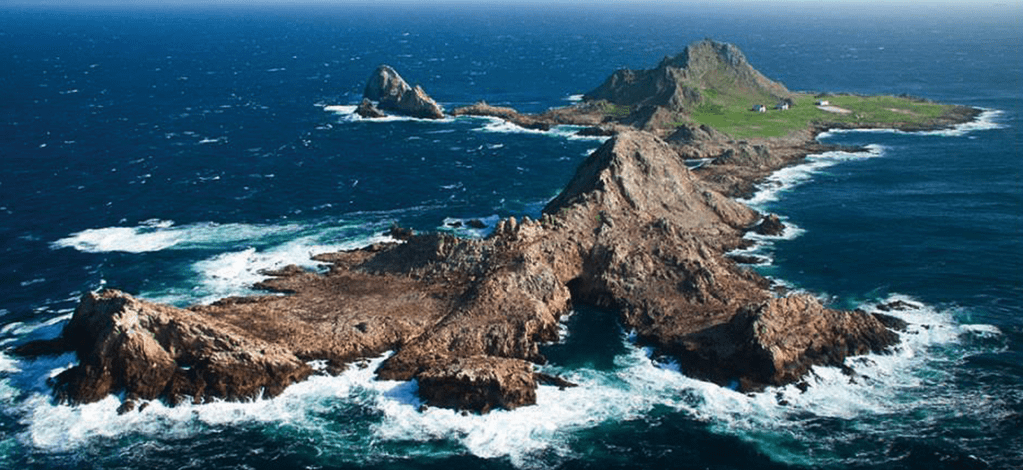
Their history is outsized given that all save one are mere crags. In 1579, Sir Francisco Drake’s chronicler recorded victualing the Golden Hind from the main island, named by Drake the Isle of St. James and now called the Southeast Farallon, as their company departed the California coast for the Moluccas. With that the Farallons entered the written record. In the early 1800s, a lighthouse was constructed and a Russian sealing station maintained by Kodiaks; later that century the massive Common Murre rookeries supplied young San Francisco with as many as 500,000 eggs a month, which nearly brought down the murre forever while giving rise to violent competition between harvesters known as the Egg Wars. Due in part to these extravagances, President Theodore Roosevelt established in 1909 the Farallon Reserve, a pact protecting the rocks to the north. This was later expanded to all islands, and later still to the entire area as the Gulf of the Farallones Marine Sanctuary. Now, as sanctuary, the islands are off limits to civilians and are inhabited only by the seals and the birds and the biologists.
The history of scientific study there goes back to the 1970s and is lovingly chronicled in Michael Whitt’s Logbook of the Farallons and racily in Susan Casey’s The Devil’s Teeth. The upshot is that scientific efforts on the islands, though official, have long been shoestring operations, and biologists, often transient and usually poor, have lacked a transport fleet. Thus was born the Farallon Patrol, a collection of local yachties who serve that function, and whose ranks Moli and I entered in 2022.
This is how I met Harmon Shragge. Initially I knew Harmon only as one of those oddballs, like myself, who found it fun to load his boat to the gunnels with gear and soon-to-be-seasick scientists for a grueling, fifteen hour “run to the rocks” at all times of year and in all weathers. But in the spring of 2023, Harmon invited me to a lunch where I learned more, that his dedication to the Farallons meant he had made the most such runs, save one, in the Patrol’s history, and that he had ventured further offshore via participation over several years in several legs of the Clipper Round the World Races, which had taken him at least twice on passages into high latitudes. And there was more.
Harmon had a dream to sail not just legs but an entire voyage, a circumnavigation of the Americas, but neither of his boats, one power and one sail, were not appropriate to the more arduous attempt. At this point there was a pause in our conversation, and the purpose of lunch began to take shape. Would I be interested, Harmon asked, in pursuing such a circumnavigation? I said, missing Harmon’s point entirely, that I had already completed that route and so would be happy to consult with him as his plans matured. For the moment, he left the matter there.
Sometime later we met again, and Harmon asked if I had considered his proposal. By now I had grasped his original intent and had spent the intervening days thinking of nothing else. What would be interesting to me, I said, was going at a route around the Americas in a direction opposite to that of the Figure 8 Voyage, that is in a clockwise direction around the continents. This would satisfy a desire to spend more time on the Alaska coast early in the season, to see the Arctic’s Northwest Passage from a different perspective, and, as capstone, to take Cape Horn to starboard.
Then it sounds like we have a plan, said Harmon.
Well, it is at least an interesting idea, I replied.
No, said Harmon, it’s a plan if we target to depart this fall.
That was May.
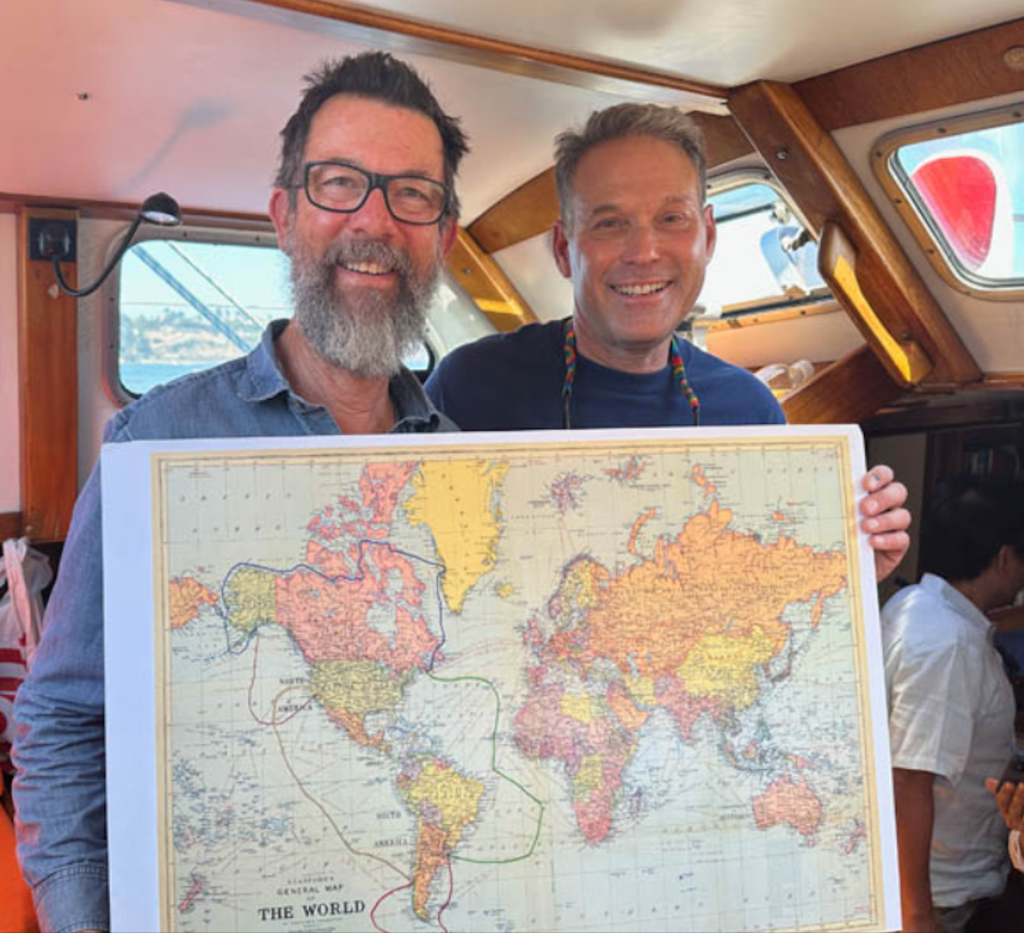
Time was short. Moli had got used to lounging in harbor and needed convincing that the aim of her design, not to mention her dearest soul mate–i.e. the great blue yonder–had missed her company. She needed waking up and cleaning up, and she needed stores for two for a shakedown cruise from San Francisco to Homer, Alaska, from where we would launch the next year into the Arctic.
The present voyage commenced on September of 2023 as recorded here and here and will continue with an attempt at a west-to-east Northwest Passage in June of 2024.
 Harmon and Randall's Voyage...
Leave a comment