Leg 2
Blog 7
July 12, 2024
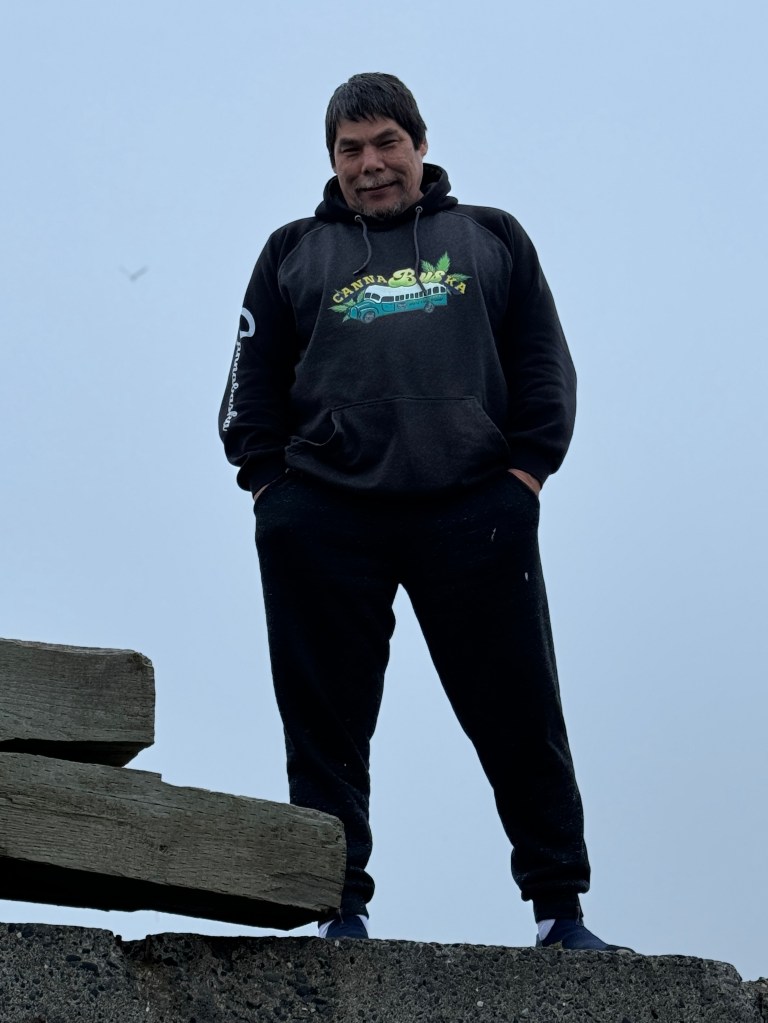
I have a lot to tell you about the Pribilof Islands and the amazing experience Randall and I had here. There is so much natural beauty, the birds, the seals, the flowers the foxes. No adjective can describe what we saw. In a strange way, I anticipated this and that is why I have dreamed about coming to this remote Bering Sea island chain for as many years as I have know about it (10 years since the last time I sailed past and did not stop). But what I did not expect was that the inhabitants (there are 35 on St. George) and specifically one family, will be what I remember most. But first, let’s talk some wildlife.
The videos below show you what greeted us as Mōli sailed into the harbor – Kittiwakes and Northern Fur Seals:
Before we get too much further along, however, let me introduce you to the Pribilof Islands. The Pribilof Islands are a four-island archipelago in the Bering Sea, ranging from 200 to 450 miles from Dutch Harbor. While little more than treeless, tundra-covered hills, the shoreline and cliffs of St. Paul and St. George Islands are filled with wildlife. Two small communities, one on each island – St. Paul, population 350, and St. George, population 35 – are the world’s largest indigenous Unangax̂ (native name) or Aluet (anglo name) villages.
Although Unangax̂ people traditionally traveled to the Pribilofs seasonally for hunting, the islands were uninhabited when Russian fur trader Gavrill Pribylov arrived at St. George Island in 1786 and established a Fur Seal harvesting operation. The Russian American Company enslaved and relocated indigenous people from Siberia and the Aleutian Islands to the Pribilofs to hunt fur seals as they established new settlements in what was to be called “Russian America”.
In 1867, Russia sold Alaska to the U.S for $7.2 million. Today’s island residents are descendants.The U.S. then turned around and immediately sold the Northern Fur Seal concession for $6 million per year, essentially paying for the new state of Alaska on the backs of the Unangax and the seals. This went along until 1910 when the U.S. government officially took over the entire seal harvesting and sale operation. After years of being over-hunted by the Russians and then the Americans, Fur Seal numbers crashed and the Unangax̂ communities slid into poverty, but the seal harvesting continued.
During World War II, residents of the islands (like those in Dutch Harbor) were evacuated to Southeast Alaska as the war heated up and the Japanese invaded the Aleutian Islands. Living conditions for evacuees were substandard, without access to proper sanitation or medical care, and many died. After the war, residents eventually returned to the Pribilofs and were compensated for the unjust treatment. In 1985, commercial seal harvesting ceased. Today, the only hunting allowed is for subsistence purposes and seal numbers have somewhat rebounded but are perhaps one quarter of their original population. – SORRY FOR THE HISTORY LESSON BUT IT IS CRUCIAL TO THE REST OF THE STORY!
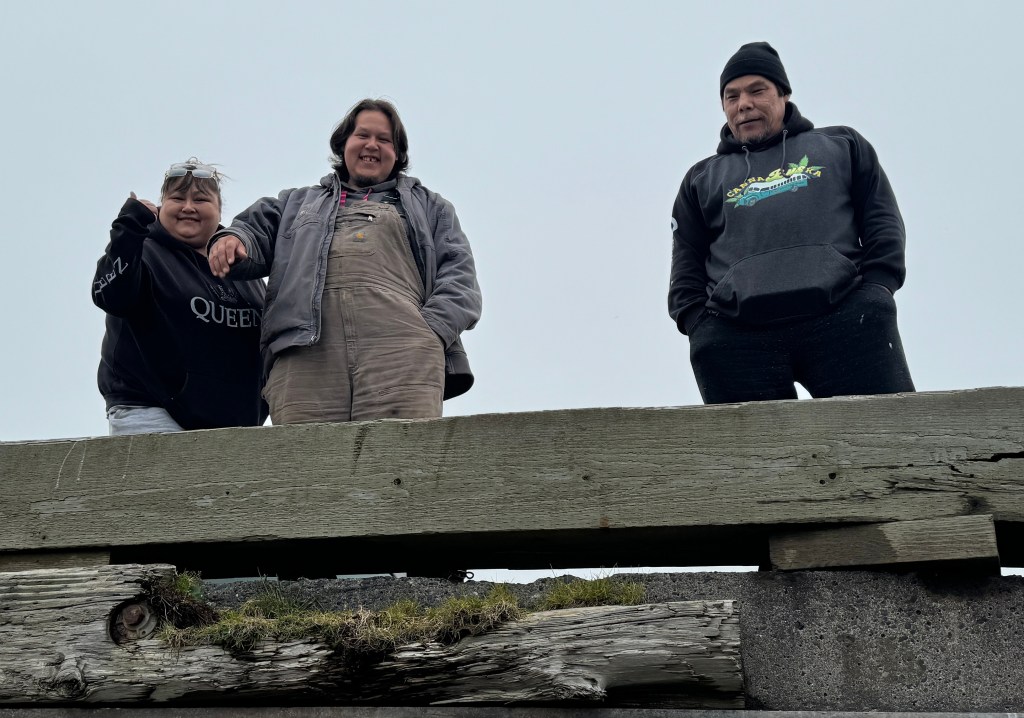
So now let me introduce you to Lawrence (father), Ruby (mother) and Curtis (son) Lestenkauf (likely some Russian influence in that name). Earlier in the day as Randall and I approached St. George, I madly searched the internet for a phone number of the govering native corporation. We needed permission to land and I did not want to show up uninvited (as I am sometimes known to do). Lawrence answered my phone call and told me it was $500 per night to dock our boat. Shocked, I asked, “How much for two nights?” “One thousand dollars!” Lawrence blurted before he burst out laughing and said, “Nah, I’m just kidding!”
So to the island we went, and upon tying up, above us on the high dock appears the whole family greeting us, presenting us with two beautiful books on the Pribilof Islands and offering to take us on a tour. But first, “Did we have any rice to spare” Ruby asked? Due to the poor weather conditions at the island, there had not been a supply plane or barge in more than three weeks. Randall had stocked plenty of rice on board, and as I had brought extra fruit with us I threw in a container of apples and oranges. In anticipation of our meeting, on the way in I had baked a tray of brownies which I also offered. “Wow” said Curtis. “Tomorrow is my mother’s birthday and we do not have flour to bake a cake so we will use that!”
Please note that St. George receives almost no visitors, outside of a few very determined birders that bring their own food and arrange their own overnight accommodations and guides. A sailboat pulling in is a rarity that does not necessarily happen even once a year.
Randall and I climbed up to the dock and into Lawrence’s pick up truck and we all went on a tour of the island. They asked us what we wanted to see? “Birds and Fur Seals” I answered, and off we went.
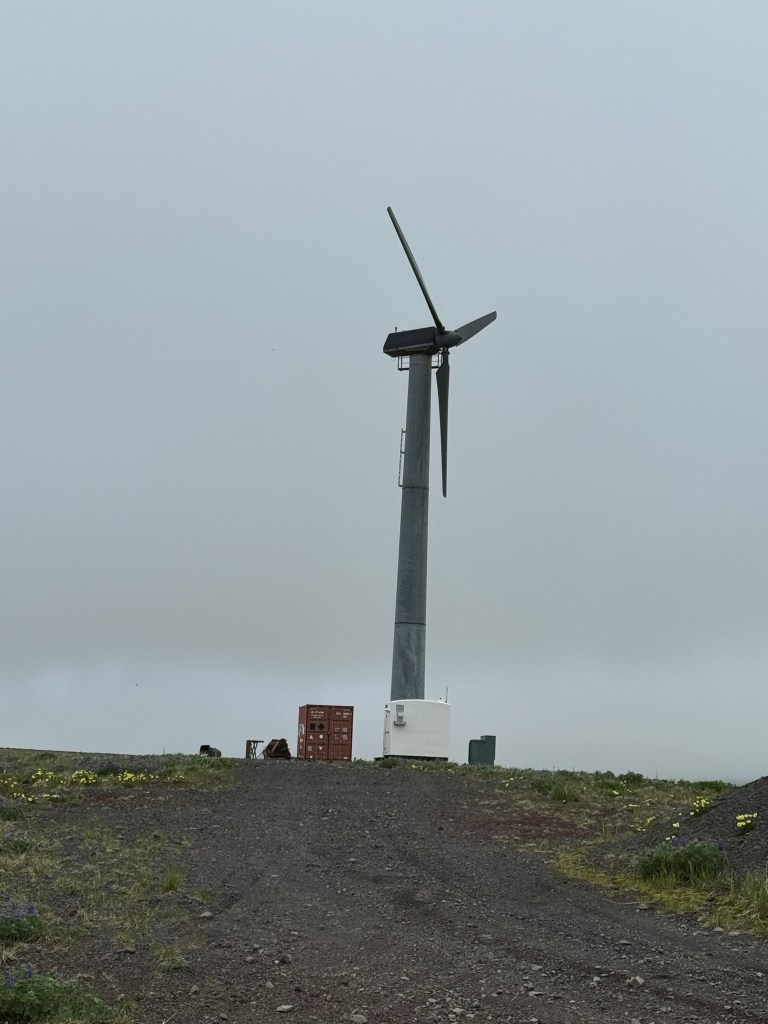
First stop was the lone wind turbine on the island. Some years ago a crew came out and installed it with hopes it would supply the electricity for the entire island. Shortly after installation a wind storm struck and the islanders could see the blades spinning so fast that it burned itself out. Another crew came out to fix the wind turbine and another storm followed. The windmill has been sitting there ever since, not functioning. Good thing they kept their diesel generator.
Second stop is the cliff directly below the town which is full of both red and black legged Kittiwicks. St. George is famous for their bird cliffs.
At the cliff, Curtis showed us the wild celery which grows over much of the Aleutians and the Pribilof Islands and is known locally as “Putchky” – notice the Russian influence.
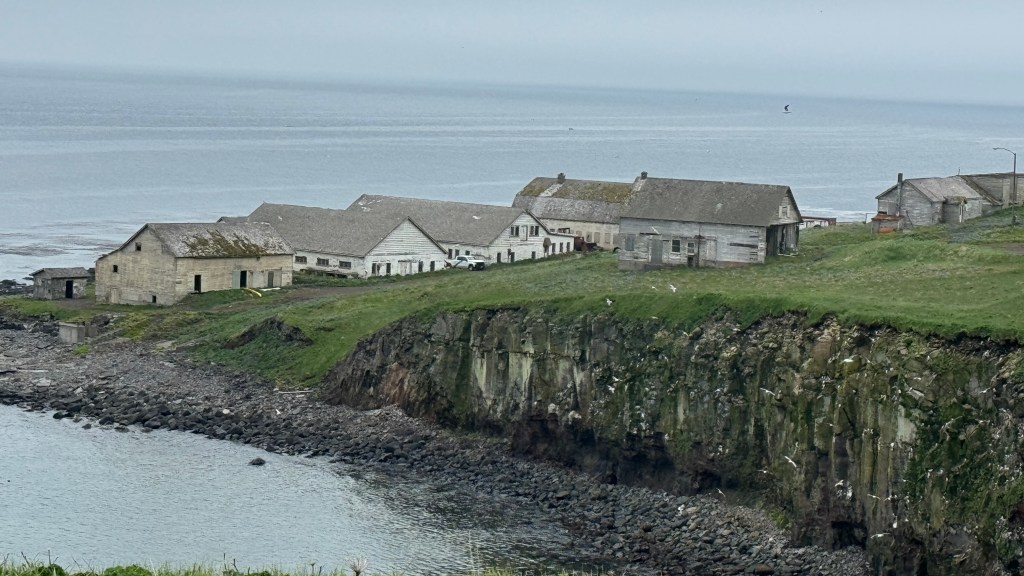
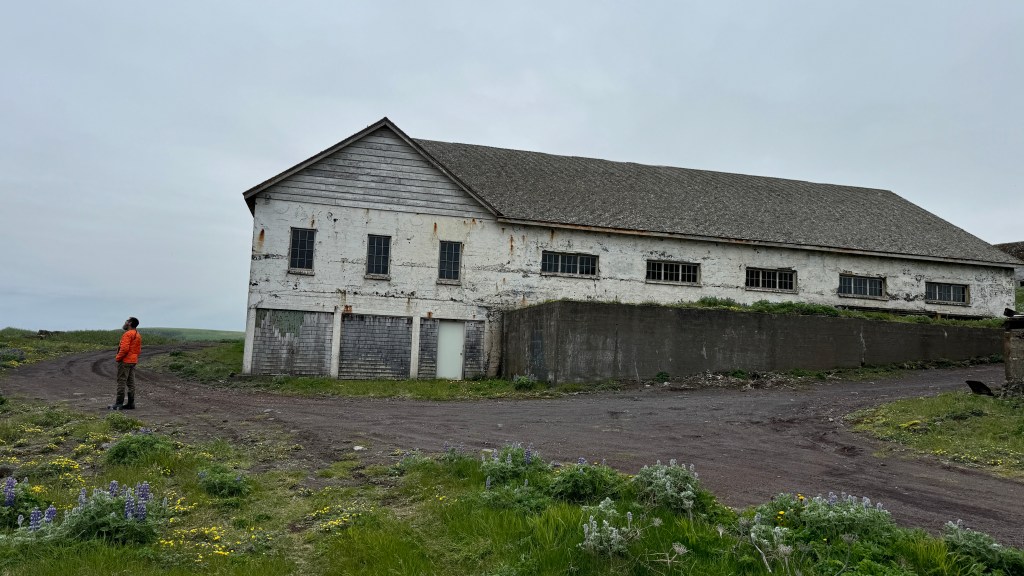
Above is the older section of St. George. It is close to the long-closed St. George Sealing Plant (shown in both photographs).
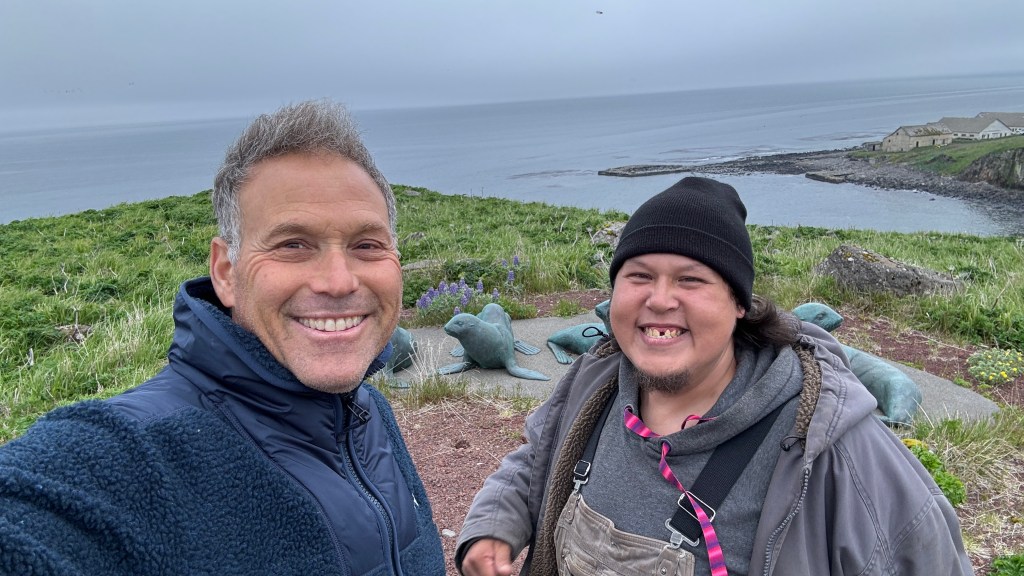
Above, Curtis and I take a selfie in front of the Fur Seal Monument that overlooks the Sealing Plant.
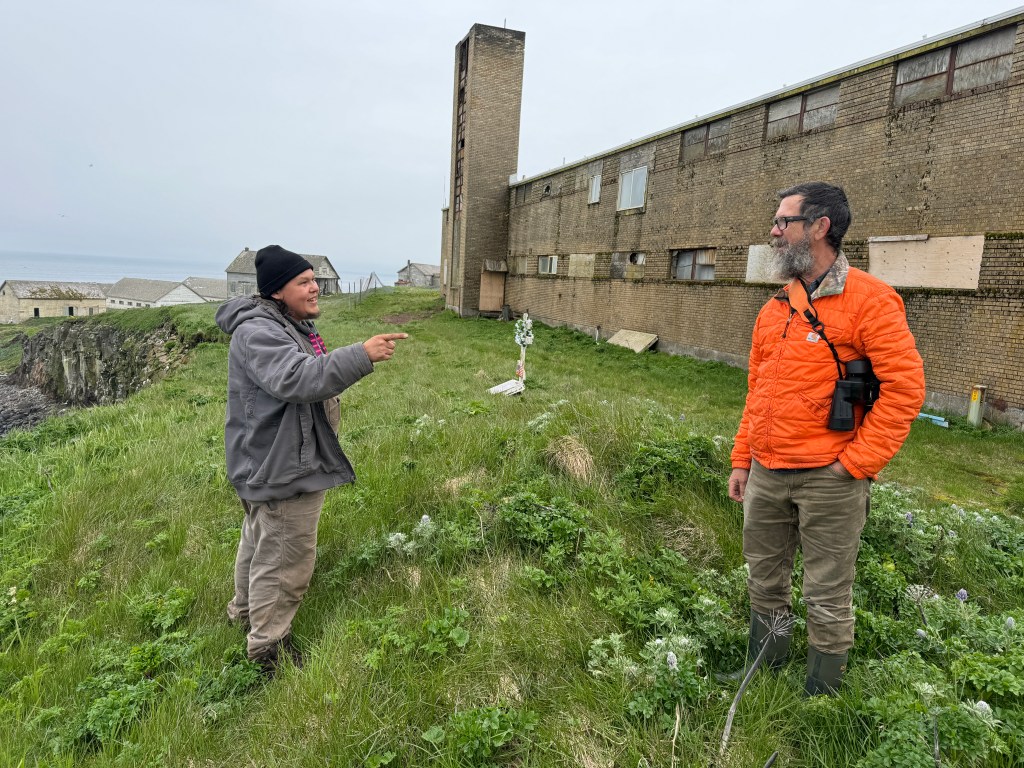
Above, Curtis talks island history with Randall as they stand in front of the only store in town that has been closed for more than 20 years now.
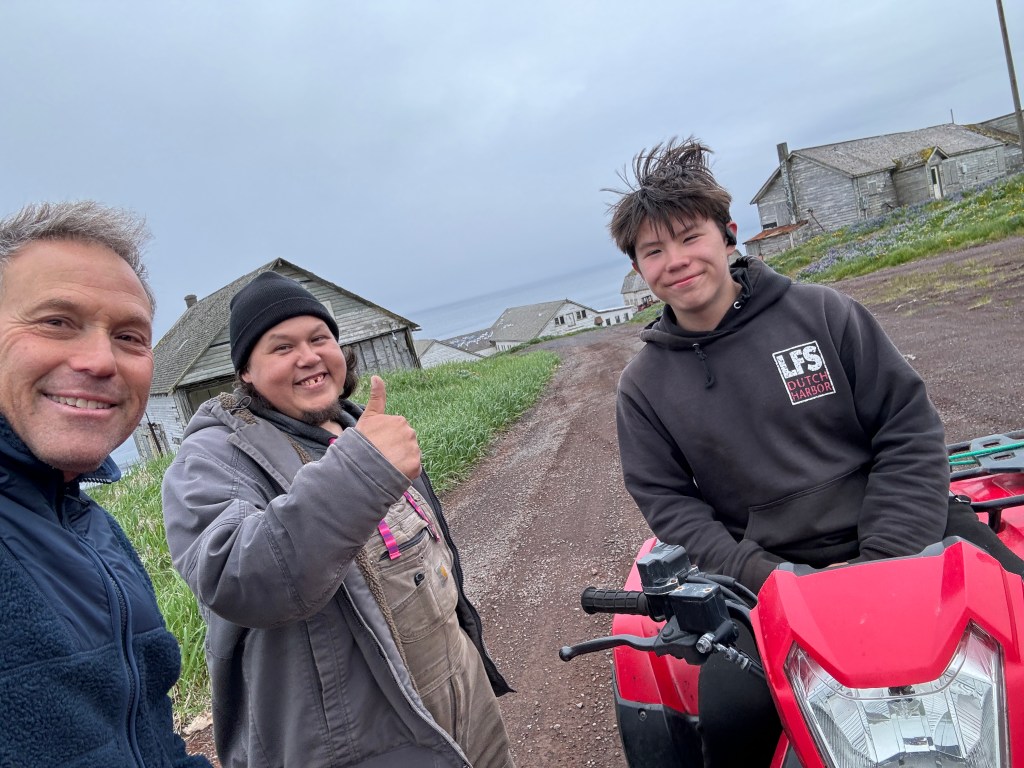
While we were talking, one of the few teenagers in town pulls up on his ATV to say hello. He is a rising senior on summer break from Mt. Edgecom high school https://www.mehs.us on the island of Sitka that caters to natives from outlying parts of Alaska as well as rank and file students that want to attend this out of the way, yet cosmopolitan school. Turns out Randall lived across the street from this school when he lived in Alaska (as an eighth grader!).
This facility, which operated in some form since the 1800’s and finally closed in the 1980’s, is the last remaining plant of its kind. It was partially restored in 2000 (for historical purposes) and Curtis gave hundreds of tours of the plant at that time so he was well versed in its operation and output. In the video clip above, he describes the “Deblubbering” operation.
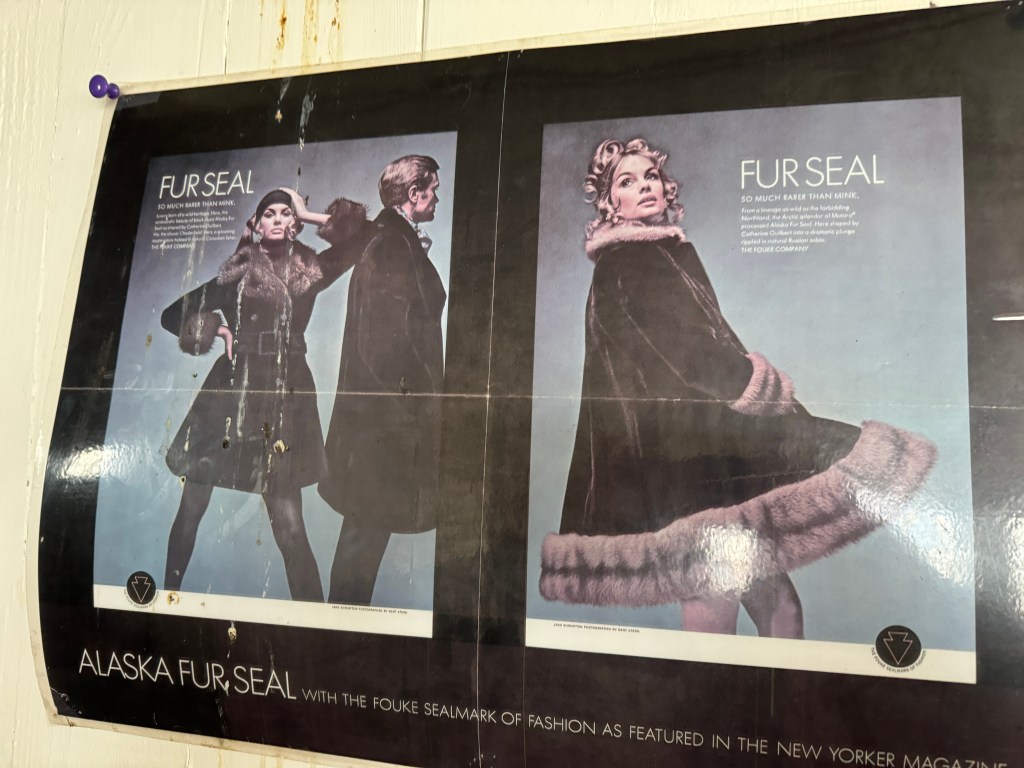
Back in the day, Fur Seal was more rare than mink and even more chic.
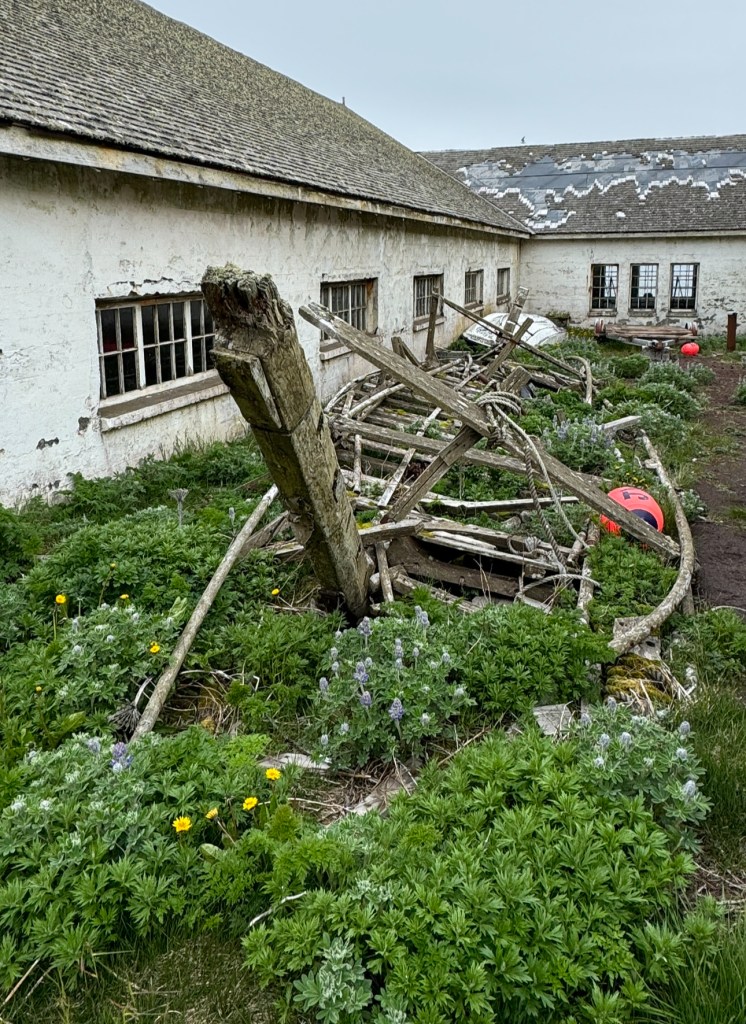
Right outside of the facility were the remnants of a decomposed bidara. These were traditional Unangax̂ boats that a were covered in seal skin. https://digitalcollections.lib.washington.edu/digital/collection/loc/id/2247/
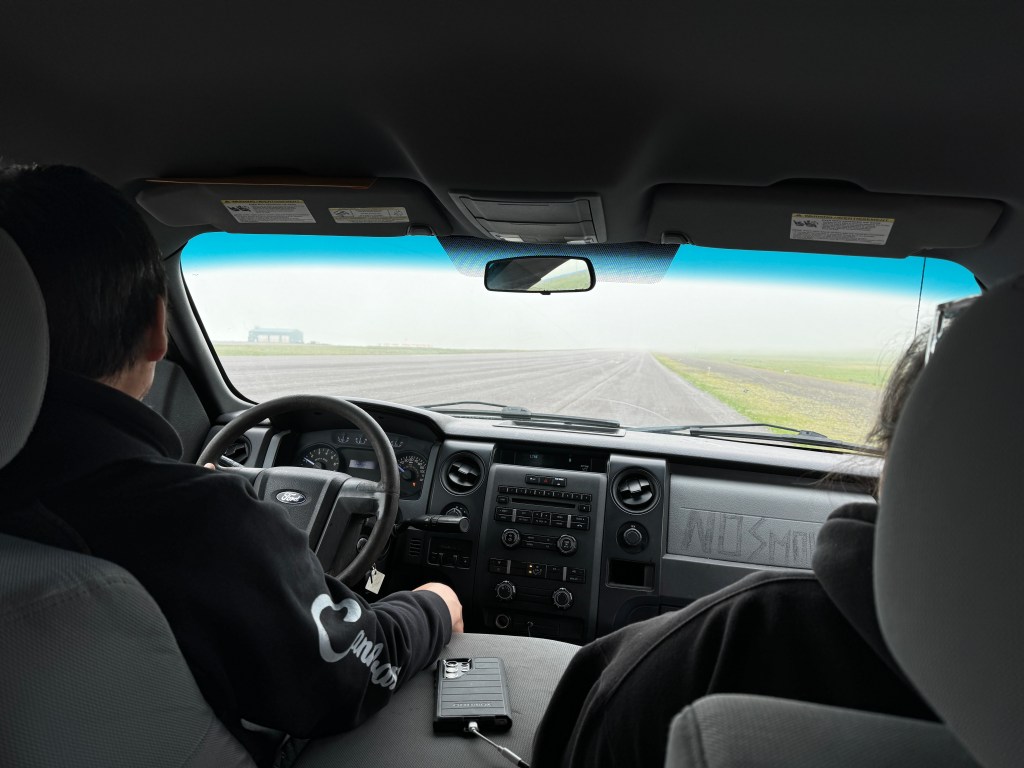
Next stop on the tour was the St. George Airport opened in 2011 at a cost of $123 million (Federal grant). I imagine the new airport seemed like a good idea at the time to meet the need of the crab industry, which was still booming, but I am not sure what else. Ruby helped in the construction of the connecting roads and Lawrence managed the facility for a time. Interestingly, they laugh that the new location is much foggier than the previous.
The evening was getting late (we had dropped Randall off at the boat long ago so he could replace the alternator that had recently burned out). When my hosts asked me what I would like to see next. I responded “Fur Seals!” I found it interesting that while I was most interested in seeing the natural wonders on the island, my hosts were most interested in showing me the bits and pieces of the island (airport, generator, roads, harbor) that they were instrumental in building as-well-as parts of the physical Island history.
Granting me my wish, we drove to the nearest rookery. While Lawrence and Ruby stayed in the truck (I mean, they see this every day), Curtis took me out. There were no signs that said “stay out” and no blinds to “hide” behind. Curtis took great care to make certain that we did not disturb the colony pointing out that if we “flushed” the colony (scare them enough to cause them to shimmy to the ocean for escape), this would not only be illegal, but cause the colony to move elsewhere.
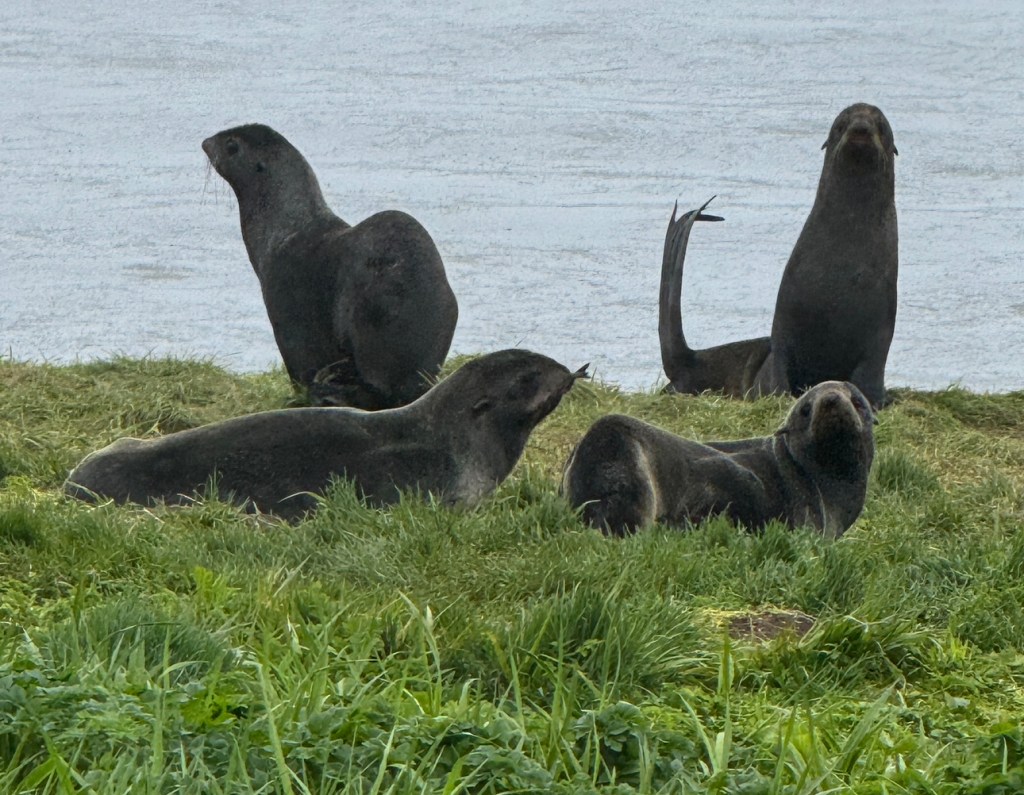
Curtis and I stayed for a long spell observing the Fur Seals. After that, we went back to the pick-up truck and sat in the back seat and shot the breeze for a while with Lawrence and Ruby.
Our conversation shifted to the Sealing Plant, and how earlier in our tour we had met two summer employees of U.S. Fish and Wildlife there to count and monitor species on the island. These interns actually lived upstairs at the old plant. I commented that I thought that would be a terrible place to live. In unison, Lawrence, Curtis and Ruby looked and me and asked me why I thought that. “I think the sealing plant must haunted”, I replied. They all nodded, and again, asked me why I thought so? “Because of the millions of poor seals that have been slaughtered and cut up there”, I replied. Aghast and again in unison they shouted, “No!! It’s not the seals, it is all of our ancestors that have been killed while being slaves at the plant.”
Startled, embarrassed and blushing, I looked for a table to crawl under. But as I was in the back seat of a pick-up truck I had few options. “I am sooooo sorry”, I explained. “You are right. That was unbelievably insensitive of me and please forgive me”, I begged.
They exchanged glances with each other, with that, “What are we going to do with this guy now?” look about them. Well, the moment passed and the mood calmed. Ruby then took it upon herself to explain the historical significance that their ancestors were “Slaves of the harvest” and had suffered greatly. In fact there is a wonderful song (and a book) with that same name. Ruby suggested we all listen to the song at that very moment. So she put it on the car stereo. It is quite moving and you can listen to it here — https://tanamawaa.com/wp-content/uploads/2013/06/02-Slaves-of-the-Harvest1.m4a
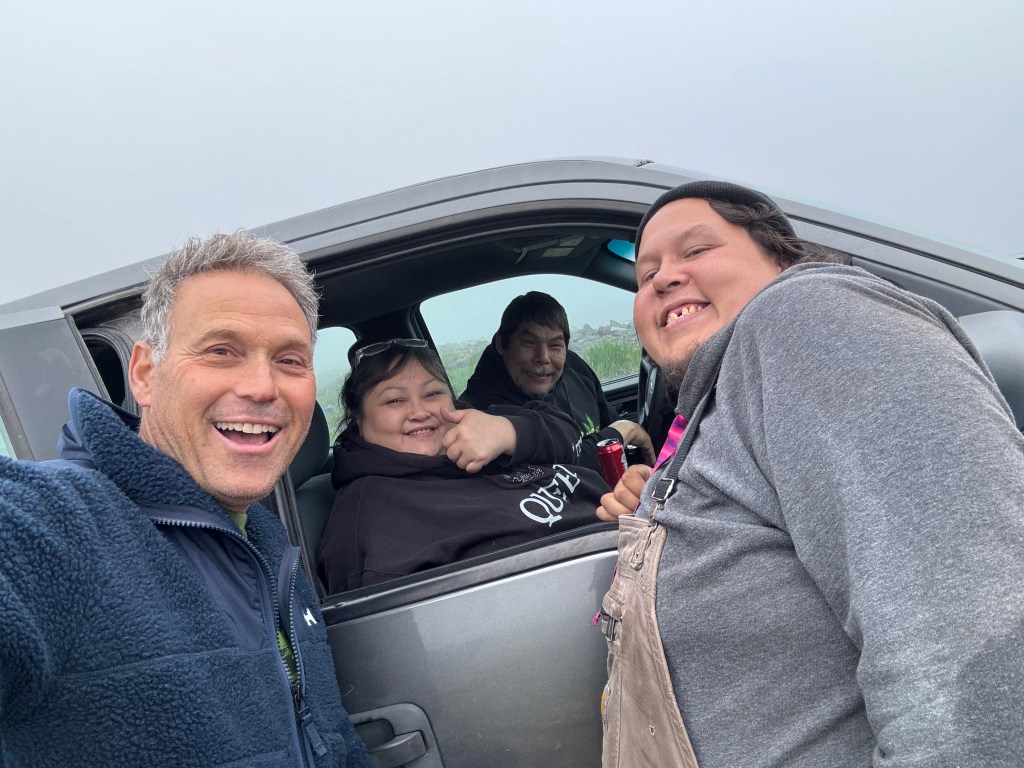
Well, suffice to say, my hosts did not bear a grudge and we parted as good friends. Maybe it was the beer we drank or perhaps it was the modern day peace pipe we smoked. I would not blame them a bit if they were relieved to see me off the island, but I was sorry to go.
St. George will forever be within me. With the decimation of the Fur Seal population, the collapse of the King Crab harvest, St. George Island has seen its human population decrease from a peak of 260 in 1960 to perhaps 35 today. But while the human population has plummeted, the natural beauty remains and here it will stay. How will the future treat St. George? The song, “Slaves of the Harvest” says it better than I – “What’s going to happen?….The future is hard to see..”


 Harmon and Randall's Voyage...
Leave a reply to anthonyvlasto Cancel reply