Leg 2
Blog 16
August 20, 2024
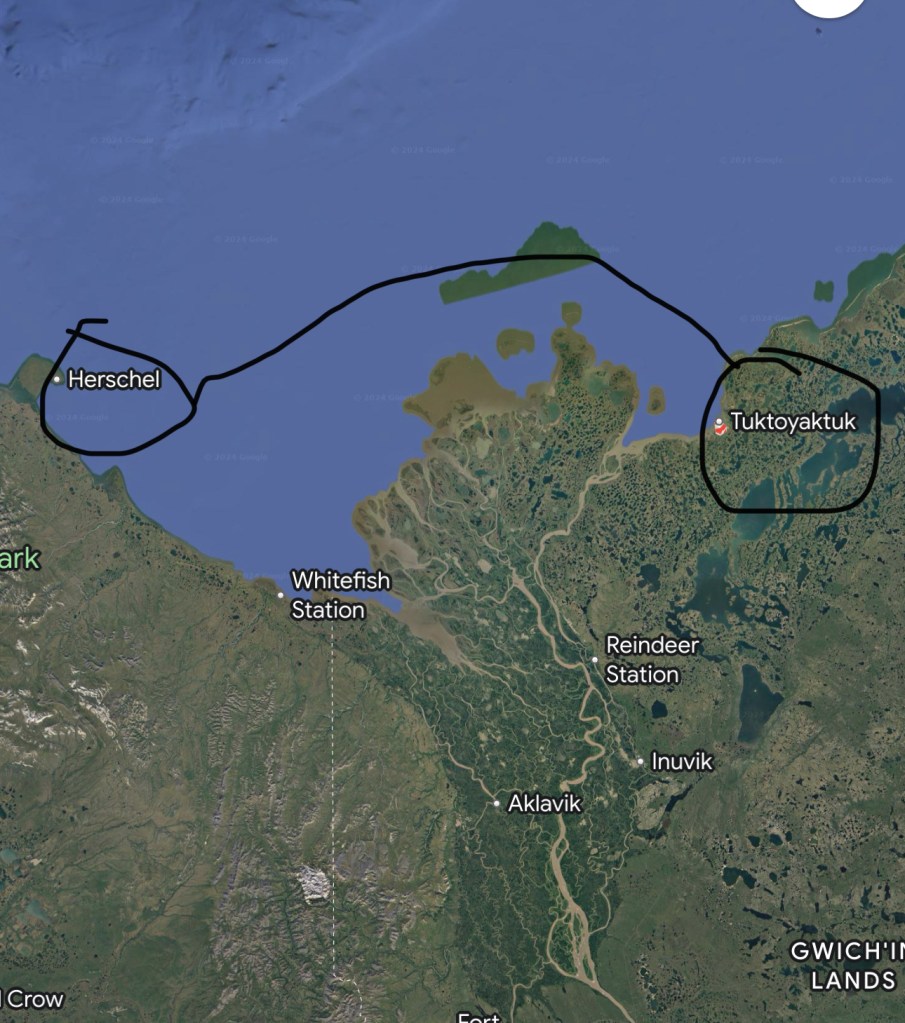
It took us a bit more than one day to sail (with a little bit of motoring) the 147 NM to Tuktoyaktuk, or Tuktuyaaqtuuq, population 897, which is an Inuvialuit hamlet located near the Mackenzie River delta in the Inuvik Region of the Northwest Territories, Canada. Affectionately known as “Tuk”, this is an important town for two reasons. For those traversing the Northwest Passage going east to west (from Cambridge Bay) or west to east (from Nome), Tuk is the first fuel depot in either direction (the practical limit for many boats in either direction). For those traveling from the south to the north, Tuk is the end of a famous road (explained later). Our route (below) seems to take us over an island about midway between Herschel and Tuk. That’s Google Maps for you. No such island exists, but it did make me nervous as I sailed directly over it during my watch.
A few fun facts about Tuk: 1) Known as Port Brabant after British colonization, in 1950 it became the first Indigenous settlement in Canada to reclaim its traditional name. Tuktoyaktuk. 2) In 1947, Tuktoyaktuk became the site of one of the first government day schools, designed to forcibly assimilate Inuit youth into mainstream Canadian culture (a notoriously bad period of history for Canada). 3) The community of Tuktoyaktuk eventually became a base for the oil and natural gas exploration of the Beaufort Sea as well as an advanced listening post for potential Russian aggression.
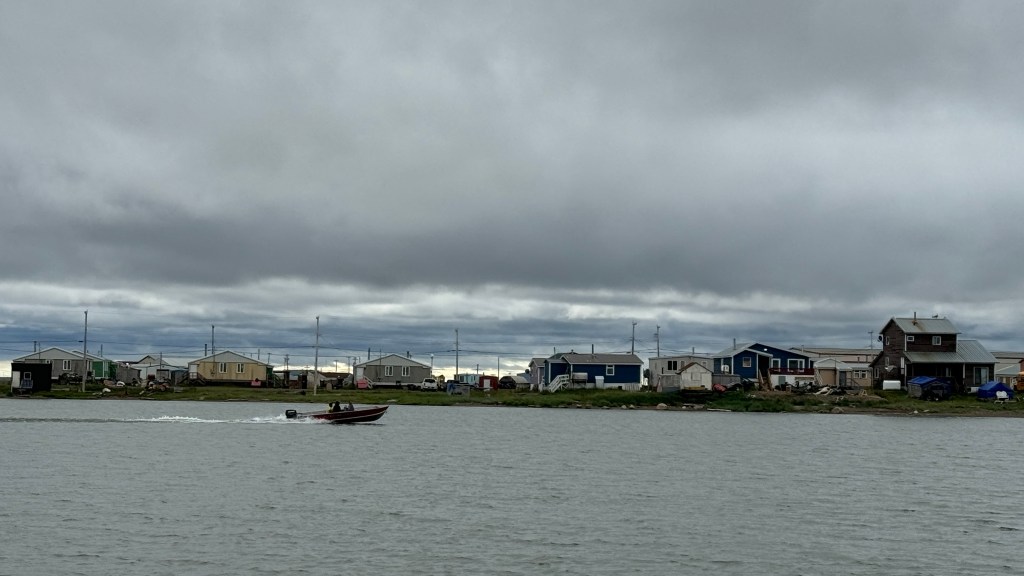
We had a pleasant entry into the harbor area. There were quite a few well marked entrances which was rather curious because there was almost no commercial traffic and no other sailboats when we arrived.
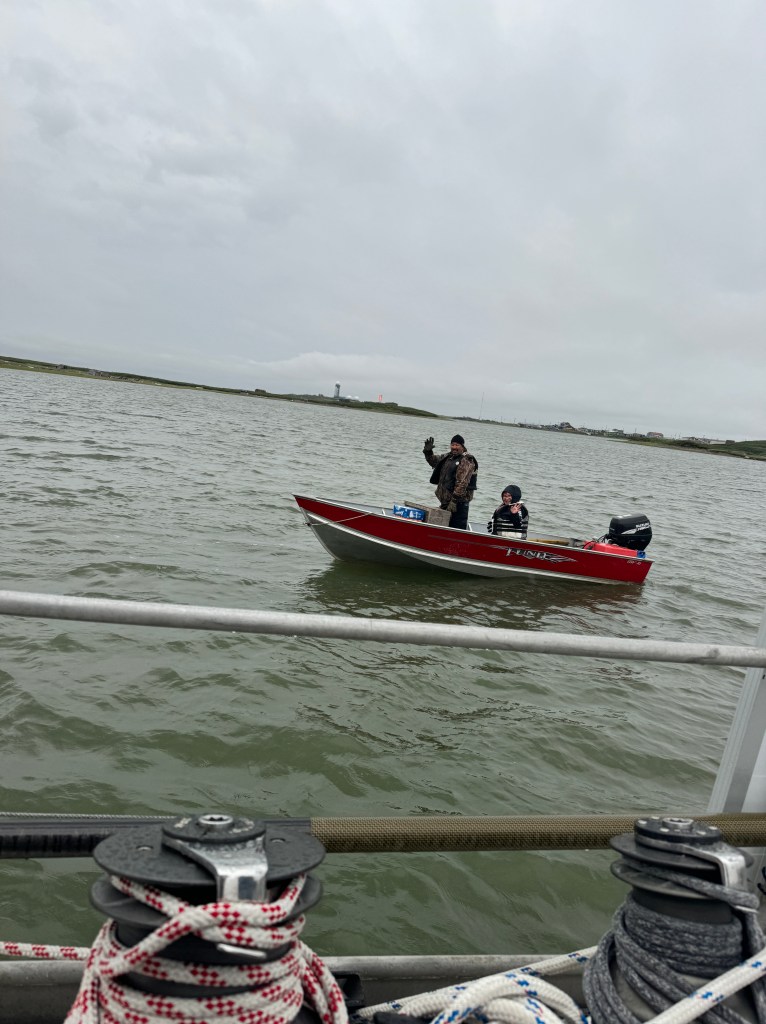
Our greeting party…YES!! I cannot tell you how happy it makes me to be met and welcomed by a local upon our arrival. Randall noticed that the boater was carrying a case of beer (visible in the front). Tuk is a dry town so we always wondered where the beer came from (and no, we did not get any!)
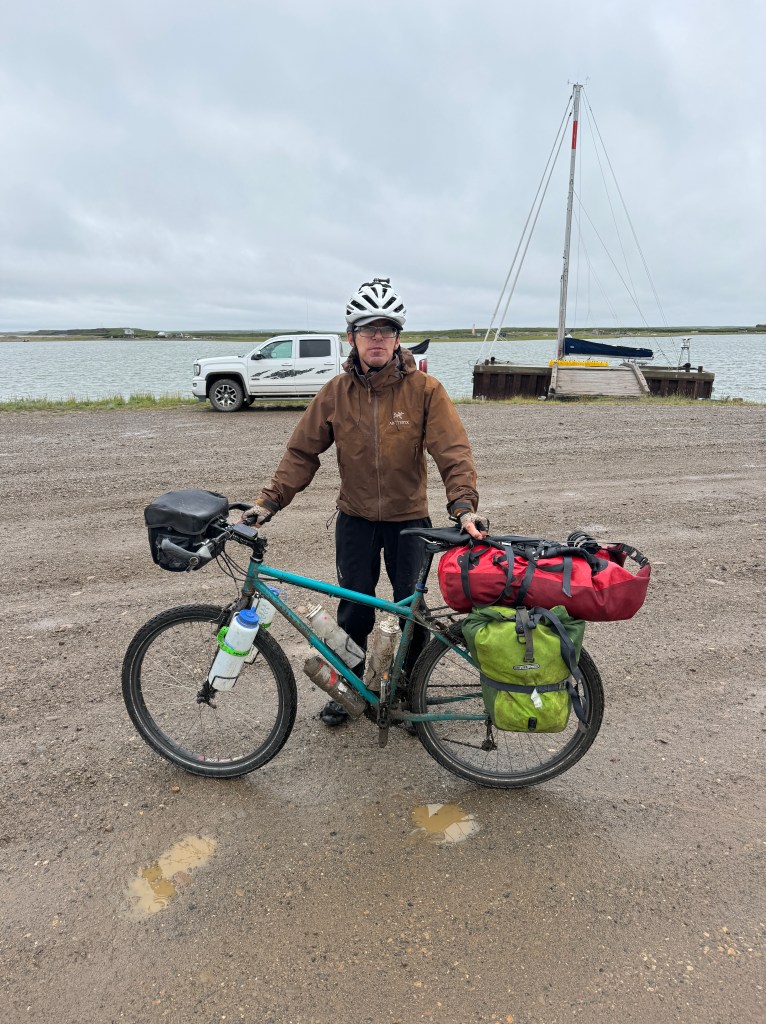
As soon as we tied up to the dock (Mōli in the background), we spotted this obviously weary traveler who could barely keep peddling and was shivering cold in the light rain. Turns out he is from Austria and had spend the last several weeks riding his bike the almost 1,400 kilometers from Whitehorse to Tuk. We invited him in to get warm and extended an invitation to dinner later that night. But all he wanted to do is pitch his tent, go to sleep, wake up the next morning and hitchhike back to Whitehorse.
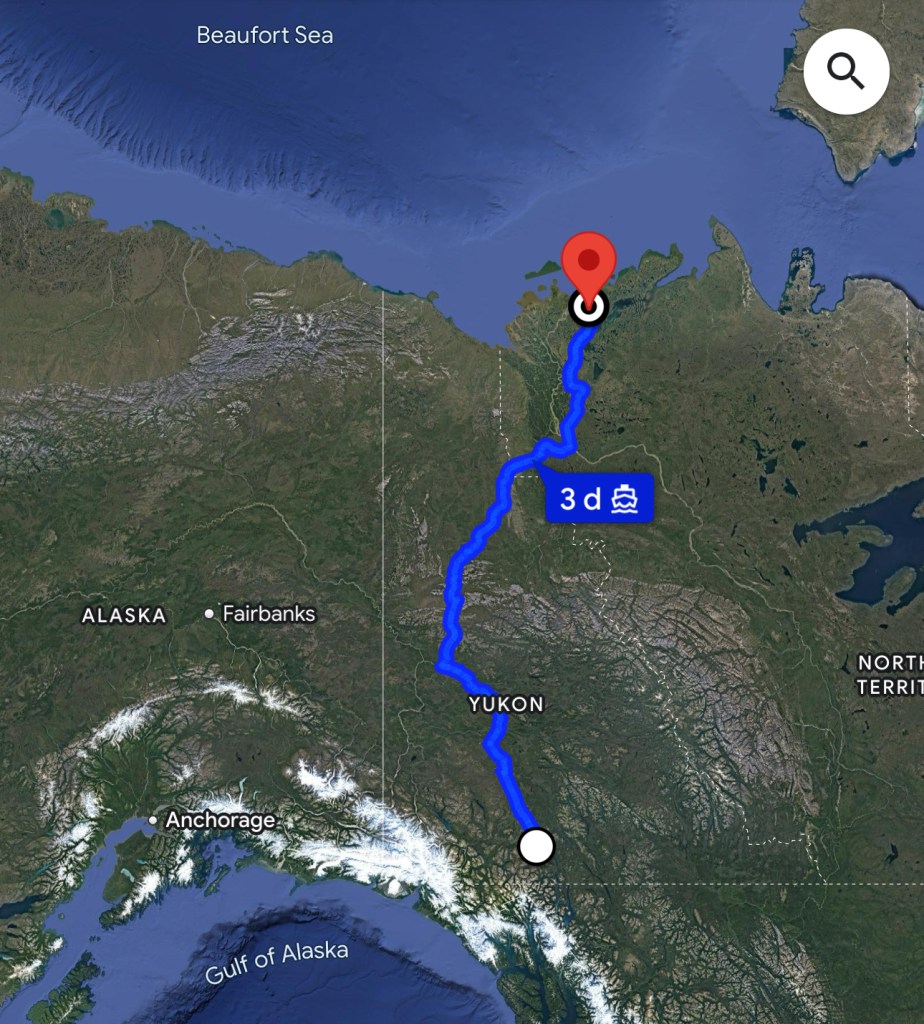
Starting near Dawson City, and ending in Inuvik, the Dempster Highway, is 740 kilometres of unpaved road. The “Extended Dempster” goes from Whitehorse to Tuk. This is the only place in North America where you can drive a private car right to the Arctic Ocean. According to some people who recently travelled the highway, the Yukon section is incredible, but needs some serious maintenance. https://www.dempsterhighway.com/road-to-the-arctic-ocean That said, the Dempster seems to be a right-of-passage road that takes you through some of the most serene landscapes and the incredible picturesque town of Dawson City which was the heart of the world-famous Klondike Gold Rush in1896.
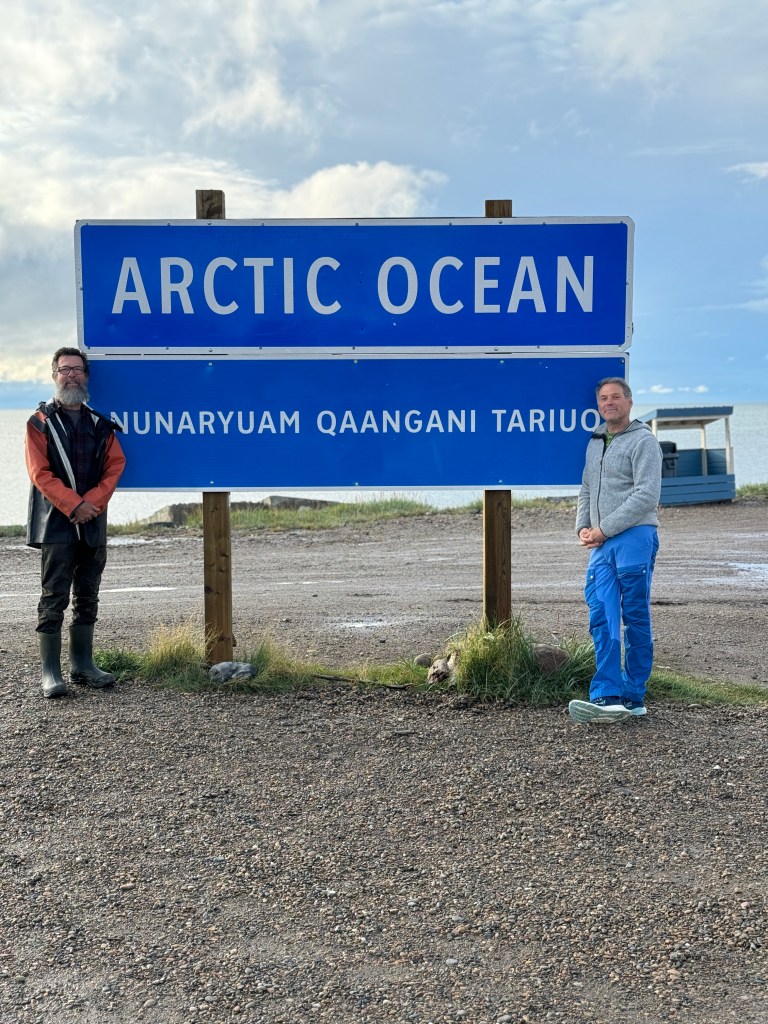
Well, this is the end of the road. Not for us, of course, but for all who travel the Dempster Highway. The town of Tuk deems it necessary to post this sign so travelers do not continue to drive into the Arctic at the end of their travels. Also near this post is another sign disallowing swimming at the end of the road. Not sure why not, but this tradition livers on, but travelers must take it to another beach.
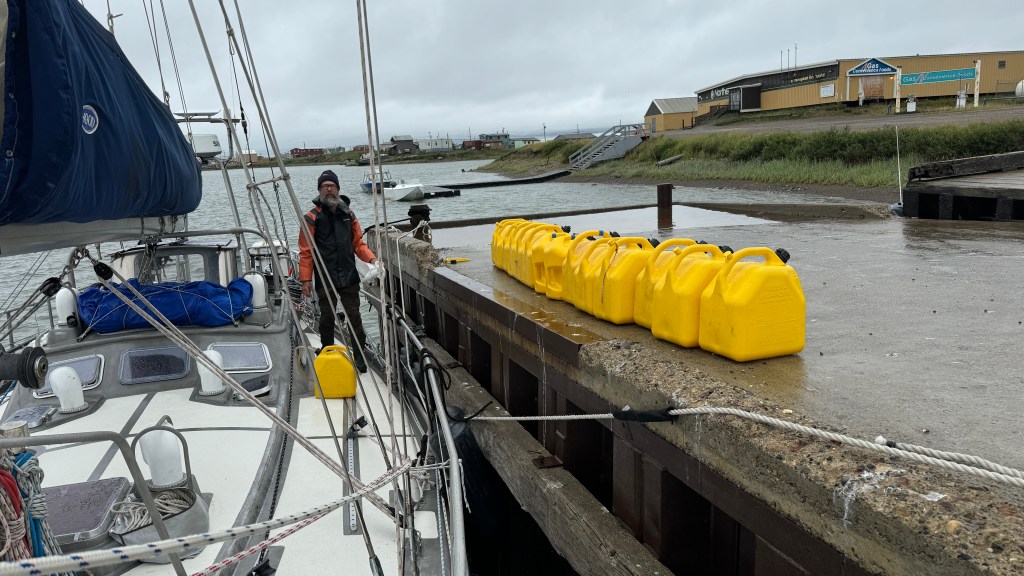
Perhaps you saw this in Randall’s previous post, but our first official duty after clearing customs was to fill ‘er up. Mōli took only 75 gallons of diesel for the 1,000 or so miles from Nome due to good sailing conditions we encountered (good news as diesel was about $13 a gallon U.S.). For reference, Mōli has two -100 gallon internal fuel tanks + we carry 15 jerrycans of five gallons each.
A note about clearing customs: As soon as we arrived Ian Tuk, Randall phoned the Mounties who came right over to meet us. Clearing customs was not their job, but they promised to get us through the process. After coming to the boat three different times over a couple of hours and Randall talking to HQ in Winnipeg, we were officially welcomed into Canada. We spent a considerable amount of time answering questions about marijuana (legal to possess but not to bring in) and alcohol on board (when first asked if we had any we simply looked at the officers and said, “Of course, we are sailors”). Interestingly, bringing two rifles into the country (for bears) did not even raise an eyebrow or require a follow-up question. No problem! – as long as we paid the $24 gun fee.
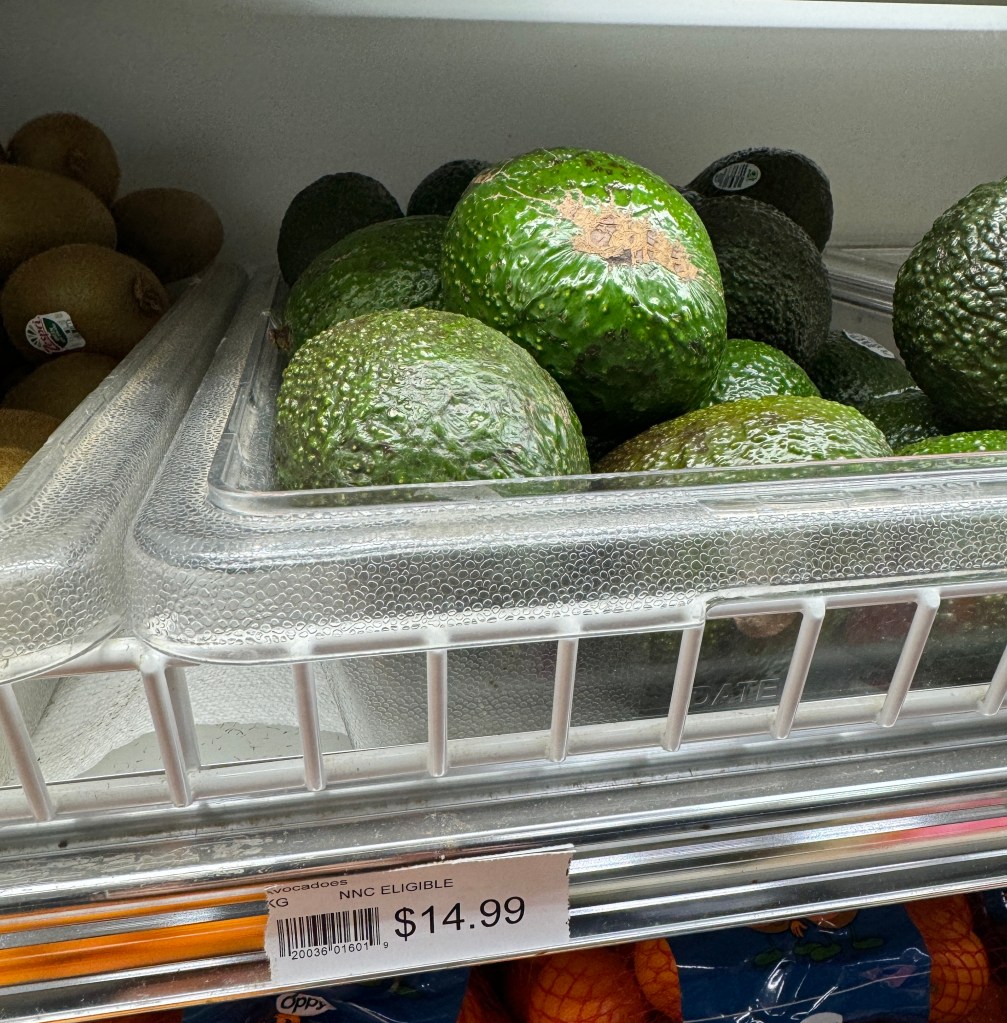
Our second official duty was to go shopping for fresh fruits and vegetables, often a disappointing endeavor in the Arctic. The good news is that we found avocados, but at $14.99 Canadian each, guacamole would just have to wait. Frozen fish sticks were $25 for one kid-size serving, but the chips and junk food were quite reasonably priced.
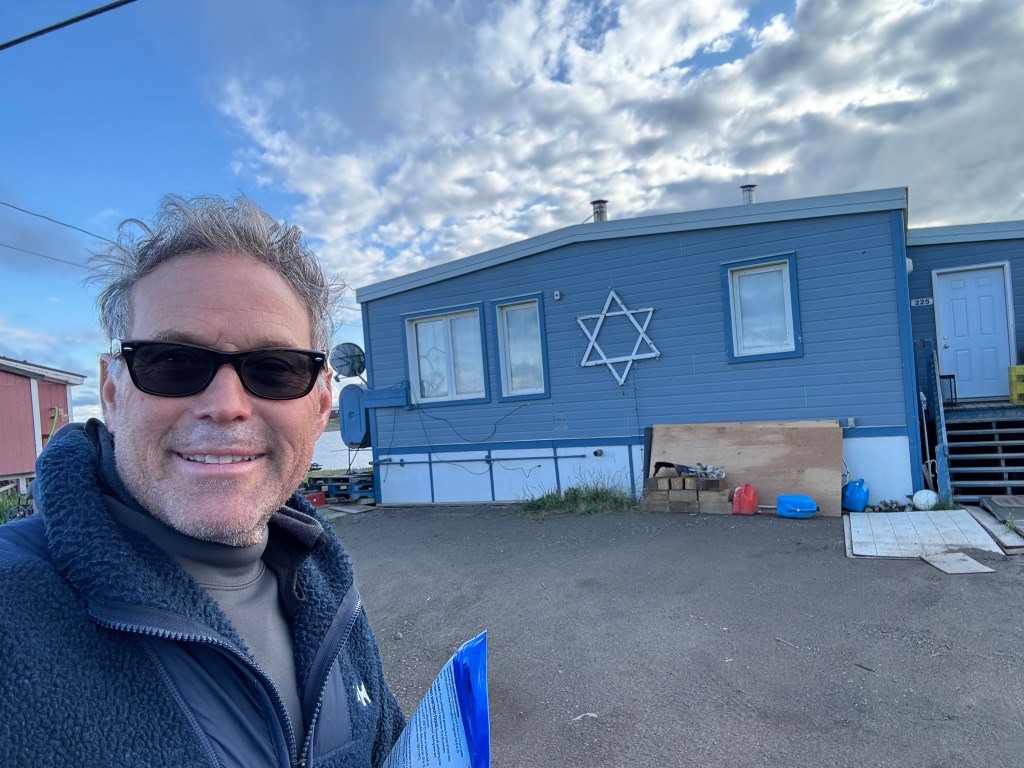
Walking through town, I had my first Jewish breakthrough. At last, I had found a place where I could spend Shabbat. But there was no mezuzah on the door…hmmmm? Turns out the owners are Pentecostal….darn!
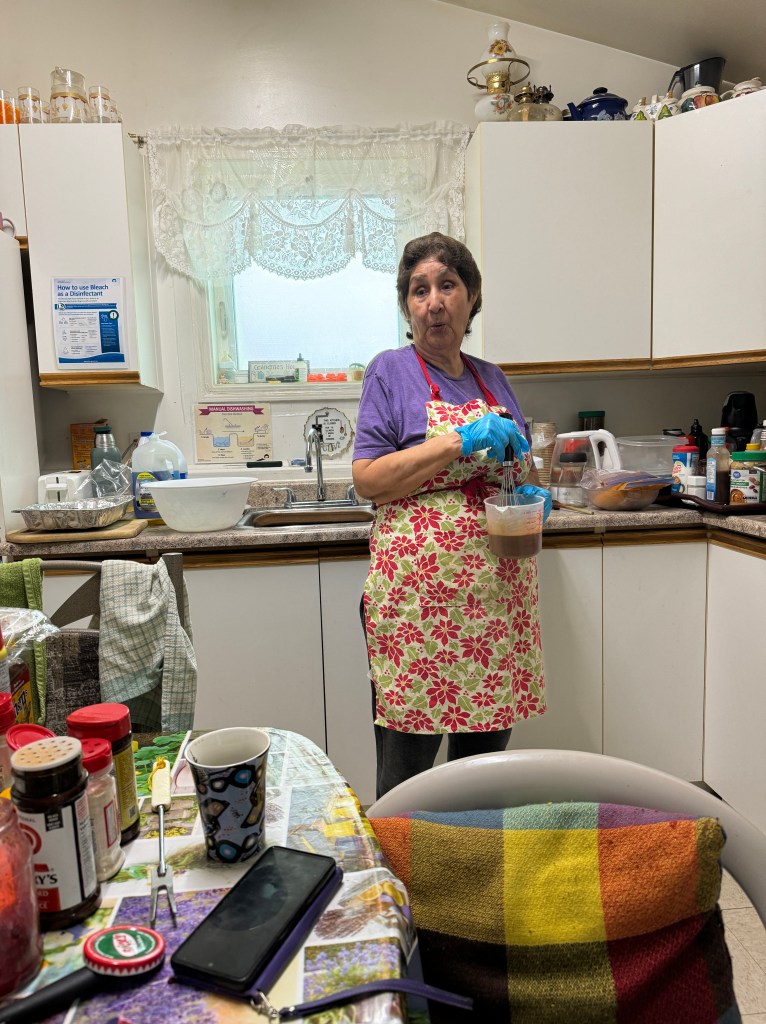
As luck would have it, I found my quasi-Jewish grandmother right next door. I was calling around town to find a place to take a shower and do laundry. There were three “hotels” (small rooming houses) that would not let Randall and I set foot in (they catered to the Dempster Highway folks) and there was not a restaurant or coffee shop in town. After my last call to a rooming house, I was told to simply drop in on the house next door to the Pentecostal residence and speak to Eileen Gruben. “Hmmmm” I thought….an Inuit with a Jewish sounding last name. Couldn’t be. Well, it was, kind of. I walk in and there is Eileen cooking up a storm of native delicacies. I sit down, she gives me a cup of coffee and a freshly baked muffin. There is another guest sitting on the couch (George, who rode his motorcycle up the Dempster Highway) and we all start shooting the breeze.
Eileen tells me about her family history (I swear I did not ask!) Her grandfather was Jewish and emigrated from Germany to Canada in the late 1800’s to establish a fur trade business in the Yukon and then later in the tiny village of Sachs Harbour on Banks Island well north of Tuk (super isolated). Eileen’s father was a hunter and trapper (fox, beaver, wolverine, seal) and local merchant marine. Eileen spent her teenage years in the (ships) galley cooking for the crew. Her husband and mother are long gone, but she kept the family house, rents a room to weary travelers and allows travelers to come to her house for a home cooked dinner. You can’t make this stuff up.
We became fast friends. Randall and I spent the next two nights feasting at her house along with seven guests on the first night and 20 (two sittings) on the second night. We also had our first shower in about two weeks and got our laundry done. Due to the preponderance of Christian morality posters, a Jesus icon or two, plus a fairly large 10 Commandment poster, I will assume that Eileen’s “Jewish” days are long past. But she sure knew how to cook and talk like a Bubbie (Yiddish for a grandmother with personality).
The native delicacies included Caribou Stew, Spotted Seal, Musk Ox Bolognese, Muktuk (beluga whale), Canadian Snow Goose (they get to shoot and eat them up here while we at home cannot, and must watch helplessly as they destroy our soccer fields) as well as two types of fish jerky and baked Broad Whitefish. Interestingly, not a lot of vegetables except jarred pickles and a potato in the Caribou Stew. Eileen also served the traditional Inuit “donut” which is essentially fried bread with no sweetening or seasoning. Desert included muffins with local blackberries (closer to our blueberry), scones, or ice cream with local salmon berries (she called them Paulatuk berries) on top. Each dish came with a family story or family history. Lovely!
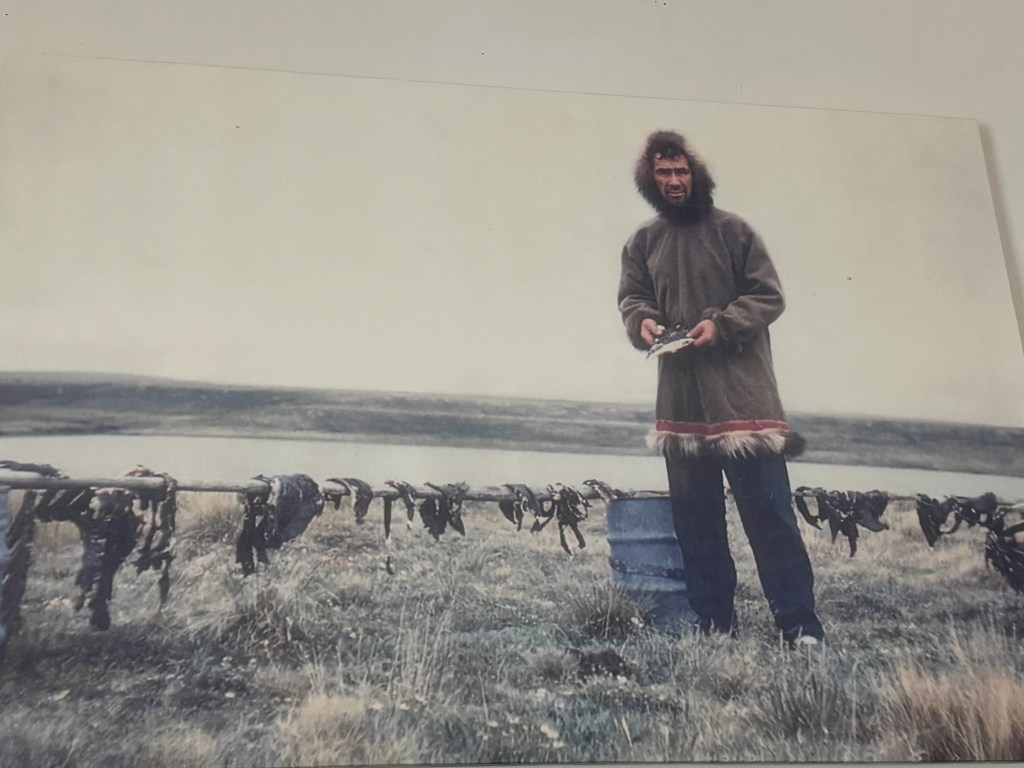
Above is a picture of Eileen’s father hard at work at Sachs Harbour.
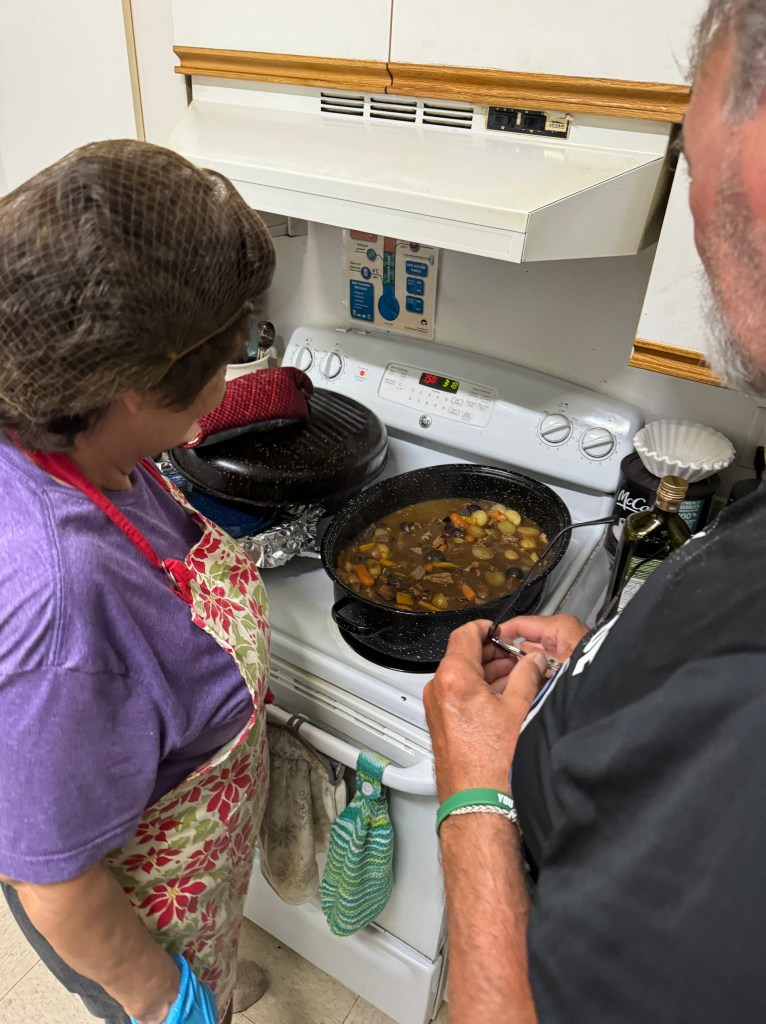
Above is Eileen showing Randall the almost ready Caribou Stew.
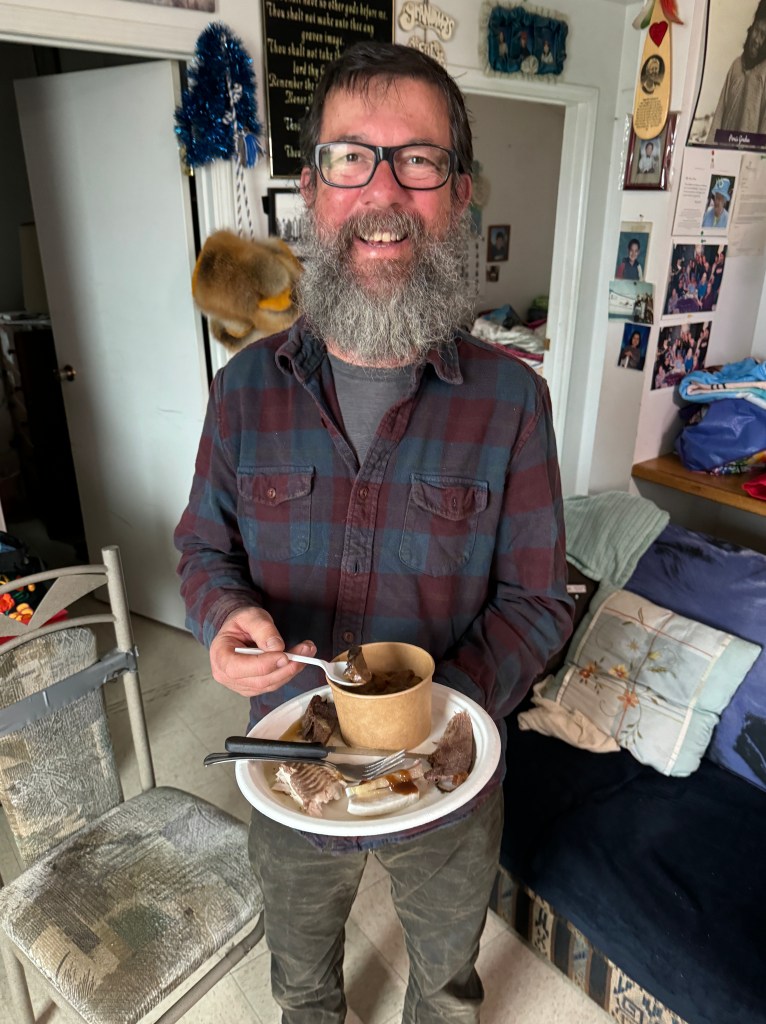
Above is a happy Randall with a plate containing just a little bit of everything. Notice the Muktuk in front with just a bit of HP Sauce on top to provide flavoring.
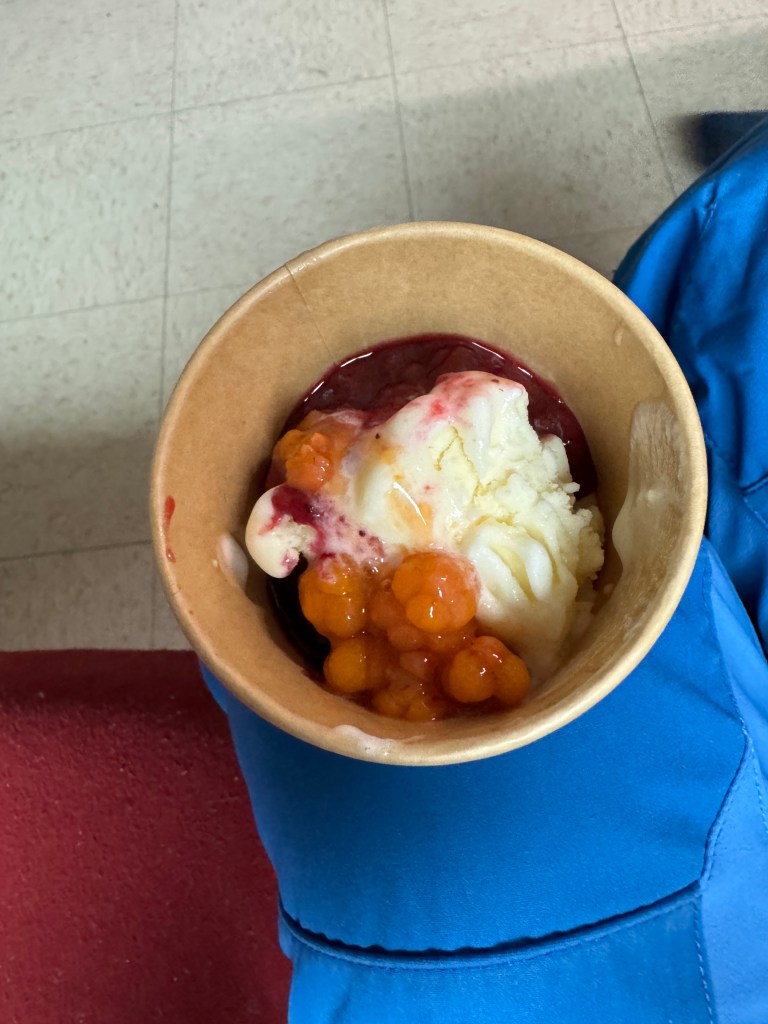
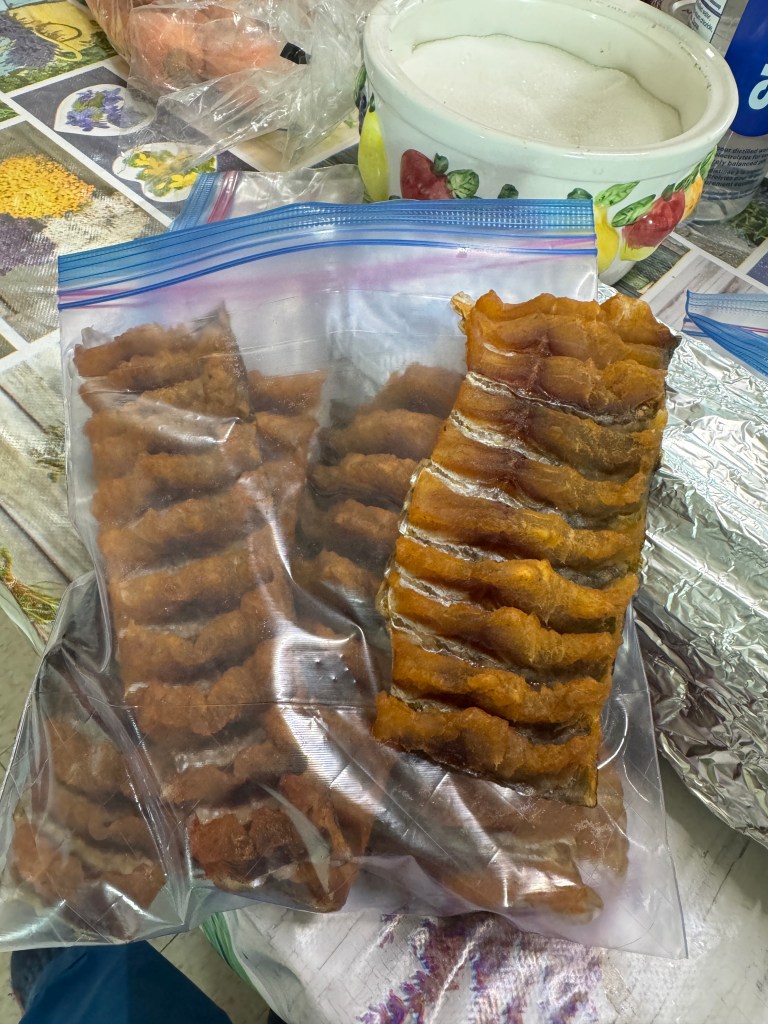
Above left is vanilla ice cream with salmon berries (orange) with a blackberry sauce. Above right is some smoked Whitefish.
Now I am sorry to report that my relationship with Eileen went downhill fast when she learned that as a Pescatarian, I would only eat the baked Broad Whitefish and none of her other meat/mammalian delicacies. I really wanted to try the Muktuk. It is not a moral thing, but I just looked at it and knew that I would not be able to get it down the hatch, so to speak. I was then the object of her sharp wit as she would say things to me like, “You know, you are cute but you are brain dead”. But she said it with such love and adoration that I could not help but laugh at myself. By the next day, she accepted me for who I was and my food peculiarity was no longer an issue.
Above Eileen takes out some of her winter ware and demonstrates it to us. The wolverine fur was spectacular.
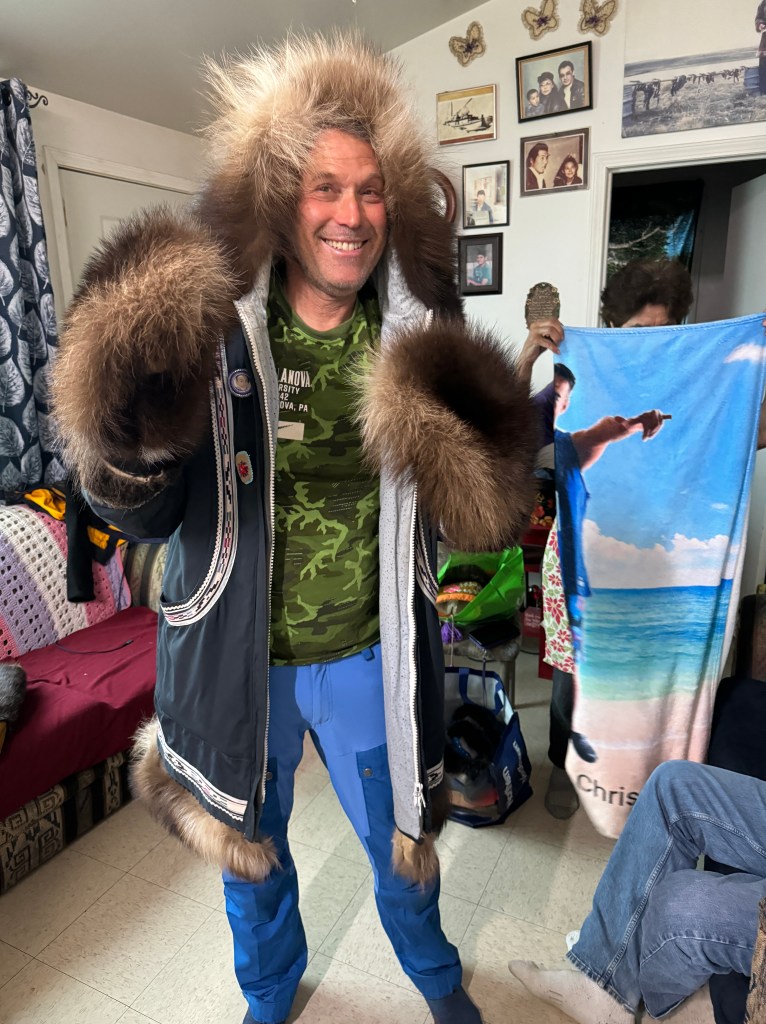
Above, it was my turn to try on the Wolverine coat. Eileen also allows the local villagers to use her home to sell native goods on consignment. I am trying on the (rare) Black Beaver mittens. I would have bought them, but I had already purchased Seal mittens back in Nome in preparation for our cold water sailing (coming soon!)
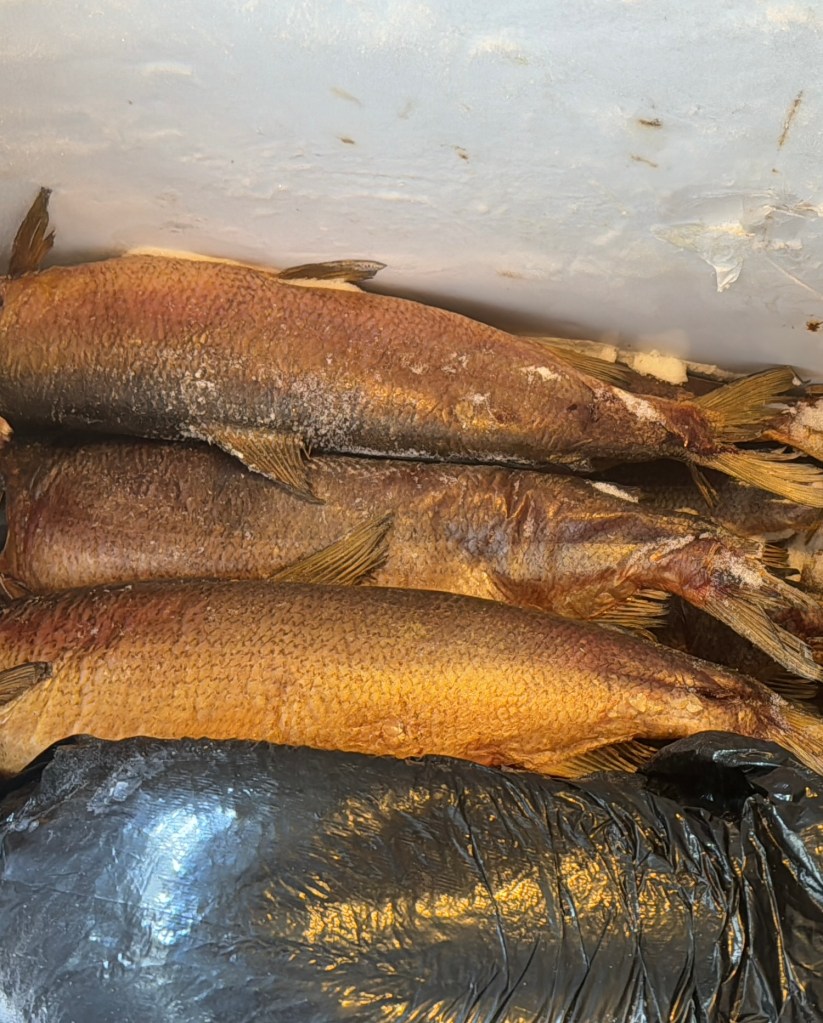
Above is a freezer full of smoked Broad Whitefish caught and smoked by her son. The flesh is hearty and boney, and you still have to cook it, even though it has a strong smokey flavor that overtakes any seasoning.
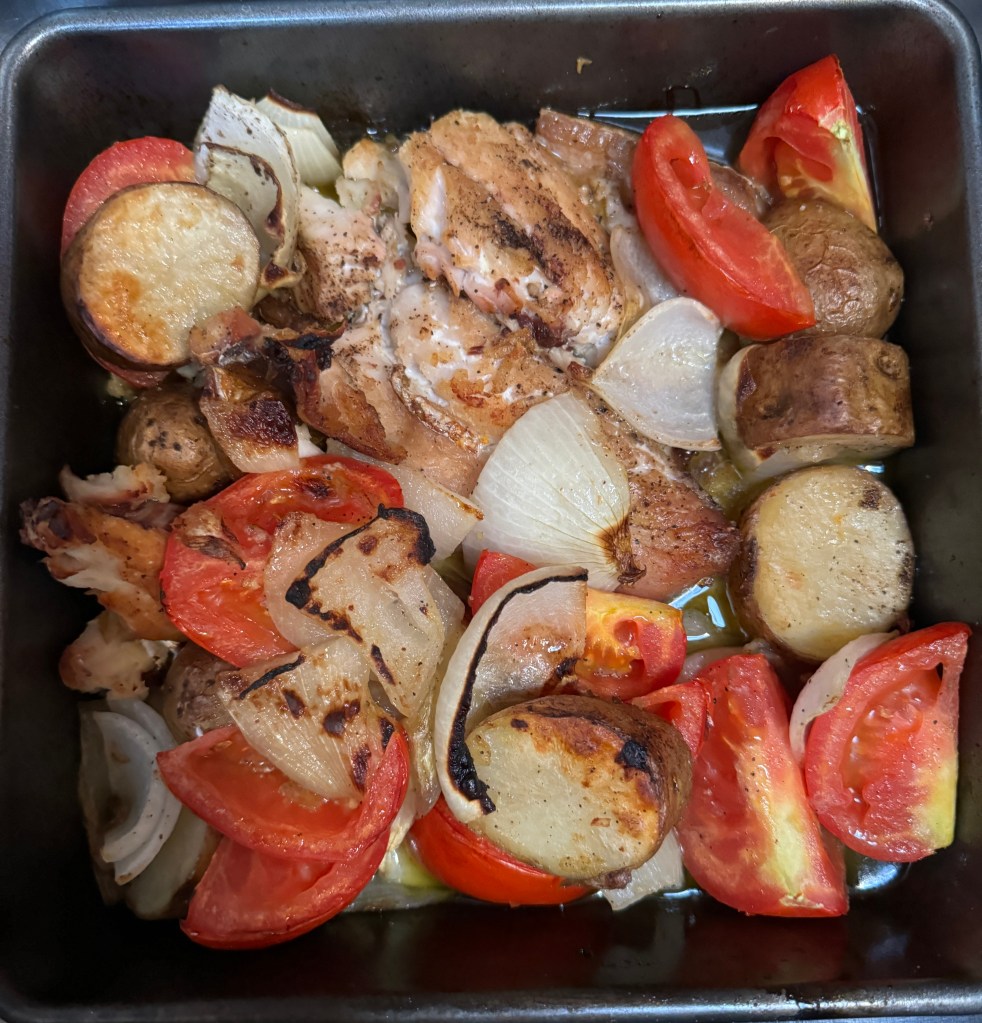
Above is how I cooked the Broad Whitefish on Mōli, with potatoes, onions and tomatoes, seasoned with olive oil, salt and pepper.
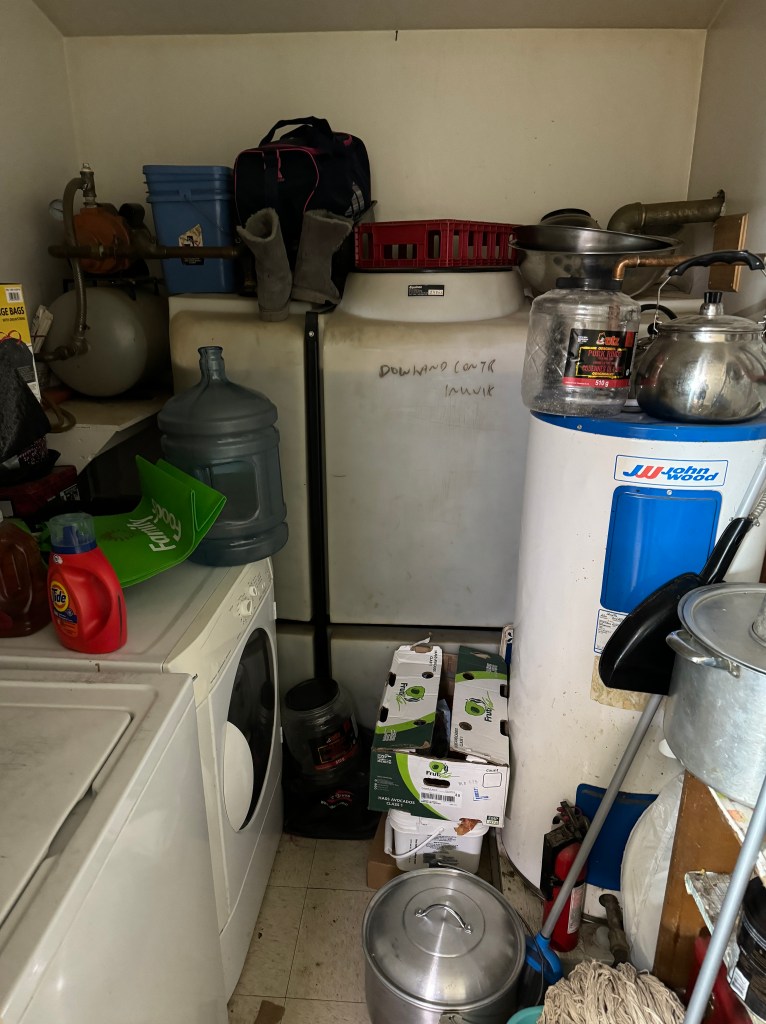
Like much of the Canadian Arctic small towns, every house in Tuk operates with a fresh water tank (seen in the back of the above picture) that is filled up once or twice a week, along with a grey/blackwater tank for sewage that is also picked up regularly. For whatever reason, the Canadians have not made the investment (like they did in much of the U.S. Arctic) to pipe-in water and pipe-out sewage.
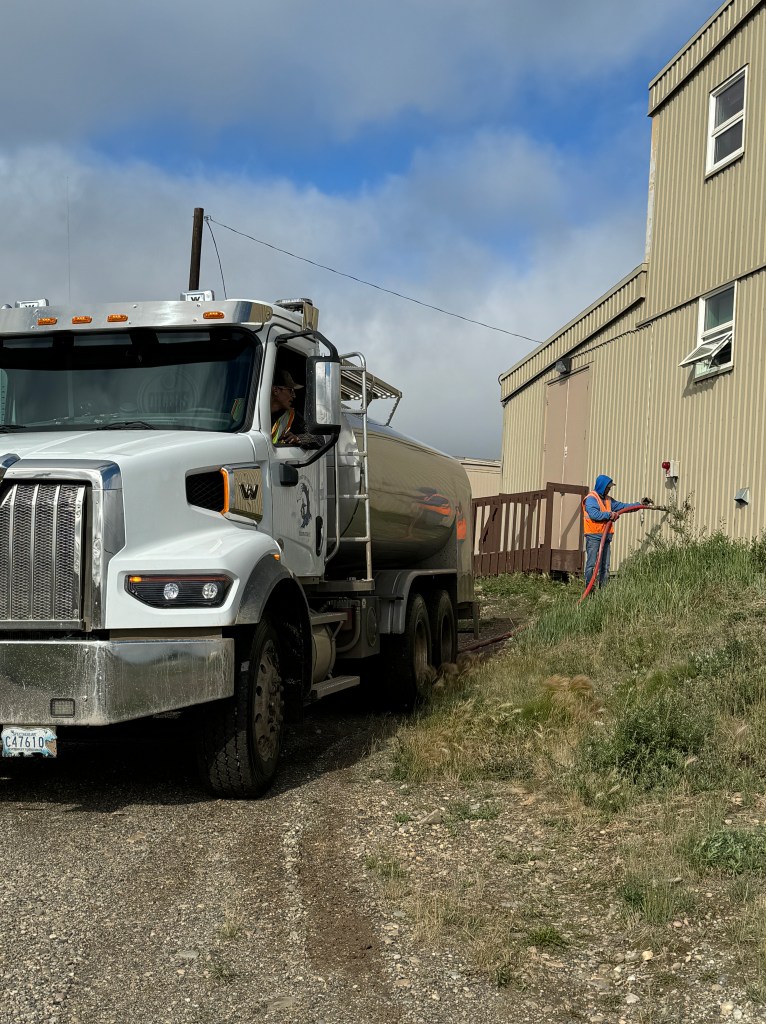
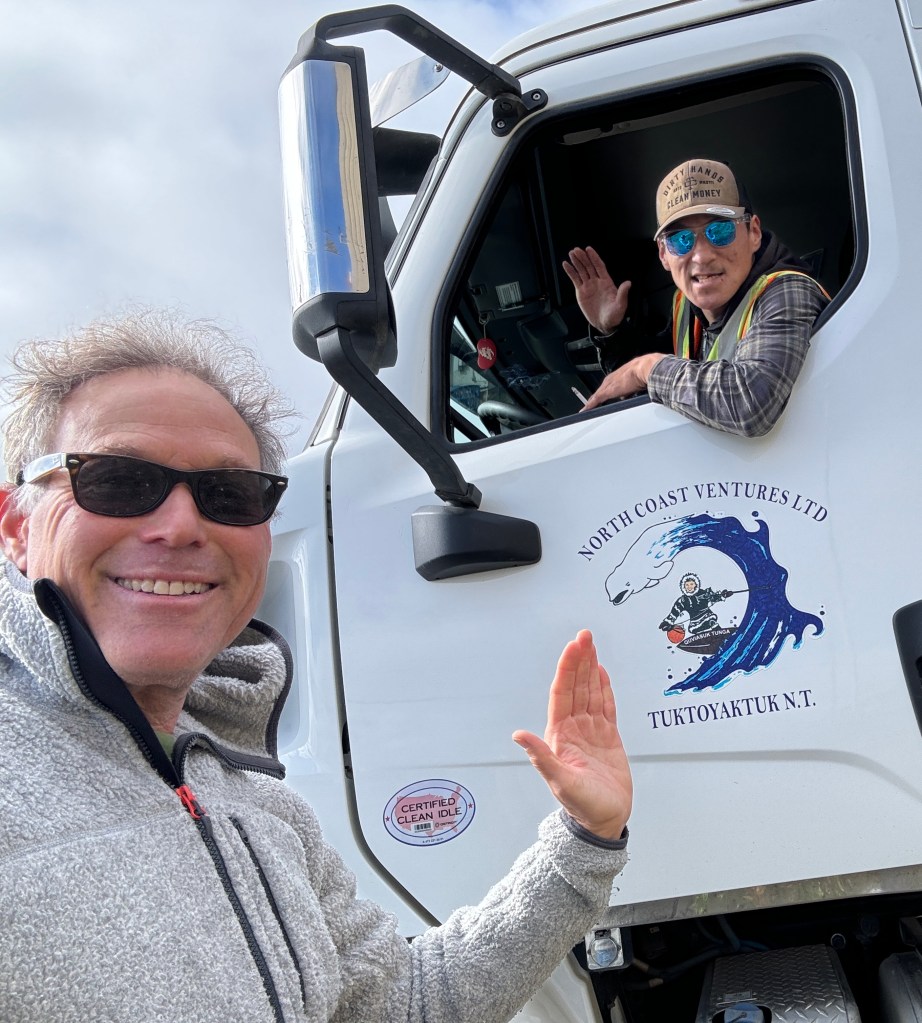
This of course creates jobs like this super-nice water man. There are two trucks in Tuk and it their full time job to keep everyone in water.
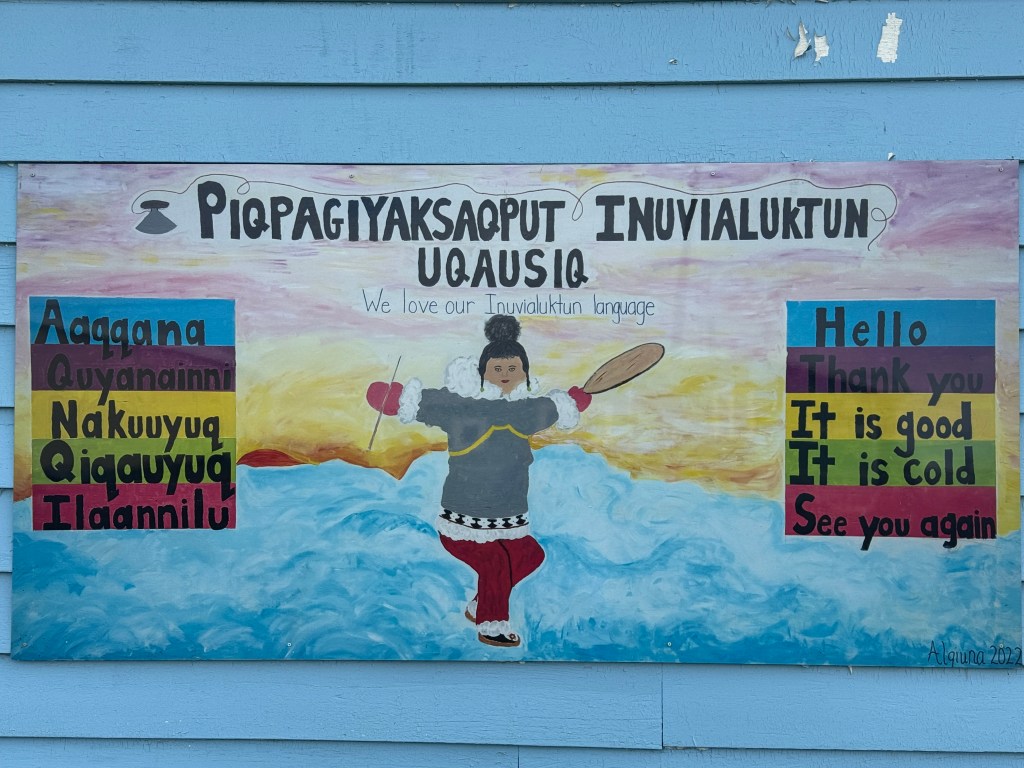
I have a little time before we go, so I explore bits of the community. The above mural on a community building does not mention the dark days of forced cultural conversion from Inuit to Canadian.

What are the chances? Across the street from Eileen is the ultimate man-cave of James (next to me) who is a distant relative of Eileen. As a dry town, no booze in Tuk, but smoking up a storm (and including your teenage children and older relatives) is socially acceptable. I guess I need to try this at my next family gathering. James is somewhat of a fixer who will also cook native foods (that he has trapped, fished, harpooned himself) as well as give tours of the surrounding area.
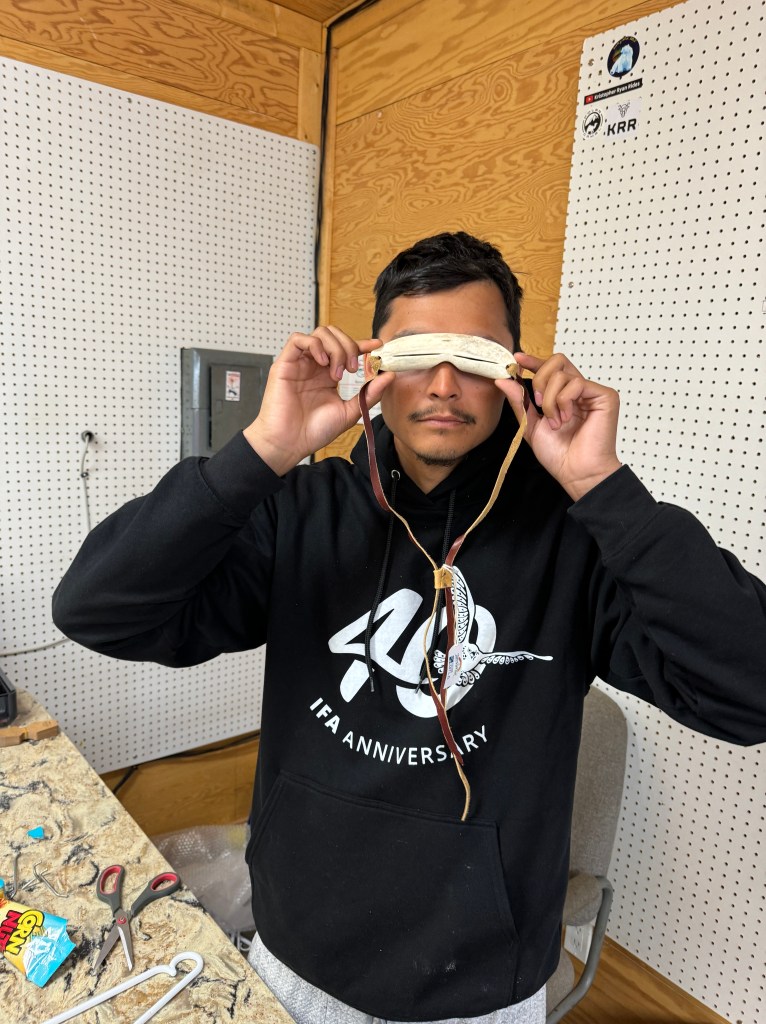
After hanging with James, I think it is only fitting for me to purchase native “sunglasses” to better fit into the local community (not!). The above Inuit sunglasses are carved from Caribou bone. Unfortunately, one no longer sees the native population wearing them, but they are classics.
PINGO! (Below)
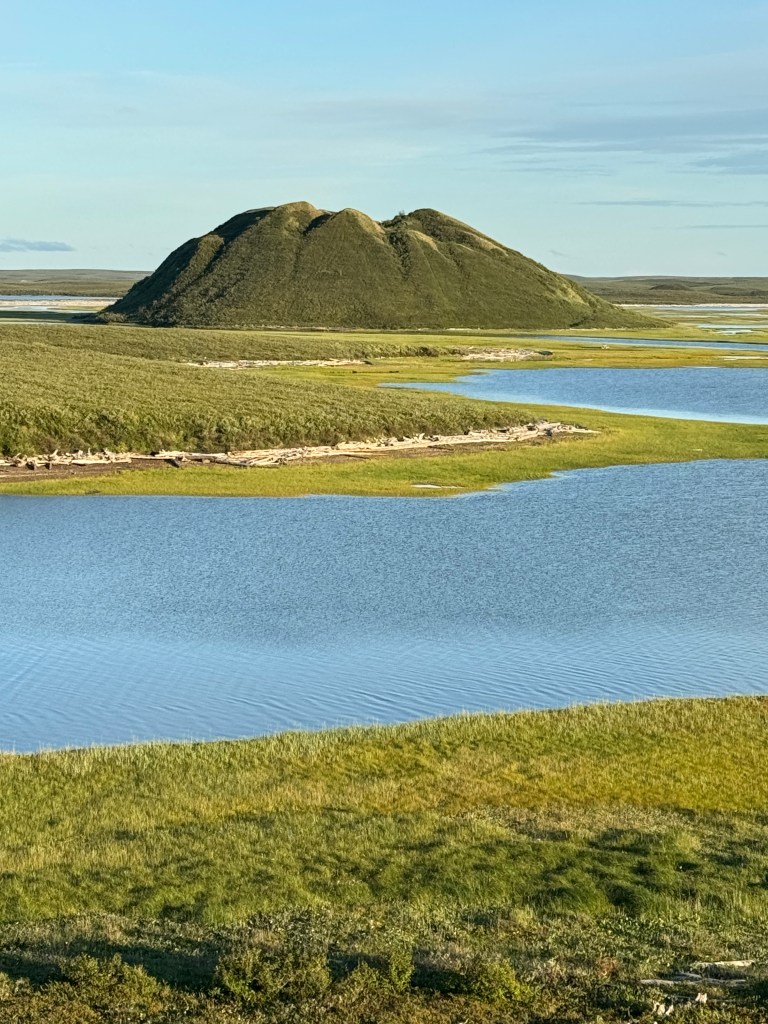
A Pingo is a dome-shaped hill formed in a permafrost area when the pressure of the freezing groundwater pushes up a layer of frozen ground. They tend to be 10 to 230 feet high and they are typically conical in shape (they remind me of a cinder cone). They grow at a rate of one to two centimeters a year. While Pingo’s are not unique to the Arctic, it just so happens that Tuk has the highest concentration of them in the world (1,350 out of a total of 11,000) and is home to the Pingo Canadian Landmark area. In terms of outer space, although no Pingos have been confirmed on Mars, scholars agree that there are indisputable signs of Pingo-like features there. The above picture was taken with my iPhone at 11:00 PM with the sun falling low on the horizon. https://en.wikipedia.org/wiki/Pingo
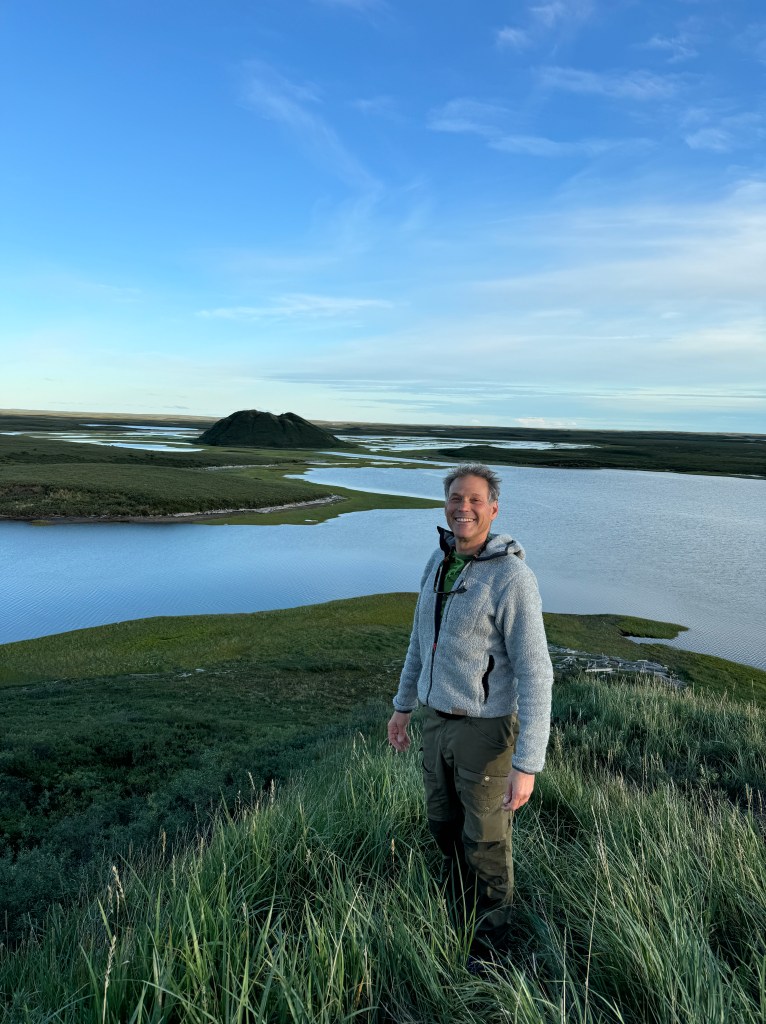
It is the day before Randall and I will depart from Tuk, so I take this moment to climb the Pingo and take stock of the incredible beauty of the surrounding tundra. Randall stays on Mōli to prepare for the journey.
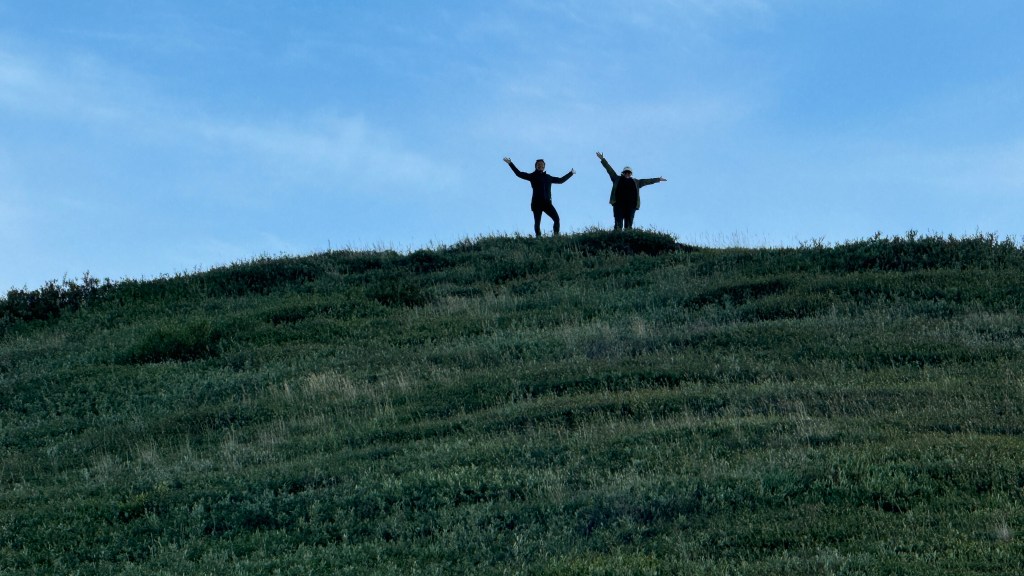
On top of the Pingo is a group of veterinarians (Veterinarians Without Borders) who visit these micro villages like Tuk and deliver animal services like neutering and rabies vaccinations. We all rode out to the Pingo on Jame’s boat (he is a tour guide as well!)

Above: The tundra is filled with wonderful surprises. While the Salmon Berries were not yet ripe, these “Blackberries” which resemble our blueberries were ready for eating.
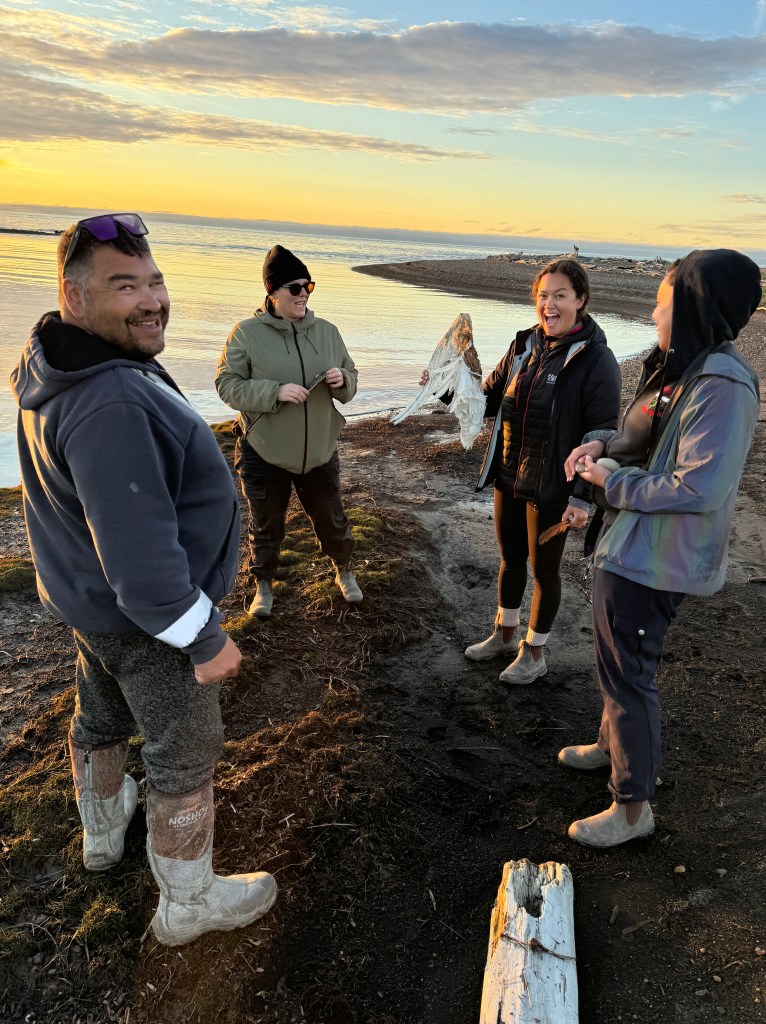
We stop to do some beach combing. The Vet’s love to collect rocks (I just keep mine in my head), but one found feathers from a Trumpeter Swan that she is going to keep. Yes, the natives eat Trumpeter Swans up here as well.
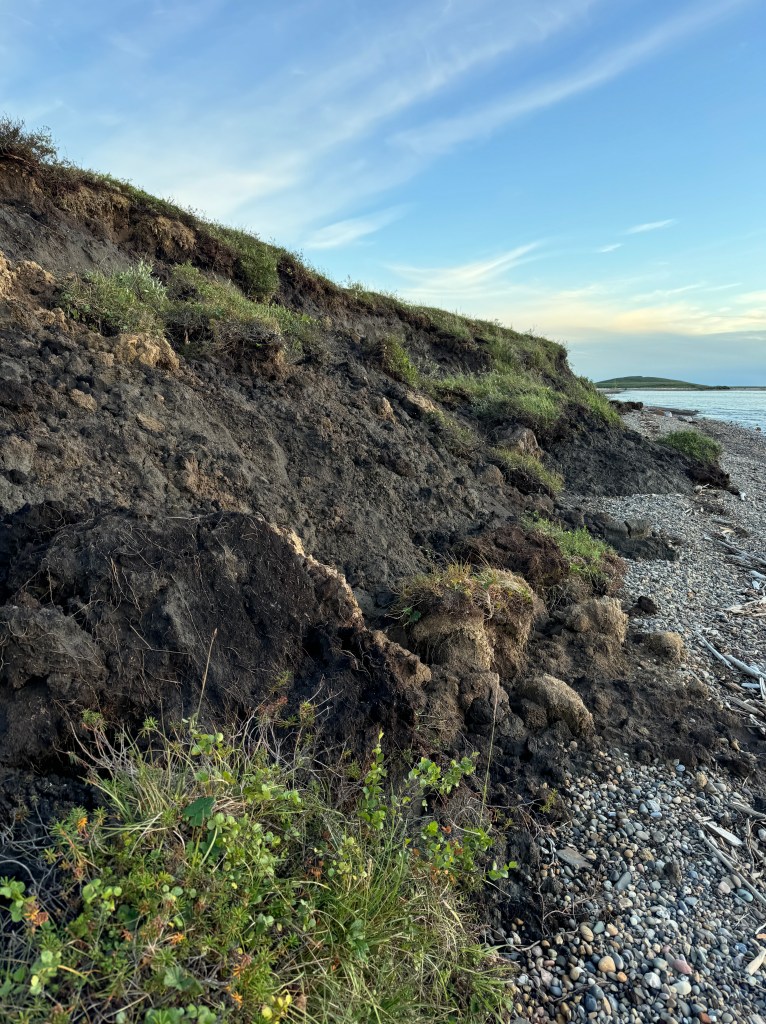
Above you can see signs of advanced and rapid erosion. Here is a short news clip on the local erosion. https://www.youtube.com/watch?v=JKMM9XBcl6Y
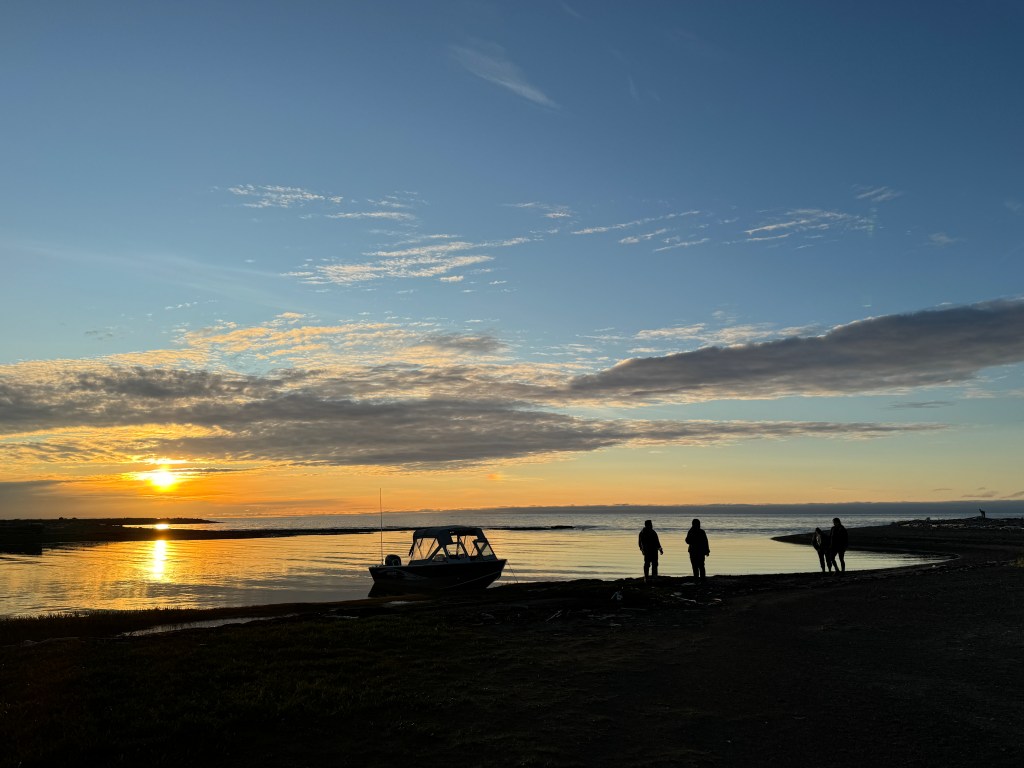
Well it is getting close to midnight and we will head back to Tuk. James promises us that we will see Beluga Whale on our way home. At present, I am going through a period of bad whale mojo where whales and I are just not coming together. I apologize to the group in advance and tell them it is my fault that we will not be able to see any Beluga. They all laugh, but we spend the next 90 minutes going to Jame’s favorite whale spots. It got pretty dark and cold, so we went home, whaleless.


 Harmon and Randall's Voyage...
Leave a reply to Nick Stewart Cancel reply