Leg 2
Blog 23
September 18, 2024
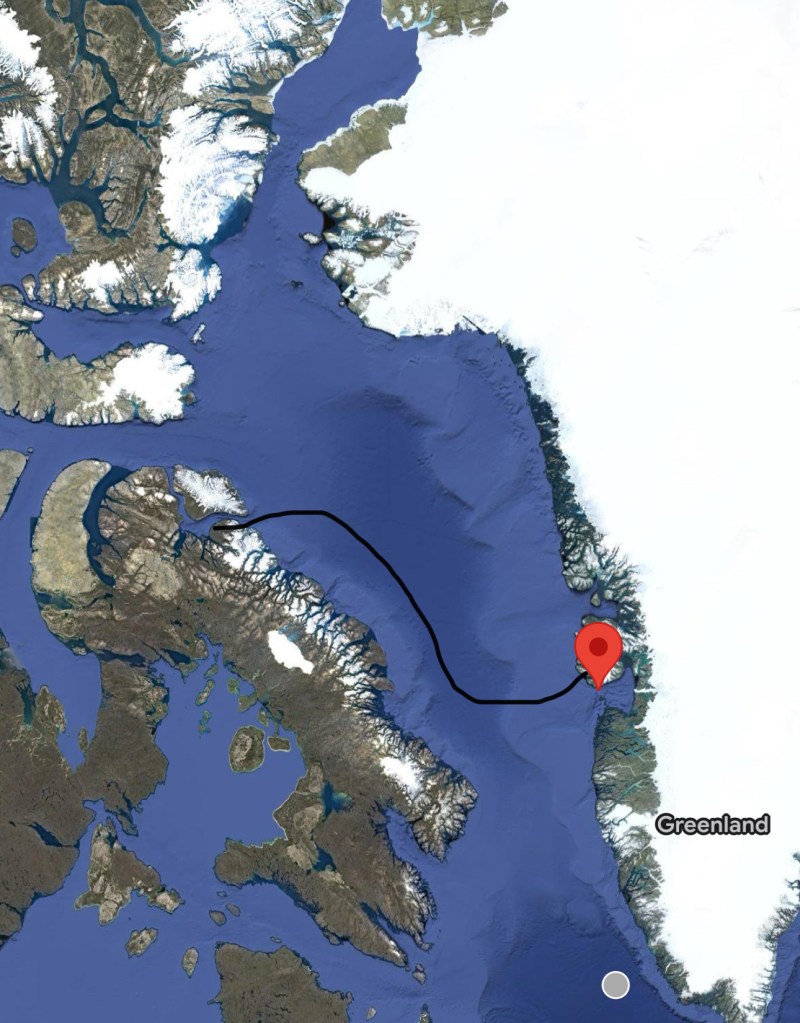
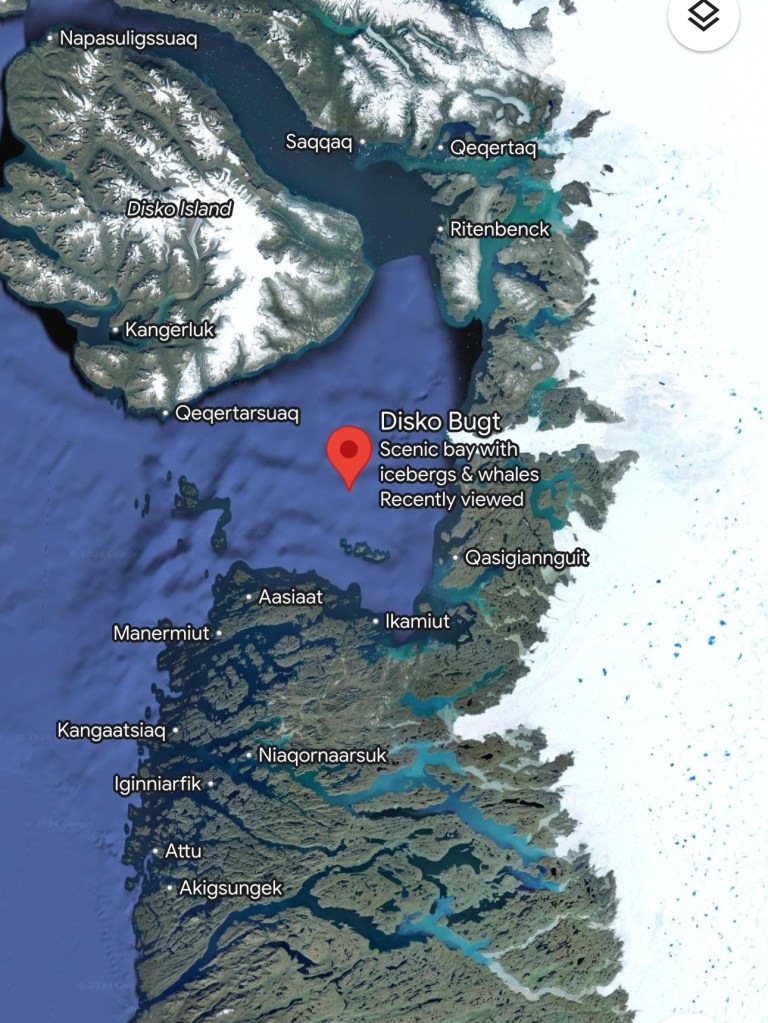
It was a “quick” 510 NM (3+ days) from Pond Inlet to the town of Godhavn (now known as Qeqertarsuaq) in Disko Bay, Greenland. But while Pond Inlet was in the Canadian Arctic, Godhavn, was in the Kingdom of Denmark and it had a decidedly clean, crisp Scandinavian feel even though it too is in the Arctic. While I welcomed coming into western civilization, it hit me hard that we had left the wonderful ‘Wild West’ feel of the Canadian and American Arctic and that my Northwest Passage days were now behind me. I will discuss this more in the next blog.

As usual, we arrived at midnight AND it was raining. So we waited until the next day to make landfall. It was still raining that entire next day, but we inflated the dingy and headed into town in our foulies.
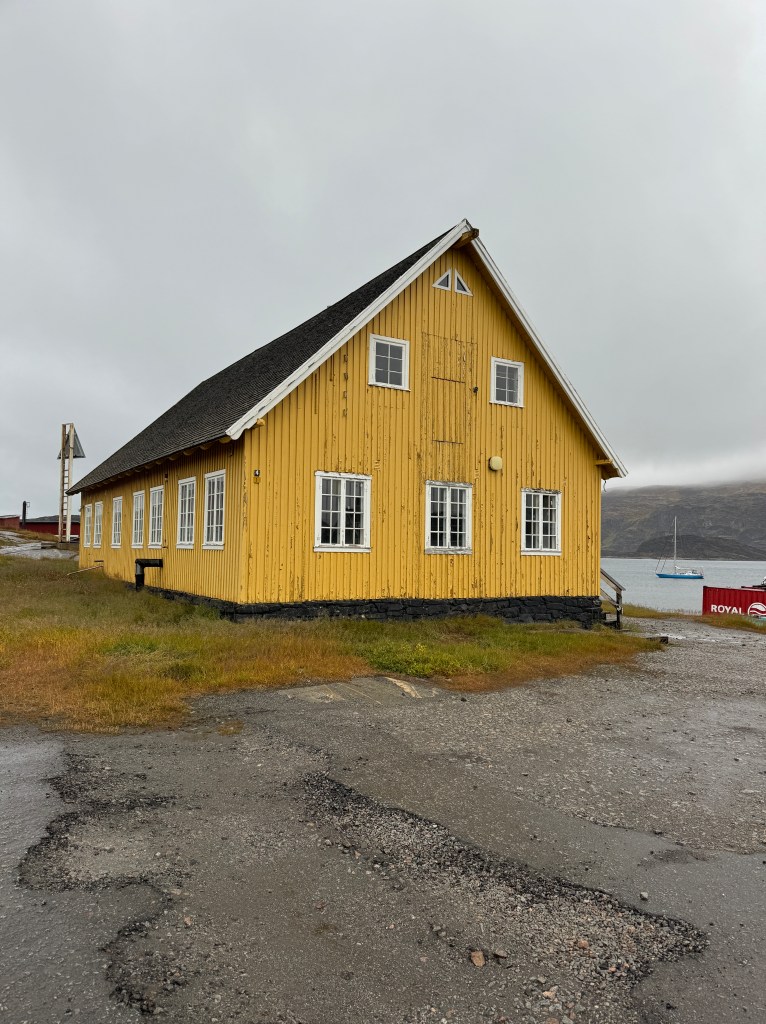
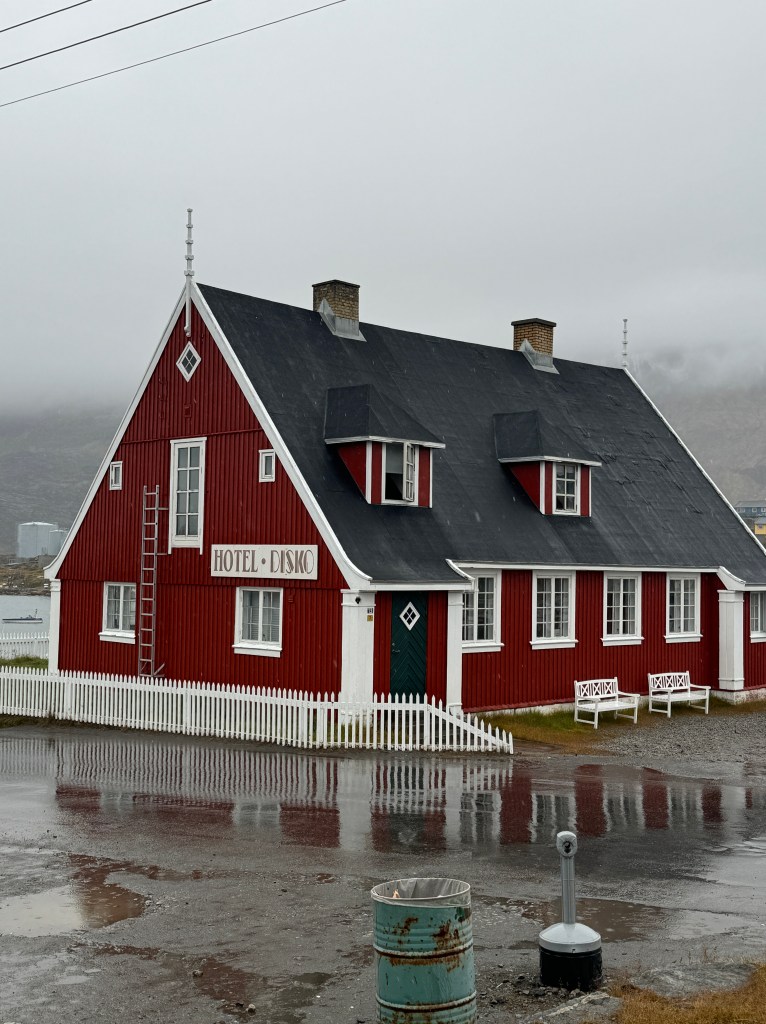
This town was more like a quaint Danish, Swedish or Norwegian village – colorful and orderly. No litter, no mess. Where are all my wild native friends?
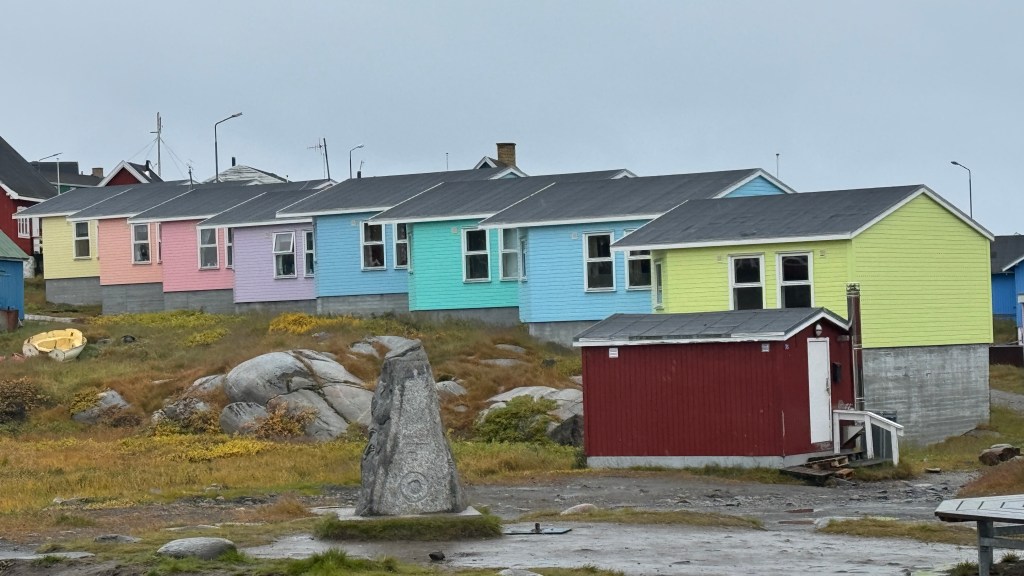
In the 17th Century, the first whaling stations were established on Disko Island. These optimal fishing grounds attracted many European whaling expeditions. Whaling Station ”Godhavn” (today Qeqertarsuaq) was founded in 1773 by the whaler Svend Sandgreen and now has about 850 residents. For many years, Godhavn was an important base for whaling in the Davis Strait. Today, the town harbor still is a lively place due to the common fishing. At some point thereafter, native Inuit began their migration into the town from their semi-nomadic villages.
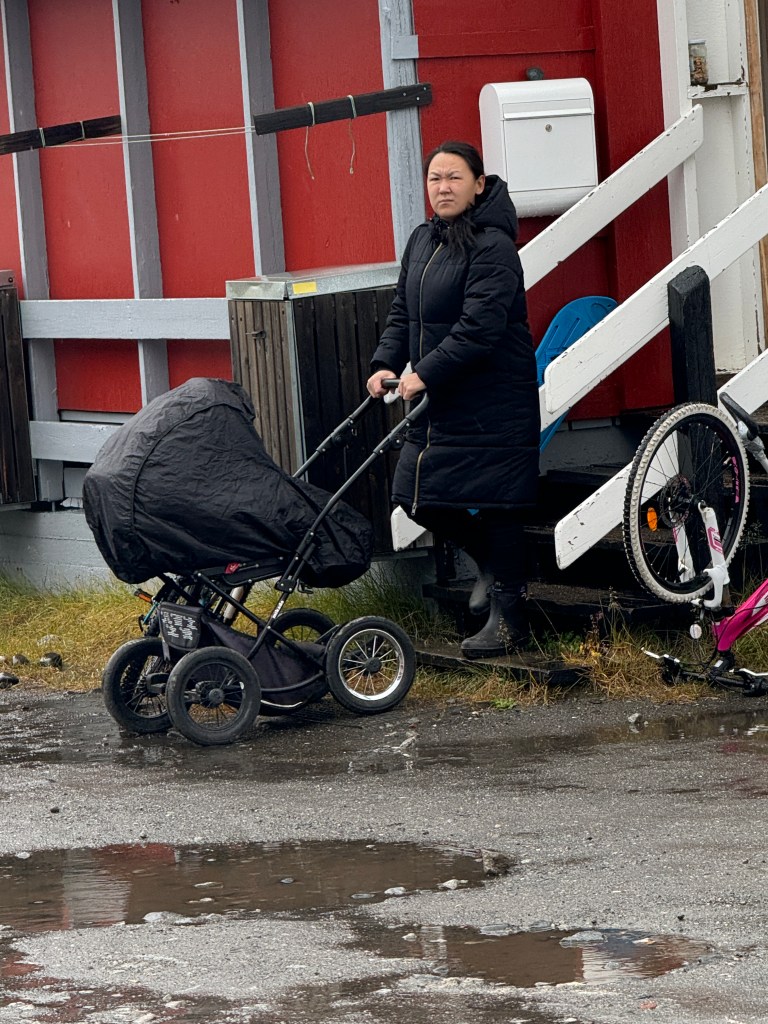
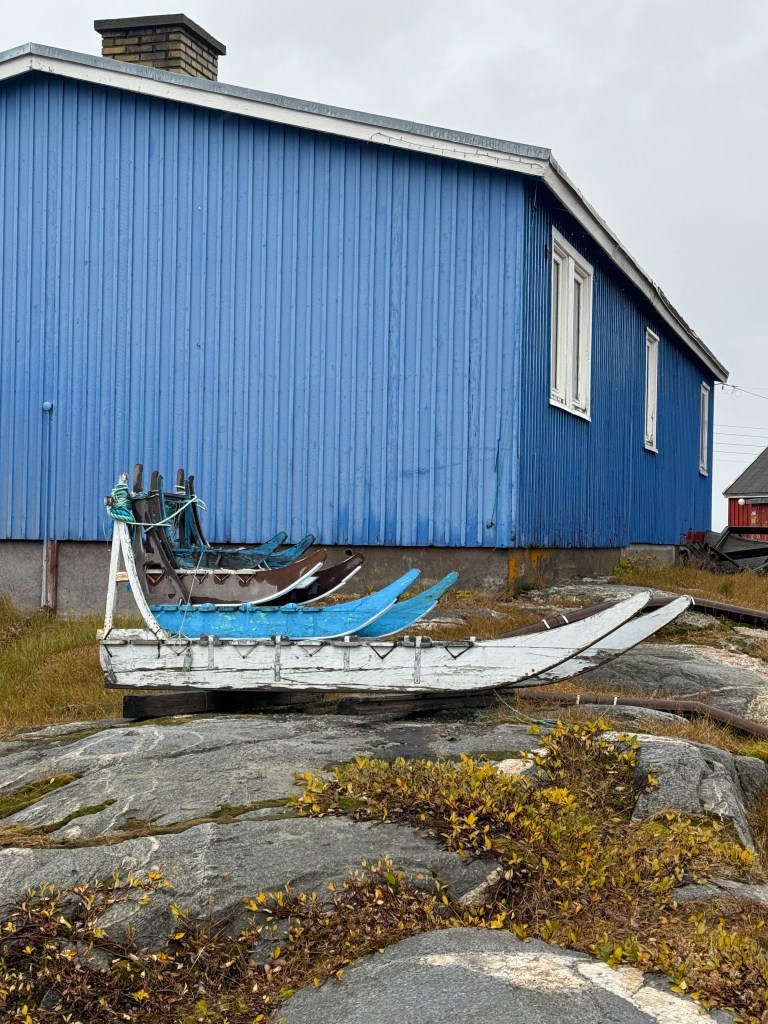
Above left: I noticed immediately that this town had a western “feel”. The dead giveaways were 1) paved streets and 2) baby carriages! Above right: The residents were patiently awaiting the next winter with their sleds neatly stacked (instead of indiscriminately thrown around). The native Greenlanders and the new Norsemen (I mean the Danes) lived side-by-side with no noticeable difference in standard of living.
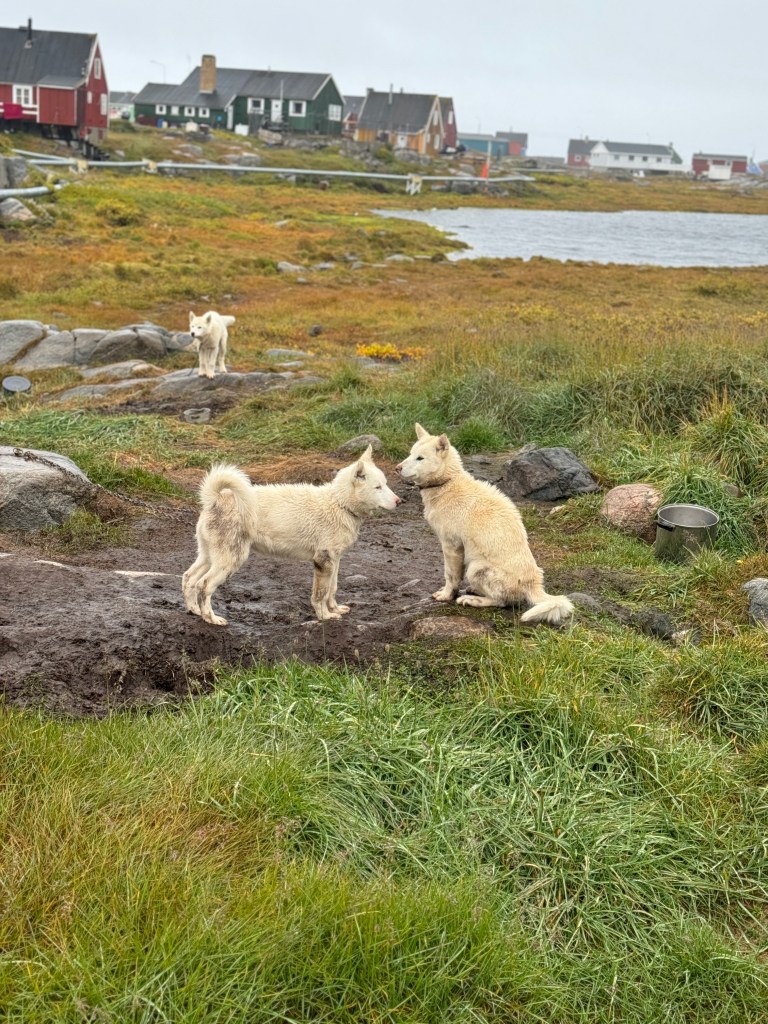
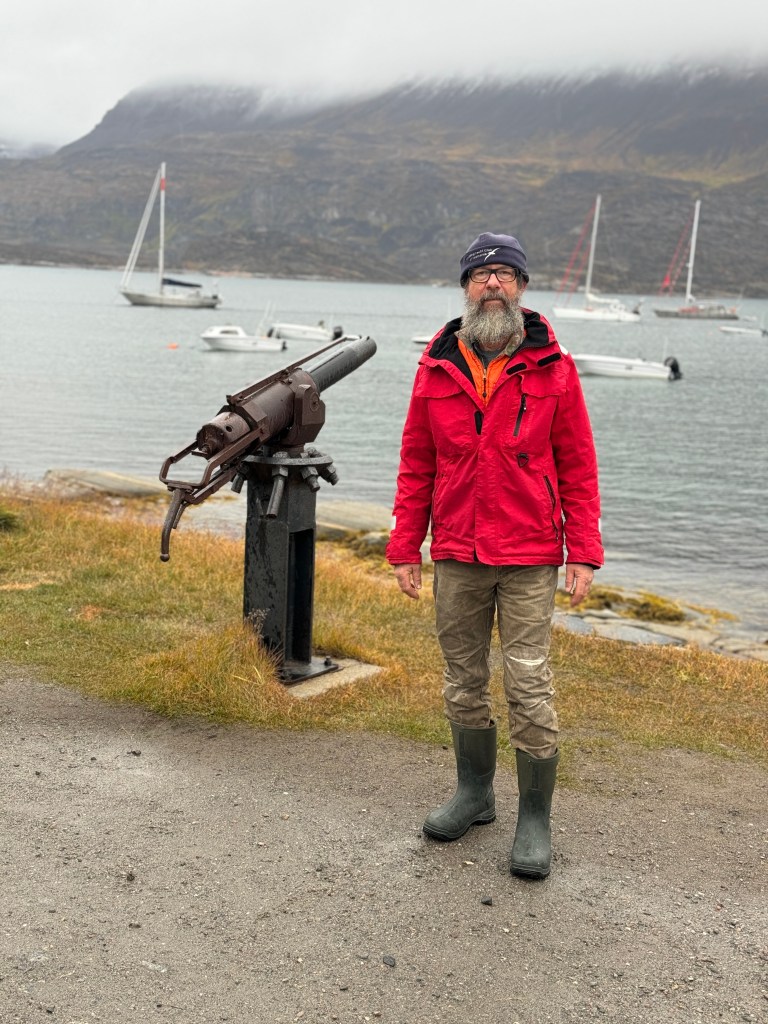
Above left: There were no shortage of sled dogs in town, so I began to relax. At certain times during the day and night, they would all howl in unison and the town would take on an eerie sound. Above right: Randall stands by an old relic in town – a whale gun. The instruments used to kill whales were the harpoon and the lance. Usually the harpoon was thrown by hand but by the 19th century, simple harpoon guns were also being used. The harpoons fired by the gun were not explosive devices but essentially similar to those thrown by hand. You will see the bowhead whales from April to May and the humpback whale from May to September.

I loved seeing the bowhead whale jaw bones at the entrance to town off the bay. It gave the town a real Arctic feel. But unlike some of the other towns we had been in, those were the only whale parts we saw, and they were encased in concrete instead of simply just leaning about.

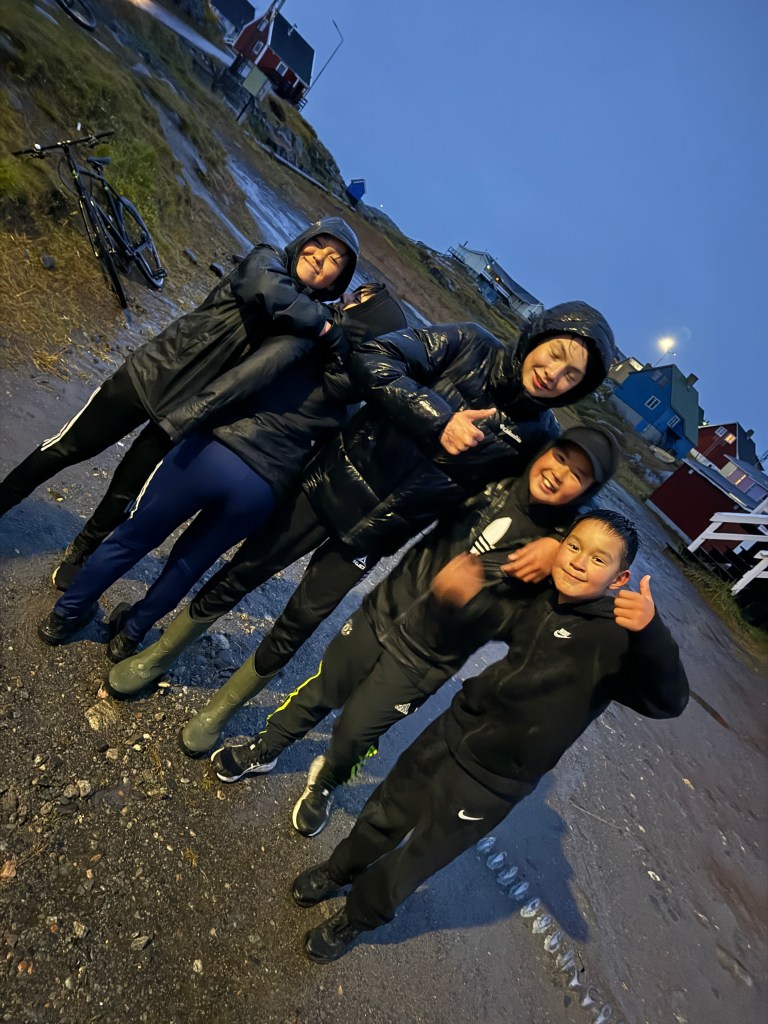
It did not take long to fall in love with the town’s kids. They all seemed to show up to the equivalent of the town square around 10 at night and play games with each other like hide ‘n seek well into the midnight hour. The boys hung out with the boys and the girls hung out with the girls. Above left, these two best friends made the most of their can of “pop” and were very interested to learn about where Randall and I came from. I found their accent intriguing and unidentifiable. In school, they learn their native Inuit, some Danish and some English.
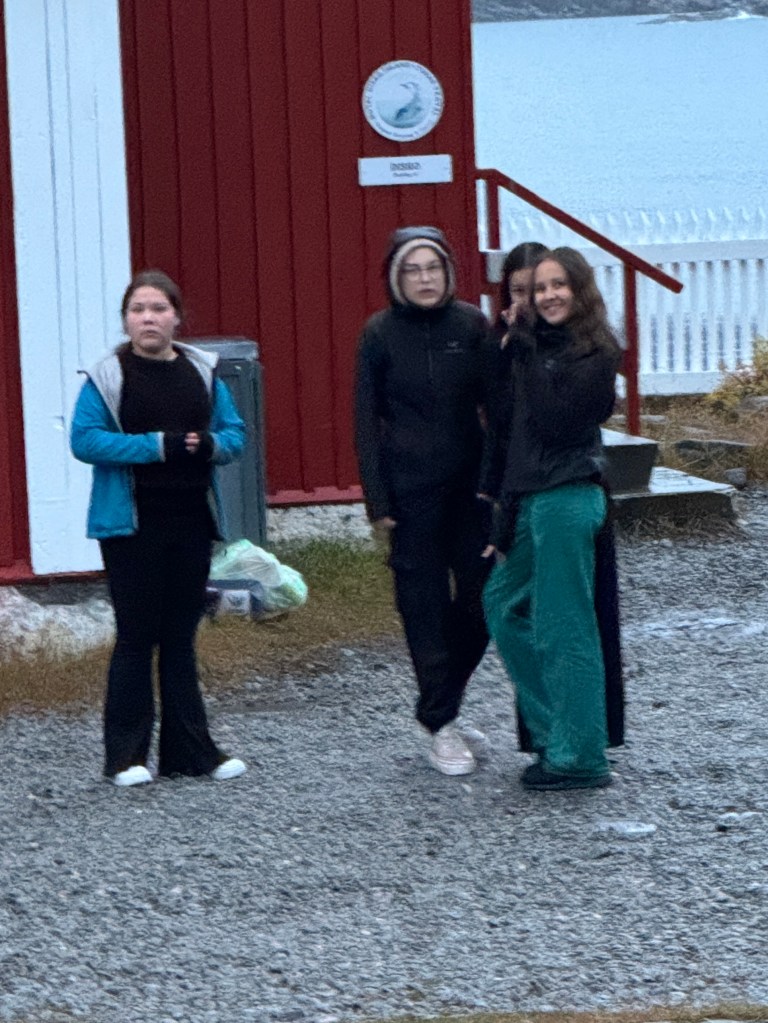
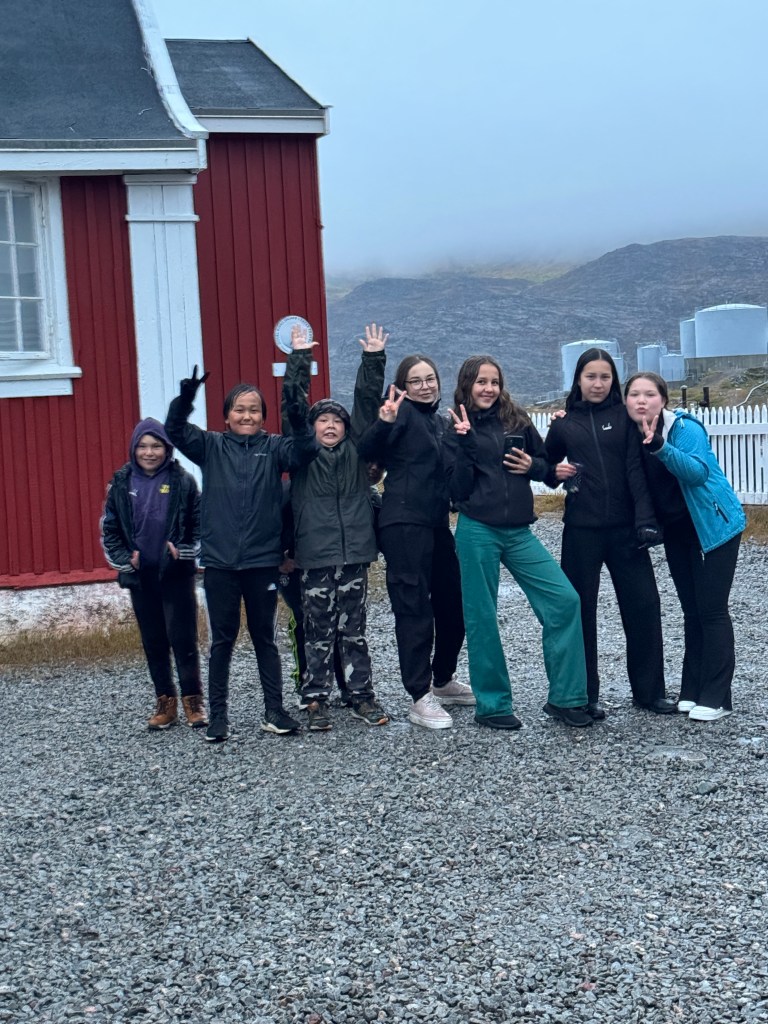
The girls were equally interested in our presence. Above left, I “sneaked” a picture of the four girls when I thought they were not looking (my kids, rightly so, give me a lot of grief for this bad habit). The girls immediately yelled, “Hey!” I thought they were going to scold me for taking their picture, but instead they called me over and wanted me to take a selfie with them (above right sans selfie) and were then happy to engage me in casual conversation to which I, of course, happily obliged.
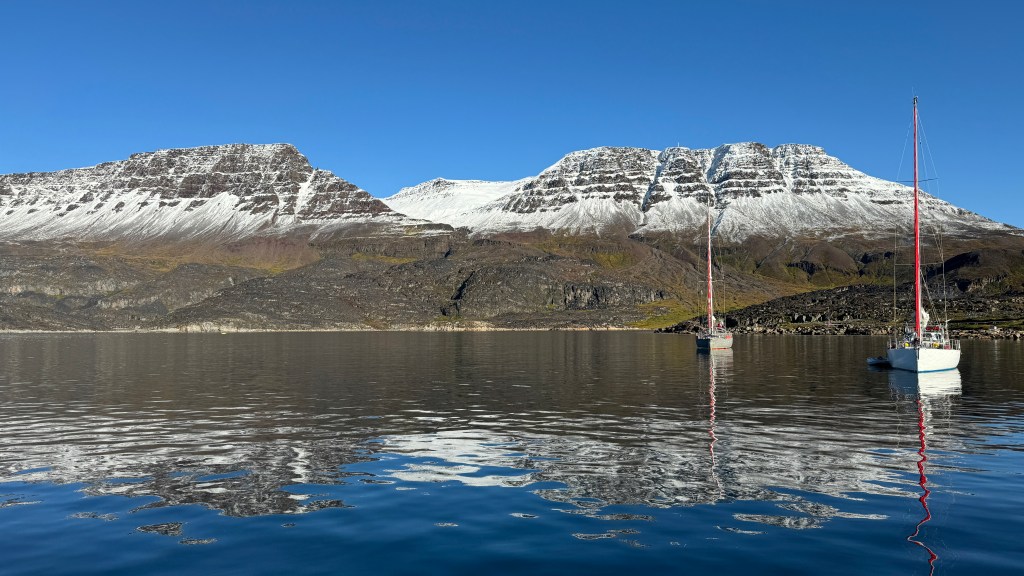
For some crazy reason, we woke up the next morning to find perfect weather. Temperature was almost 50, no rain, fog or wind. Dang, about time! Godhavn directly translated means “Good harbor” and you can see why it was so appealing back in the 1700’s.
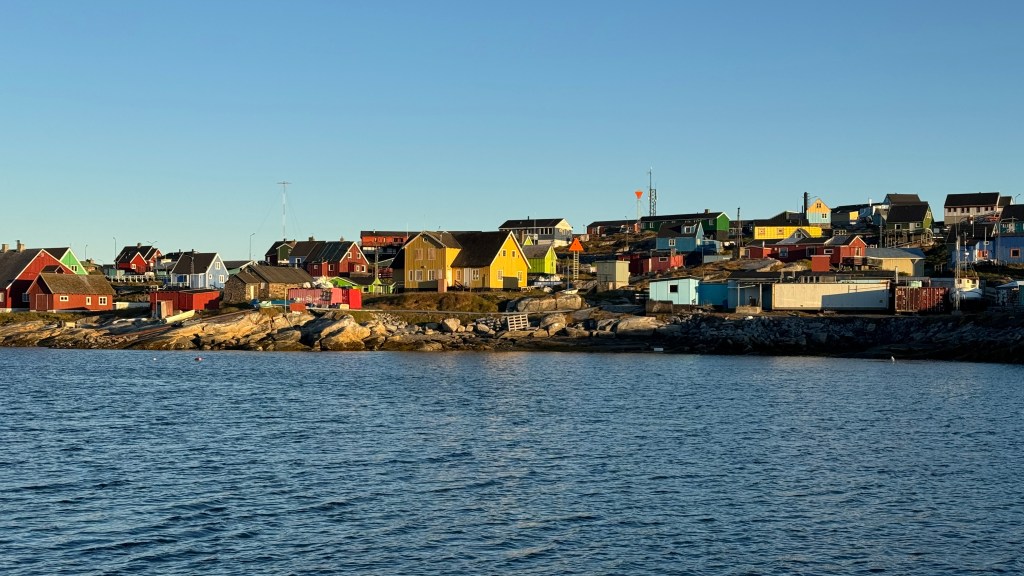
Now you can get a better feel of how picturesque the town is with all of the beautiful houses lined up around the harbor.
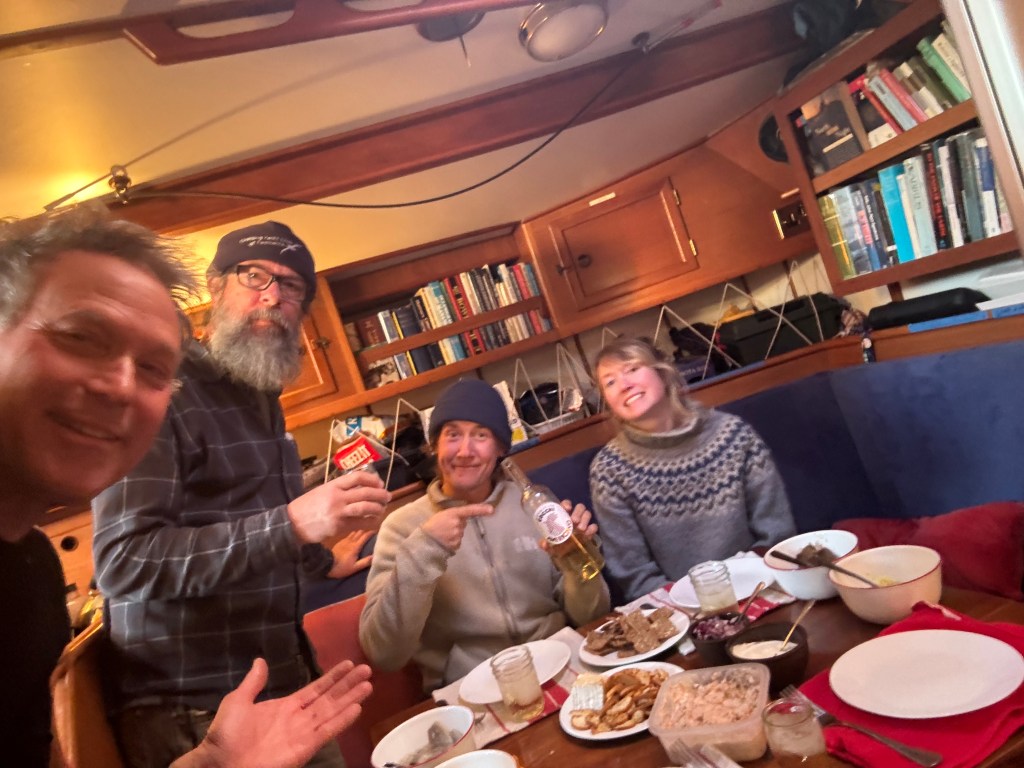
We invited our favorite Finnish couple (Juho and Sohvi of S/V Lumi https://alluringarctic.com) over for a late breakfast of pancakes and watermelon. We had to eat fast as the store in town was going to close at 2:00 and it was 1:15!After breakfast, Randall dropped me ashore.
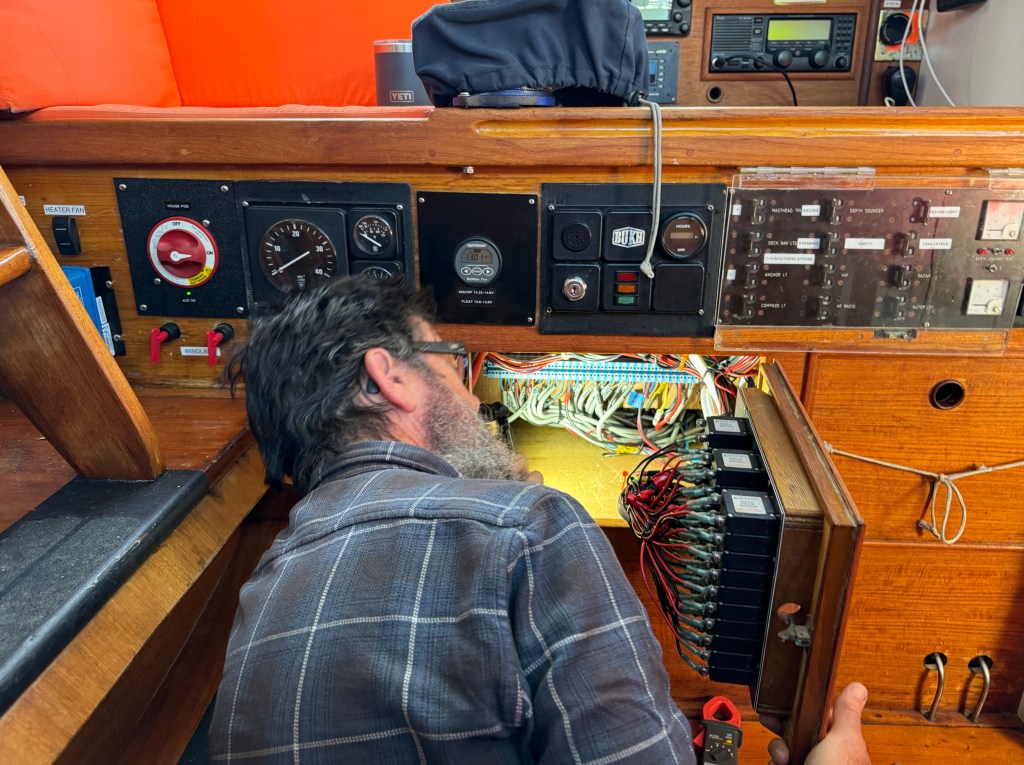
Dr. Reeves came back from shore early as he had to diagnose an electrical problem that was causing the autopilot circuit to overload and then turn off the autopilot at the most inconvenient moments.
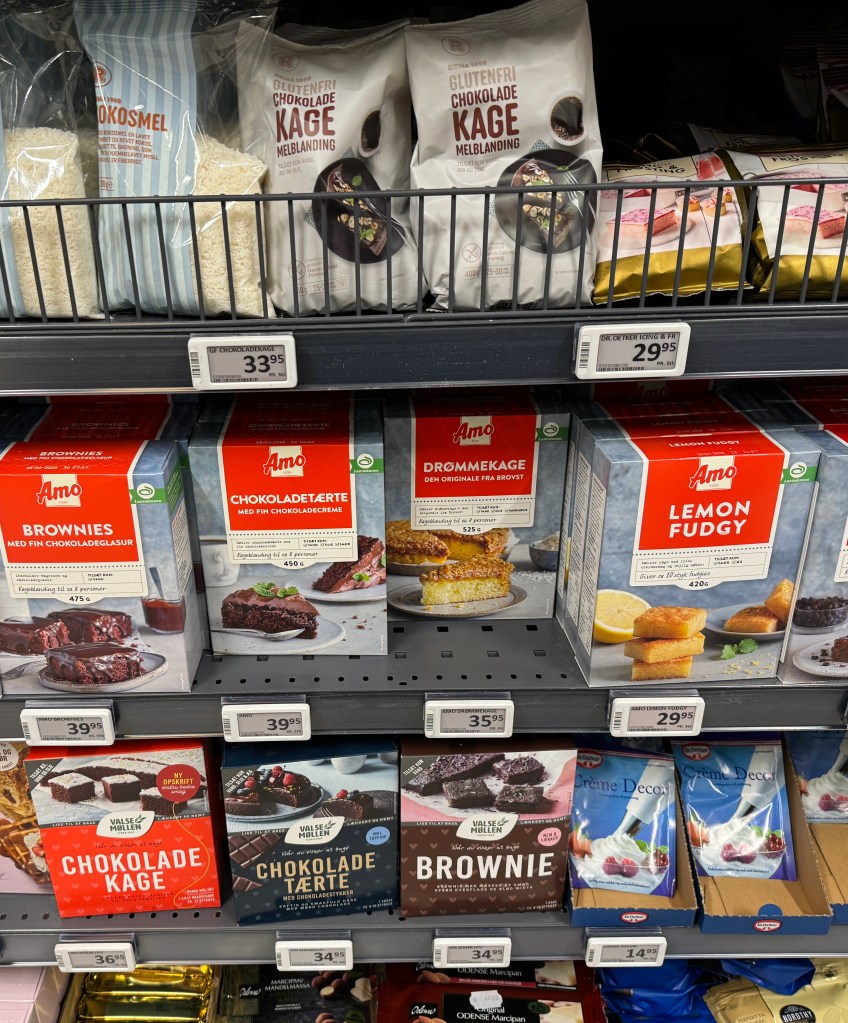

Meanwhile, we made it to the store just in time and I was in heaven to see that so many of my favorite Swedish foods were in stock (but they had Danish labels). I bought plenty of cake mixes and herring. I tried to buy some beer but was given a polite “you should know that in Greenland we do not sell alcohol on Sundays” look. Hmmmm! Interestingly however, I noticed that they sold rifles at the market (my kind of place). Yes, you can buy a gun on Sundays in Greenland but not a beer. Welcome to Scandinavia in Greenland.
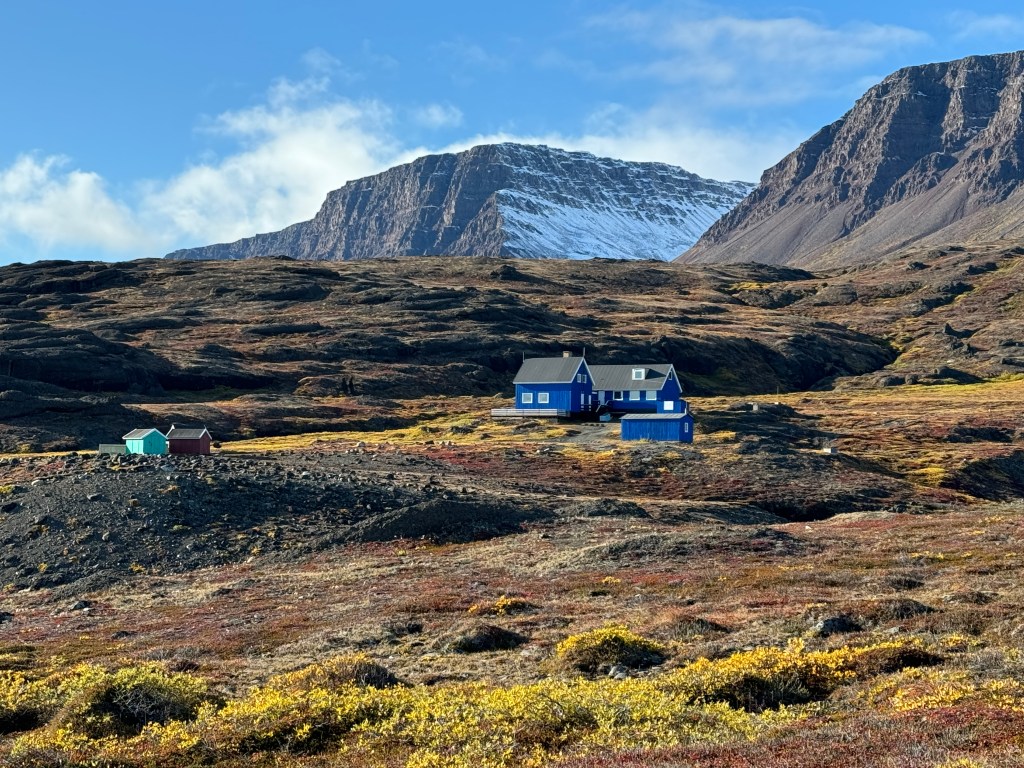
Later that day I took a hike inland. This mountain setting is reminiscent of the Swiss Alps.
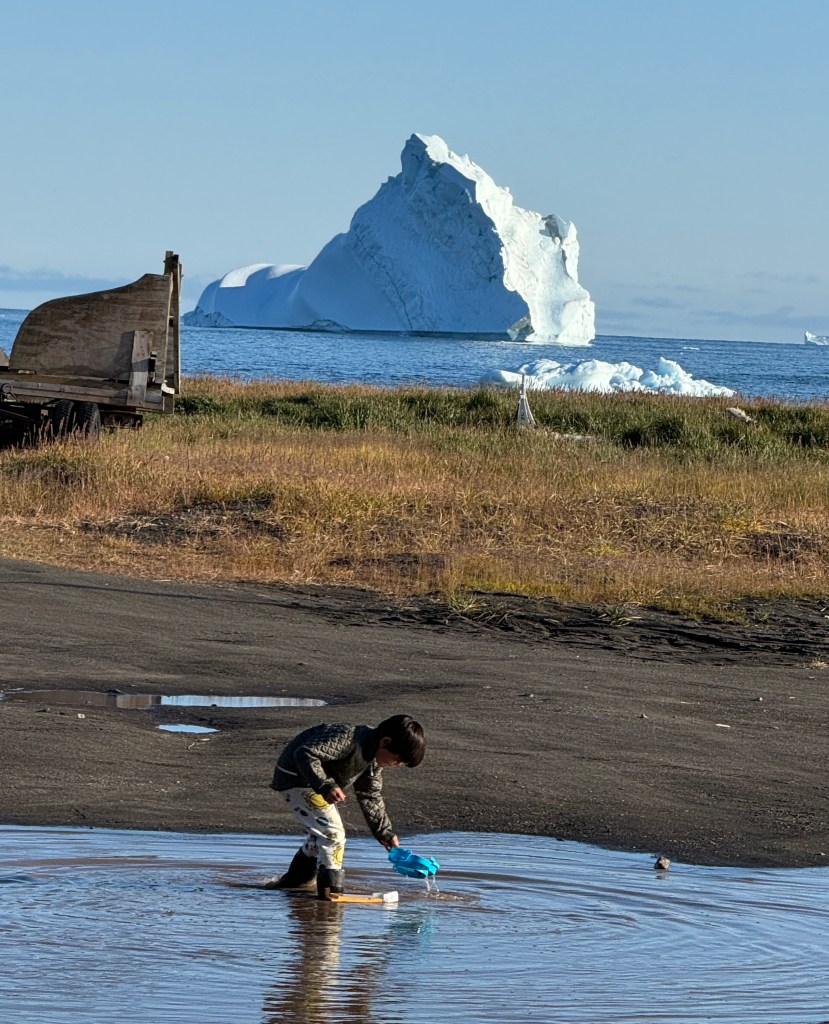
On the way back to town, I walked past a row of houses adjacent to the beach. Imagine playing with this in the background?!

With 32 degree water and ice for sand, I was not quite ready to go swimming. I did nevertheless pick up a mini-berg for cocktails later that night.
This is a quick pan around Disco Bay from the beach.
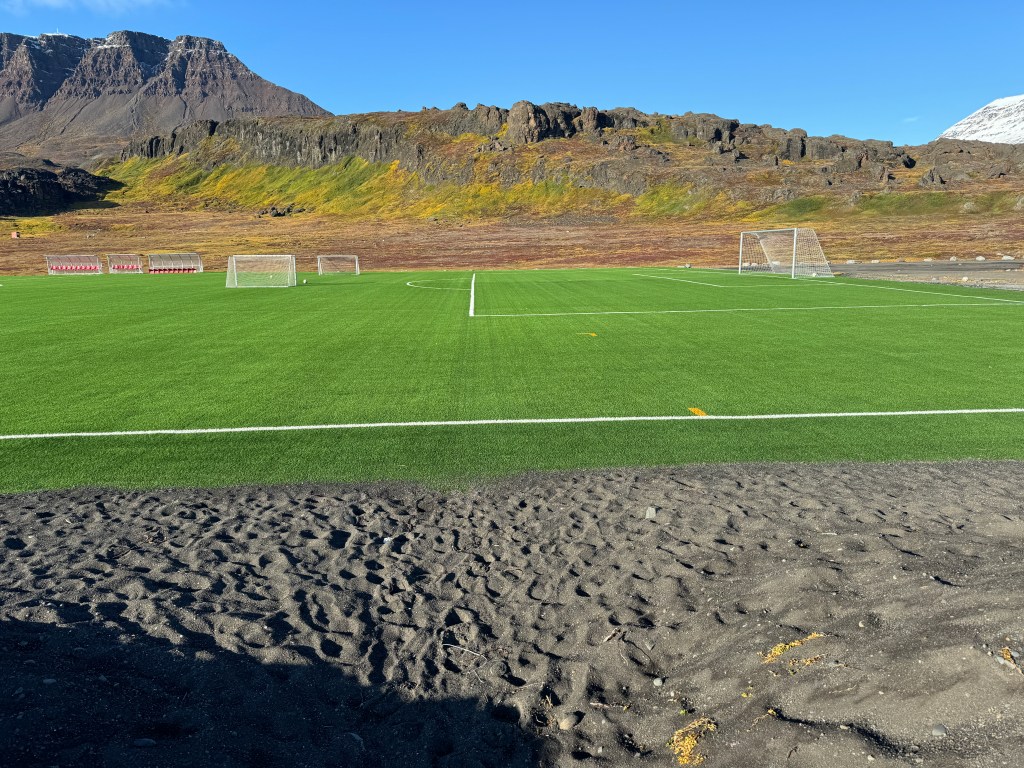
Turns out that Godhavn is famous for their soccer field adjacent to the beach and icebergs. What I found interesting is their ability to keep the sand out of the soccer field. There was not one grain that made it to the field. Not sure how they do it. All I know is that at home, any playground with sand, or any beach adjacent sidewalk or how about the Great Highway in San Francisco, there is sand spilling over at every possible occasion. Total mess everywhere back home but not here.
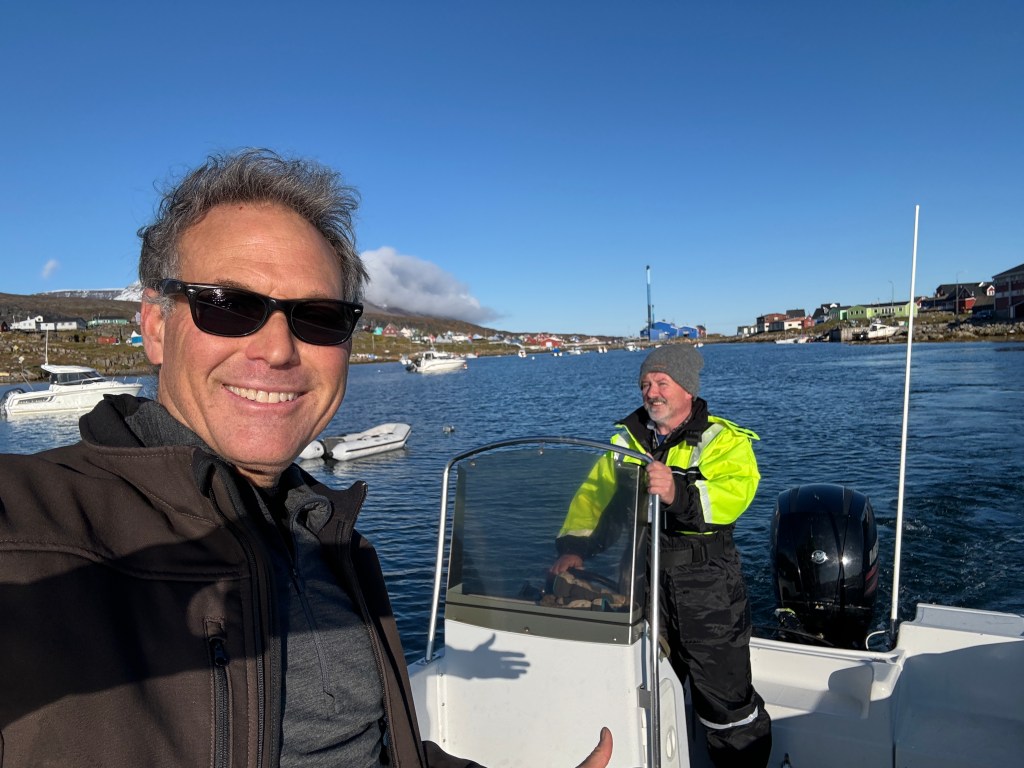
Getting back to Mōli I hitched a ride with this man at the dock. Before I got on, he and his wife unloaded a basked of cod they just caught. Turns out he lived most of his life in the Faroe Islands https://www.faroeislands.fo before moving to Godhavn. The Faroe’s share the Norseman past and Danish ownership with Greenland along with an isolated, but slightly western and decidedly Scandinavian outpost feel.
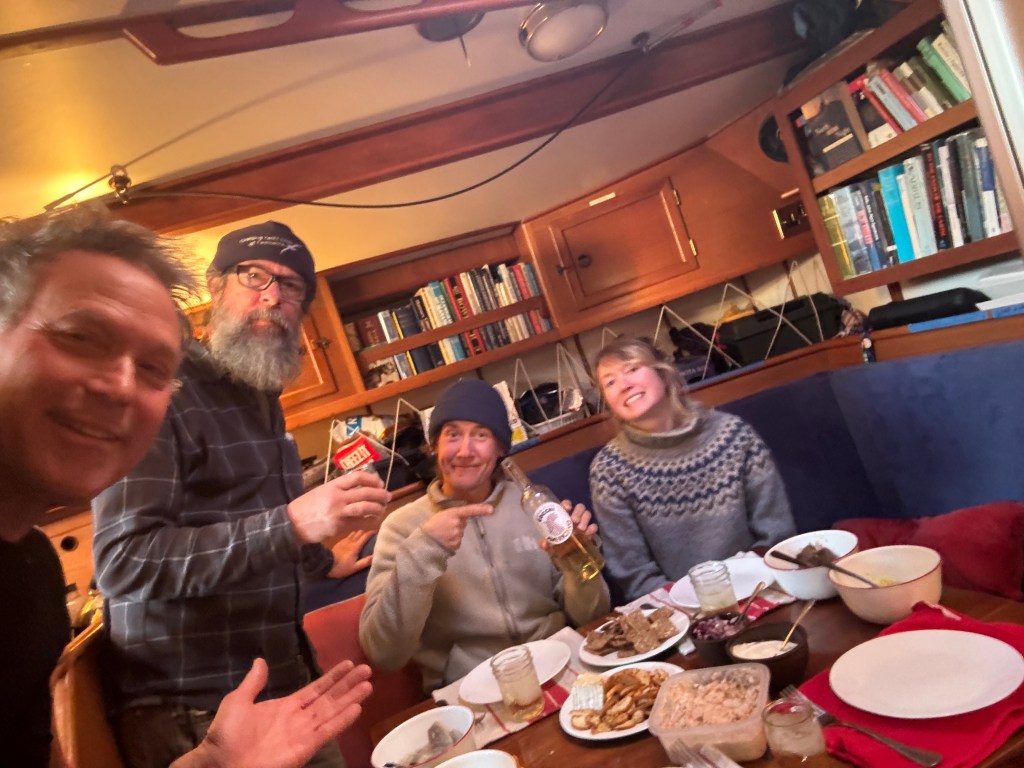
Because our breakfast was so rushed, we had Juho and Sohvi over for a pizza (homemade) and herring dinner with aperitif given by Mike Grebowicz (thank you!). Conversation over dinner centered on all of the boats presently transiting the Northwest Passage this year (maybe 15?). They both had an amazing command of the individuals on board, their equipment and their chances of making a sucessful passage.
Juho and Sohvi will over-winter their boat somewhere in Greenland in a location that will enable them to both live on the boat, and cross country ski the incredible mountains. “Hmmm” I thought to myself. I was told to make my career, get married and have kids in my 30’s and 40’s. I didn’t know it was “legal” to explore the world instead! All in good time and no regrets here. It just blows my mind to see the different life paths of our fellow sailors.
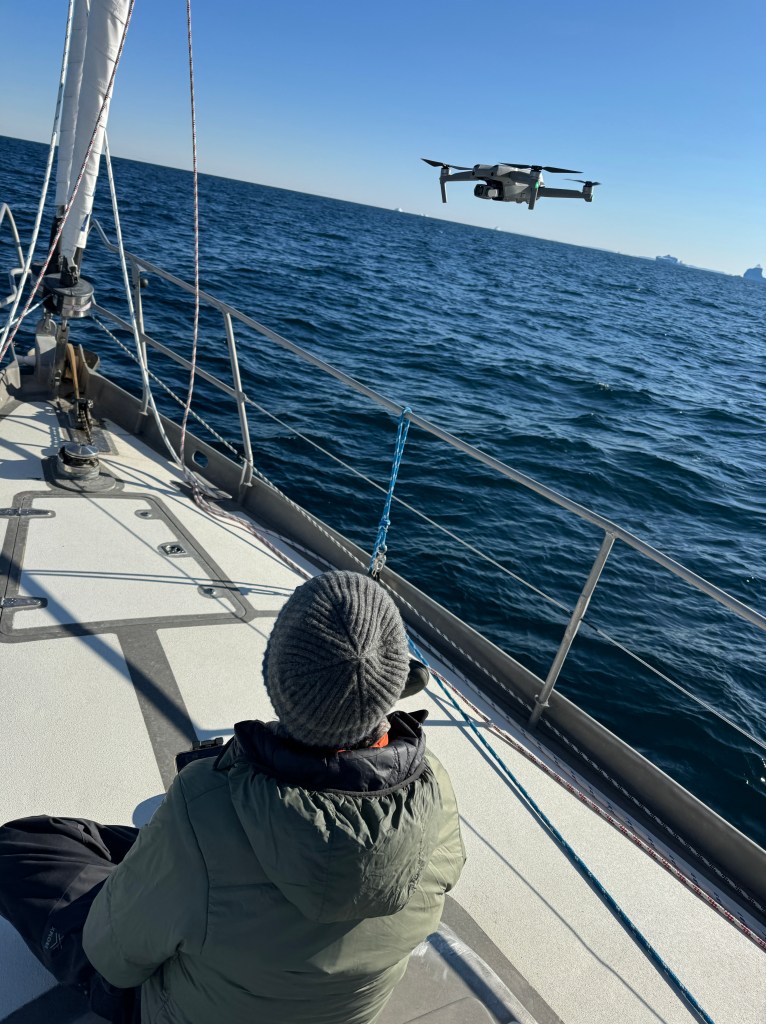
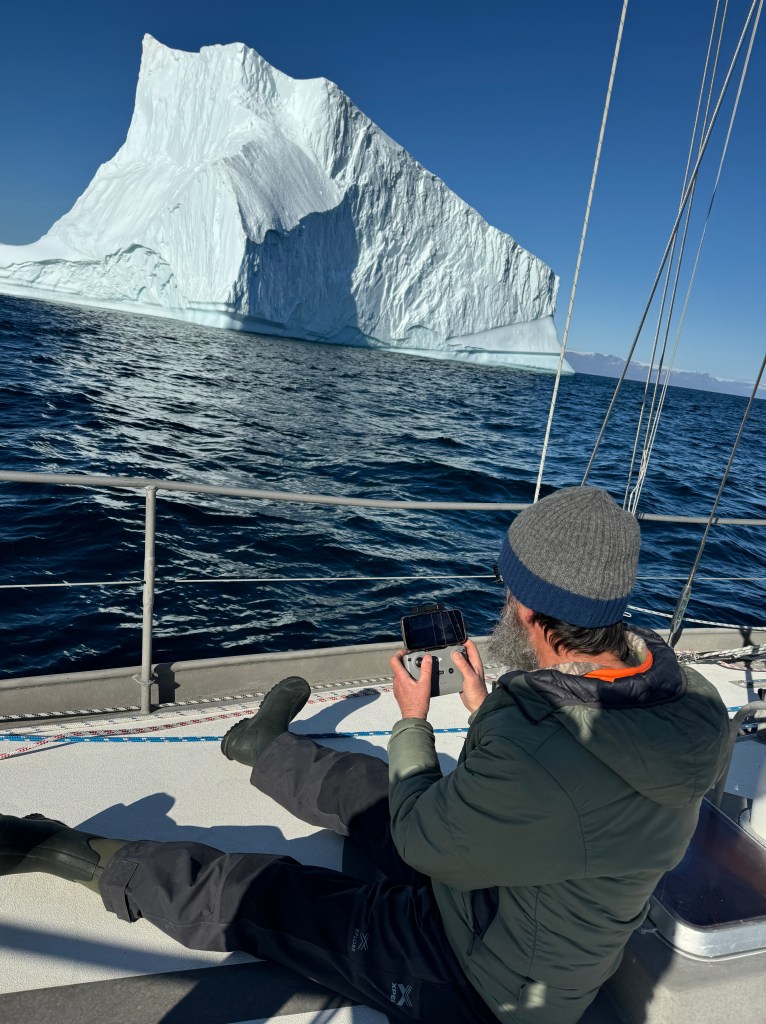
We departed Godhavn the next morning and decided to spend a bit of time exploring the giant Greenland icebergs. Our drone had been sitting dormant and we decided that now was the time to bring it out and do some fly-by’s. Randall did an excellent job assembling and flying the drone over and around the icebergs. I watched over his shoulder at the incredible footage he was assembling. But I am sorry to report that on its return to the boat at the side of the iceberg and in front of Randall, the drone hit the water and promptly sunk (with the SIM card!). Well, it was fun while it lasted. Goodby drone.

I found it fascinating that the foot of these icebergs were formed like the bow of a large ship. My theory is that these particular icebergs are so large that they are actually sitting on the ocean floor below. As they are not moving, they are subject to tides and currents that form the shape of the “bow” of the iceberg. If anyone has another theory, please let us know.
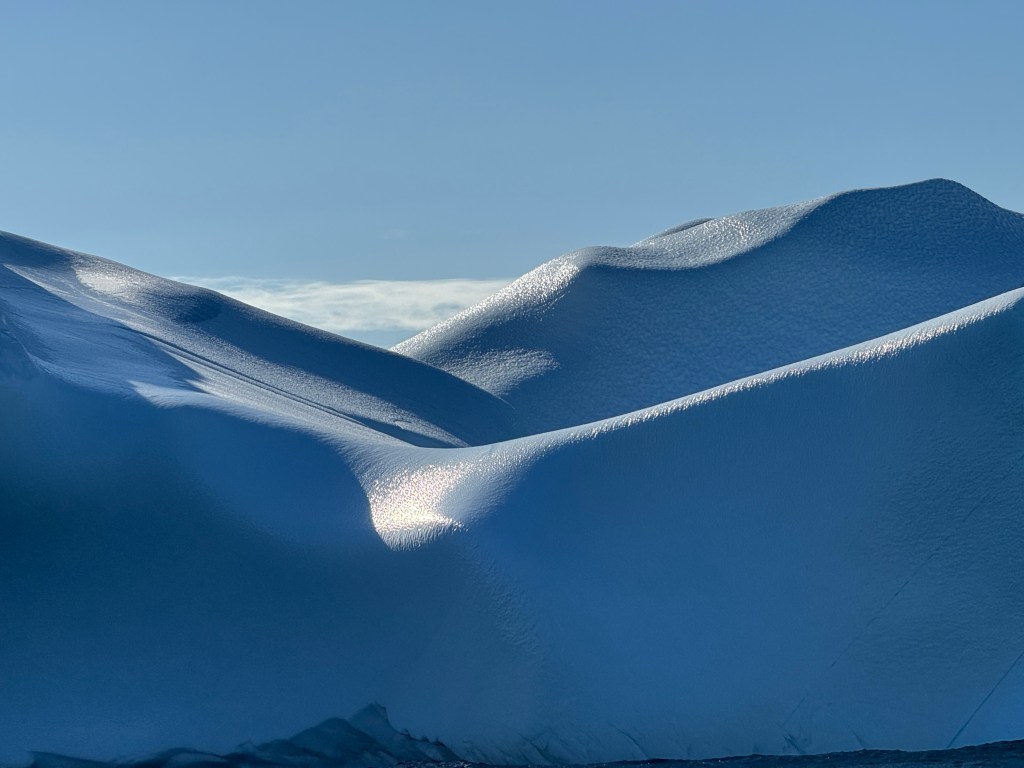
Above is the top of a large iceberg. Seen from this angle, it is an optical illusion that looks like a distant frozen mountain range. I found the curves to be soft and sensual (I have been away from my wife for a long time!)
A rare interview with Randall about icebergs and geography. See you next blog as we complete Greenland.


 Harmon and Randall's Voyage...
Leave a reply to tcgibb Cancel reply