St John’s Azores Leg
Day 2
Tuesday, June 17
Noon Position: 47 45.3N 45 48.6W
Course: E with a touch of S
Wind: SW 10 – 14
Noon Miles: 147
Total Miles: 297
A day at sea, as you can tell from the above, is from one noon to the next. This reflects a natural order that only-landed folk have long forgotten. Let this serve as your reminder. As such, daily mileage is also counted off by noons. These are local noons, and thus on a passage crossing so many meridians, not all days will be exactly 24 hours. At the moment, ship time is still Newfoundland Time, mostly because we can’t tell the difference by glancing at the sky. By rights we should have lost the half hour that is the island’s curiosity and moved immediately to +3UTC. We haven’t yet.
All is well aboard. We motor sailed much of the night in winds of 8 – 11 on starboard quarter, a poor angle for Mo in any case. Then at sunup (4:45am) we moved to a full main and full jib in slightly brisker conditions. The day is a bit warmer, which is appreciated. Sea temp has risen from 36 to 41 degrees, and the sky is consistently clear so the sun can do its work. The cabin was 58 at noon.
This is the second day of only easting. So much of it is required now because below us is the center of a high pressure system, whose promise to the sailor is even less wind than here. Our wind flows east and then southeast and increases tomorrow as the high below us is gently squeezed by a small high to the north. So tomorrow should be faster than today.
I have found that in light conditions on the quarter, the best thing on Mo is fly everything you have. At the moment we have the large genoa free to leeward and the smaller genoa poled to windward; the main is as high in the air as it can go and the cover cradle has been lowered to increase its sail area by (a guess) ten percent. Of course, this is a scandal and an abomination and nothing to write home about; that said, it does help to move the boat!
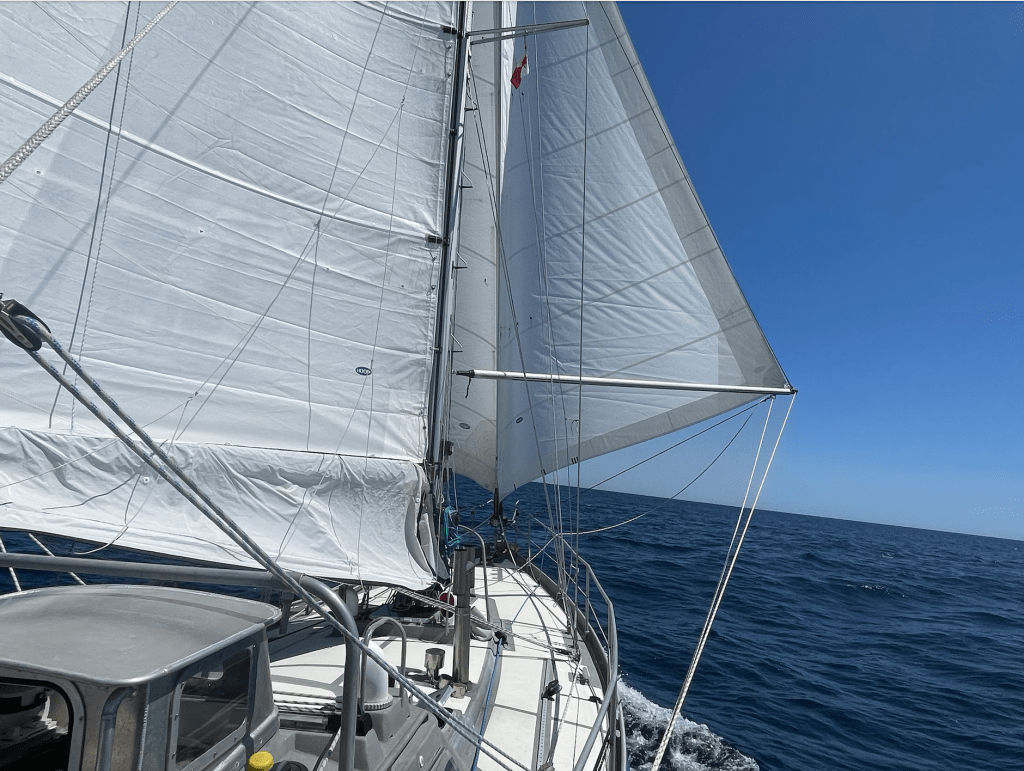
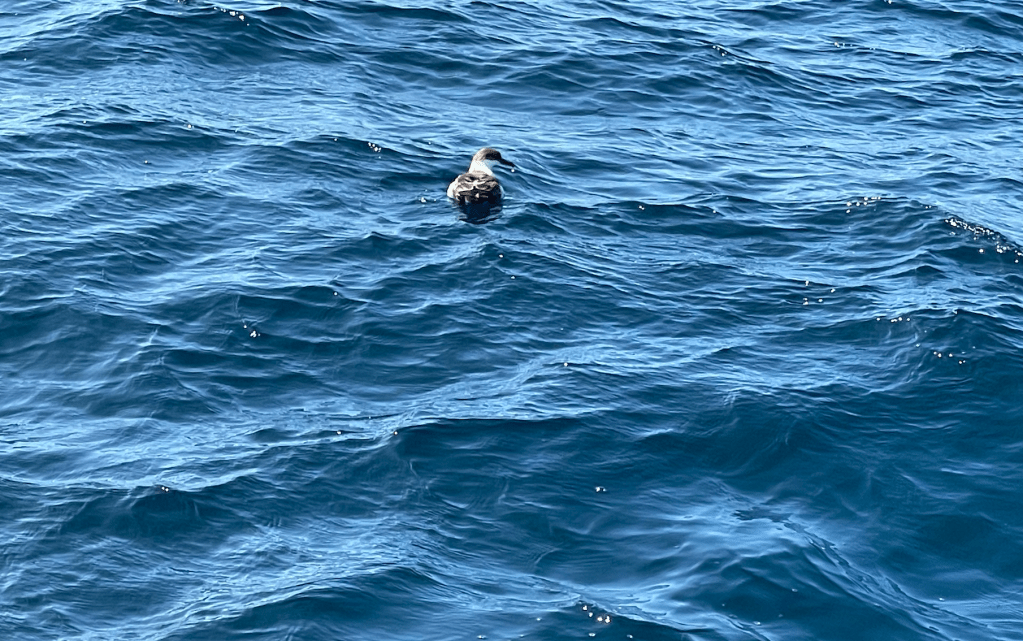
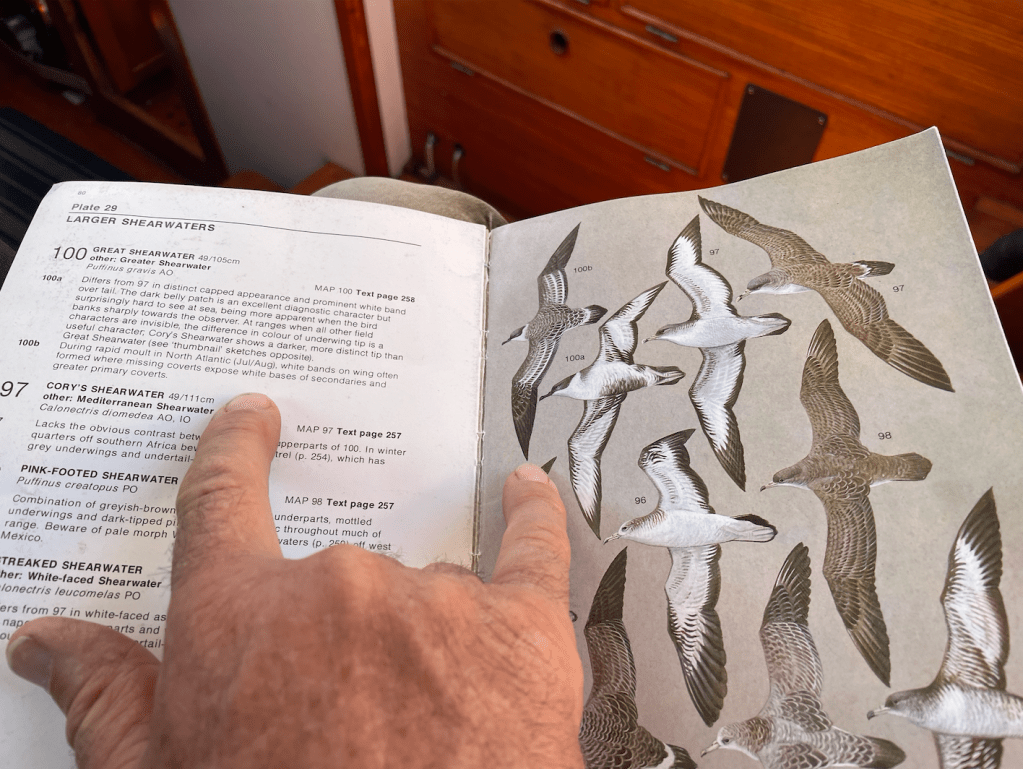
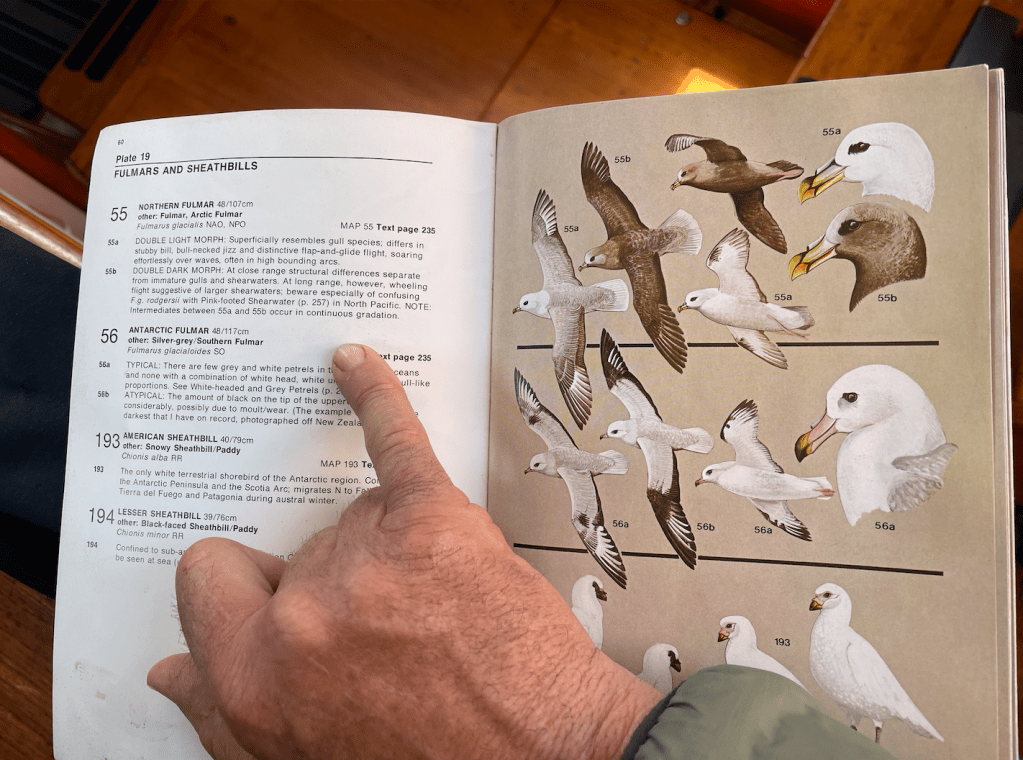
Though still over the banks, we are by now well and truly at sea. If by no other sign, this transition to “at-seaness” is known because the bird life on offer has transitioned from Gulls, Cormorants, and Gannets in Conception Bay to Murres, Puffins and Gannets near coast to Murres, Northern Fulmars, Storm Petrels and Great Shearwaters offshore. As I type, the community is mostly Northern Fulmars, say 10 to 30 in sight at any one time, with the occasional Great Shearwater. These are true pelagics both, who know of land only as a hard spot on the water used once yearly for procreation, and this solely because no bird has yet figured out how to nest an egg on either water or wing.
The fulmars fly by and around the boat then plop on the waves and watch as we pass. Then they do it again, as if to say Mo is the strangest thing they’ve seen since the great flood. Or Mo divides a small gatherings discussing the day’s events at water-top; some of these flush into the sky and some waddle furiously away duck-wise. It is odd to notice in these encounters a common pattern: whether we interrupt a coffee clutch or a bird is approaching by air, each bird finds himself, too late, startled at the sudden entry into his world of this big, gray behemoth. A floating bird will panic as Mo approaches a boat length; a flying bird will radically alter course at a similar distance as if utterly gobsmacked to find a sail in its way, as if he had not seen Mo until the last second, even though she’s the only thing to see for miles. This leads one to surmise that sea birds are nearsighted. They are surprised because they, in fact, have just seen us! And why not? In a world that is endless water, there is little advantage to distance vision.
On the banks are numerous whale pods, seen to blow and fluke but always at distance. Similarly, pods of fat, black porpoises sometimes approach but then refuse to play in Mo’s admittedly minimal bow wave.
So it goes for animal life thus far. Animals above and below go where the food is, and over the Grand Banks it must be plentiful. I’m guessing that a day or two from now our wildlife sightings will diminish appreciably.


Leave a Reply