Rolling Explained–Randall

Madeira Cape Verde Leg

Day 6

Saturday, July 12

Noon Position: 19 22.0N 22 21.3

Course/Speed: SW6

Wind: NE 15

Sail: Both headsails poled out full, wing and wing

Noon Miles: 147

Total Miles: 877
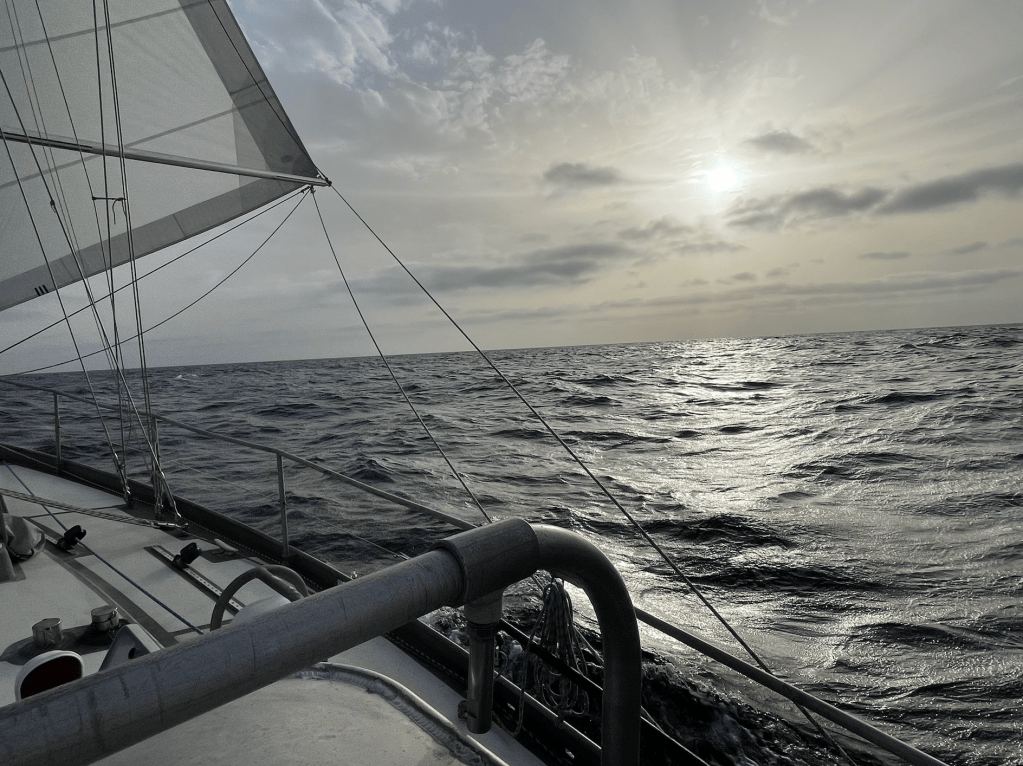
It has come to our attention that certain of the crew were dismayed by the jostling they got in their bunks in the wee hours of last night and are blaming such on the trade winds in the Atlantic. Here’s what really happened.

Overnight wind pulled into the N and created a tough situation for the sailor—the need to change his suit of sail when he doesn’t want to. Running under two poled out genoas has many advantages but distinct disadvantages: 1) it’s complicated to loft, gybe and lower the set; 2) it has a narrow operating wind angle. If the wind comes too far left or right of dead aft, the sails become uncomfortable, won’t fill properly, shiver themselves and the boat and generally behave like two bed sheets on a drying line.

The problem is that changing them is long process (30 minutes if alone, say, to gybe—change one for the other) and it was night and we were tired. So, I compromised; we shortening the windward sail and stiffening the lee.

The effect in the latter case was that it became flat as a board. A billowy headsail acts like a catcher’s mitt, accepting the wind and keeping it there for a time before releasing it to its wild ways and in this way stabilizes the boat. A stiffened sail is more like a kite, pushed back and forth in the boisterous breezes and the boat with it.

In short, my tactic plus a mature trade wind sea produced the rolliest of rolly nights I’ve yet experienced and nearly sent the crew in search of other boats and skippers who knew what the heck they were doing.

Luckily around midnight, wind came back to NE and Mo the Mechanical Bull ride machine ran out of quarters.

Today was pretty quiet. Did a bit make and mend.
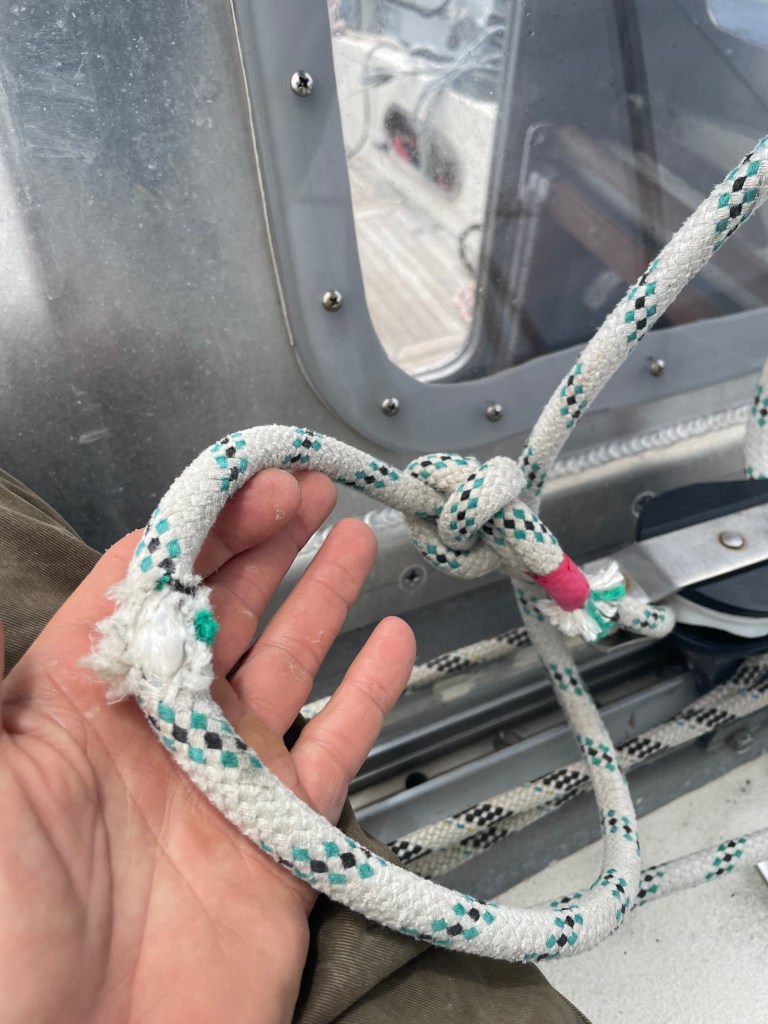
Repaired a frayed bit of main sheet.
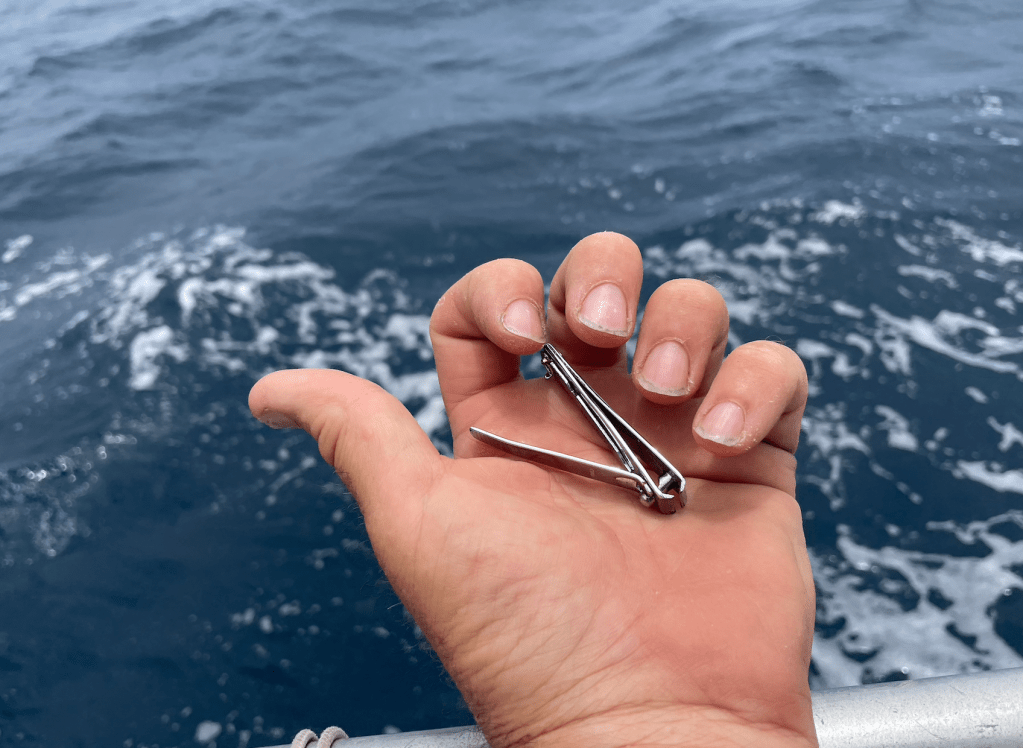
And clipped my nails. You know you’ve been at sea a while when the last time you clipped your nails you were also at sea.

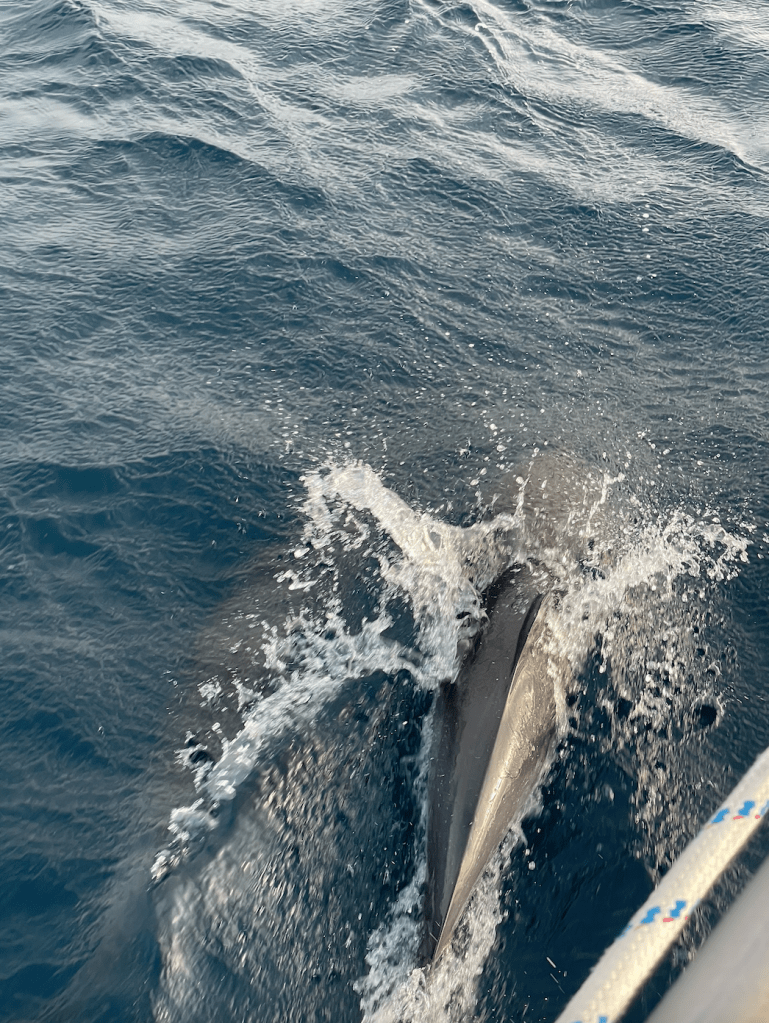
If I didn’t know it, I might suspect there are islands nearby, in this case Cape Verde 157 miles to the south. Bird sightings have begun to increase—a few storm petrels, for example, even a few together. And late, a large herd of dolphin lolloped by for a play in Mo’s bow.  
10 responses to “Rolling Explained–Randall”

  1. contrary to what I told the whining crew I am going to say that he should be relegated to sleep in the anchor locker…..

    Like

  2. keep up the good work – you’re making great miles

    Like

  3. inventivesublime2bdf311d23 Avatar
    inventivesublime2bdf311d23

    Request for large dolphin pod videos any time you feel like taking and posting them!

    Thanks,

    Beth

    Rabbi Beth Singer Retired!

    Like

  4. anthonyvlasto Avatar
    anthonyvlasto

    Ah all is now clear – there is always an explanation. A bit of temporary discomfort beats trying to do a difficult sail change when overtired any day – good call!

    Fabulous dolphins.

    Like

  5. Can you expand on the wind angles that the two poled genoas can handle? I’ve been looking to make this change (we have a more traditional single pole), and I was thinking it would be suitable all the way to at least 140° and was actually hoping it could do even better than that.

    Like

    1. On MO, the best I can get is about 30 degrees (all mention of degrees is apparent) each side of dead astern, so 150 degrees. There are several factors to consider when trying to carry wind on the quarter with poled out headsails. 1. With both sails at the bow, moving the wind much forward of 30 degrees of dead astern begins to unbalance the boat. There’s too much pressure forward, and the boat starts to feel weird. 2. On Mo, the two genoas are of differing sizes. While the large sail can be sheeted/poled in more tightly on the lee side than the small sail, as the wind moves forward, the pole will be on the forward shrouds before you’ve got the sail shape you need. If you’ve made the mistake of poling out the smaller genoa to leeward (as I did on the last leg), then the issues is that it is too small to pole too far aft without going completely flat. At flat, it does not fill properly and actually adds considerably to rolling. 3. This is not all bad. As the wind moves forward, I switch from poled out genoas to main to lee and a genoa poled to windward. This is an easy transition and you notice a return to balance immediately by way of a) less rolling; b) less tiller; c) more speed, maybe a lot because the main is ideal for quartering and the genoa is poled out into perfectly fresh air. This can be carried, if you have to, nearly to wind abeam but, again, begins to be wonky much forward of 110 or 120 degrees, by which time one can run the genoa free to lee. If the wind is moving forward or you need to change course such, the above transitions are easy/natural. That help? Feel free to ask. Did you see I responded to your previous comment re Uruguay? Best, RR

      Like

      1. NATHANIEL MONTAGUE Avatar
        NATHANIEL MONTAGUE

        Yes, thank you, that is exactly the helpful information that I was looking for.

        Apologies for my lack of response about Uruguay. We were just about to weigh anchor for our sail down to Florianópolis when I saw your reply. Poppycock will arrive in Uruguay some time in early August, weather permitting–I’m pretty cautious with the wx windows these days since the little ones take a lot of energy and sleep from the crew while at sea (and at all other times!). We have some work we want to do on Poppycock before we start moving South again so we will be in Uruguay for quite a bit of time, most likely Piriapolis. By the time you arrive, we’ll already have the 411 on all the best hardware stores and coffee shops–all the most important places in any port.

        Cheers,

        Nathaniel

        SV Poppycock

        Like

  6. don’t suppose you would be willing to show how you repaired that bit of rope? I have a halyard that needs similar attention.

    Like

  7. oh, and by the way, loving these notes from Moli. Thank you. Reasons for not doing all that work changing the sail trim? Sounds reasonable to me. And isn’t it generally understood to be miserable sleeping in the vberth? Poor Harmon. Yet he smiles. Obviously a sweet natured boy.

    Like

    1. Hey there Jacqueline… That wear spot was near the end of the run of line, so I simply cut it out. Sorry not to have a snazzy technique to share. Other wear spots I often wrap in electricians or sail tape. Post sand blasting the deck, it’s quite abrasive in spots and so I’m chasing a fair bit of wear at the moment. Harmon likes to say that on Clipper boats they’d whip the wear spots, but he’s not reached for the bosun bag as yet… 😉

      Like

Leave a reply to strongmonty Cancel reply