Madeira Cape Verde Leg
Day 7
Saturday, July 13
Noon Position: 17 28.8N 24 15.2W
Course/Speed: SW 6
Wind: NE 15
Sail: A quartering set of sail with main full to lee and poled out #2 to windward
Noon Miles: 157
Total Miles: 1034
We are five days in Mindelo now, thus the below is a catch-up post that gets the story safely to harbor.
Under the heading “Recompense of the Absent Mind ”, the following:
A steady, moderate trade all the way into port was declared by both GFS and ECMWF, and as we had been living and breathing the same for days, I was lulled into inattention. I just didn’t stop to think (remember, rather) that a wind, as it moves between two land masses, accelerates. The channels between the Hawaiian Islands are good examples, where an 18-knot trade can become 25+ in the gut with a tumbling sea added to the background ocean swell. It is also why, in much lighter winds, I had recently shaped our course through not around the Canaries.
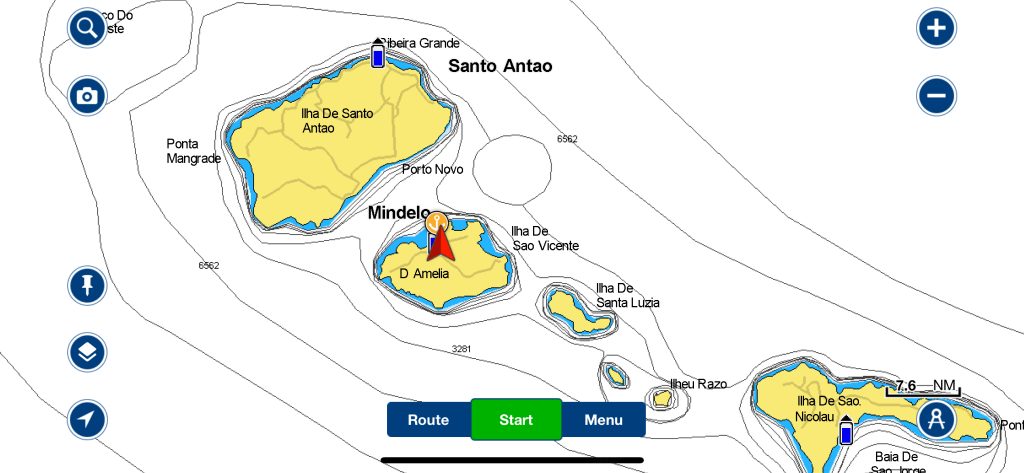
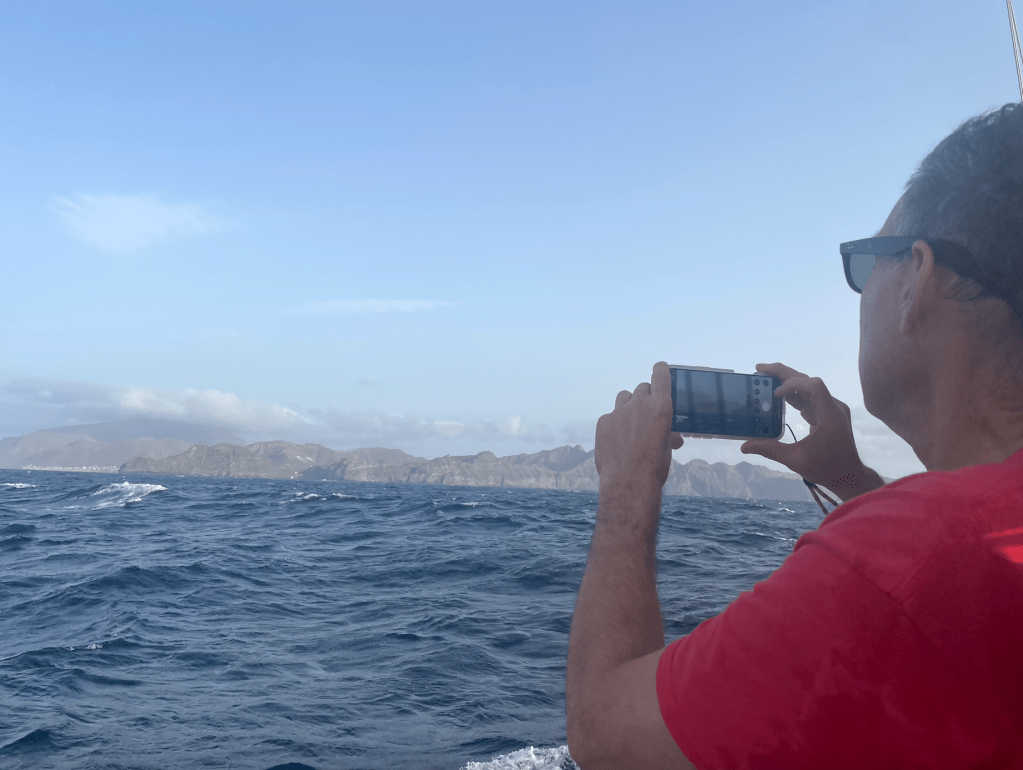
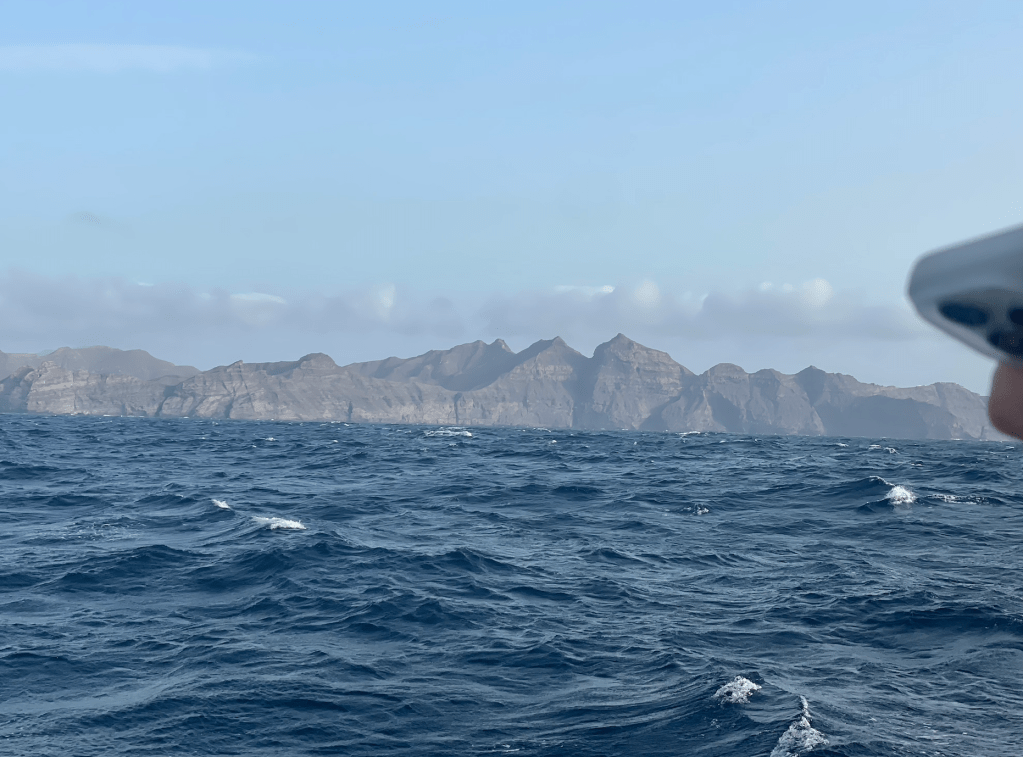
And so it was here on the approach. Fresher and fresher until we were gyrating in heavy, white capped heavers in 30 knots and still with full sail set for a following wind and all the hatches open. The jib and pole were easily dealt with, but just as we came to the entrance rock, Ilheu dos Passaros, I had Harmon dash forward to douse the main as I rounded us into the wind, at which point Mo chose to take a sea over the bow, some portion of which flowed with the grace of gravity into the cabin. Randall. Just. Not. Thinking. That’s what a steady, day-on-day trade will do to you.
The water was easy to mop up and soon we were under the protection of the harbor entrance.
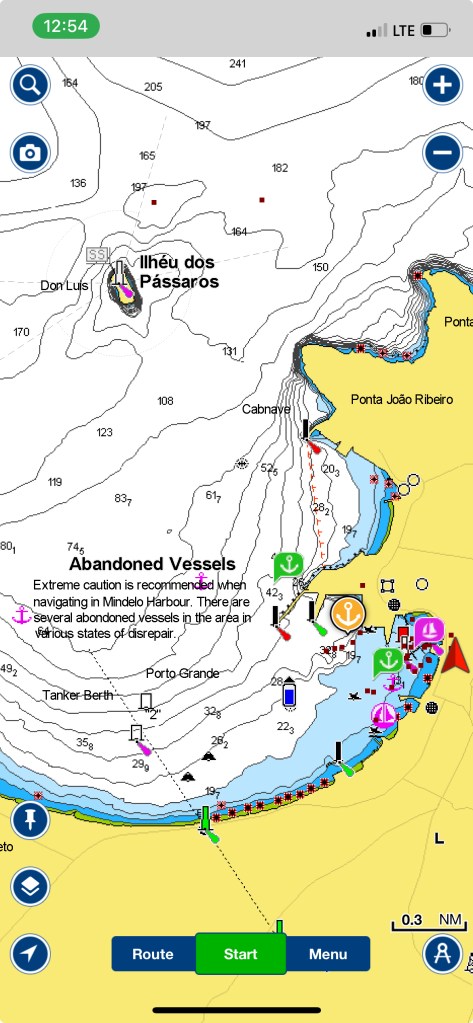
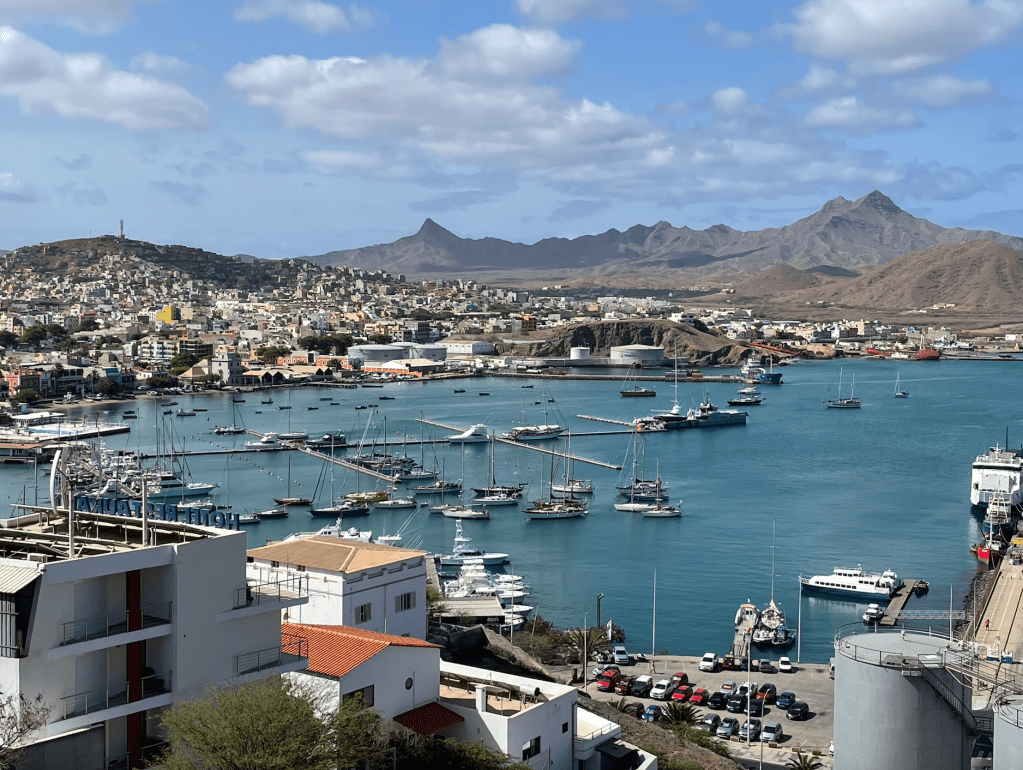
Here the chart warns of “abandoned vessels in various states of disrepair,” which is generous. “Numerous exposed wrecks” would be more to the point. A large fishing boat submerged to the bridge deck, a ship turned turtle, becoming an oblong, steel beach where none should be, others only apparently floating and only because there was nothing better to do, none marked; all made me glad we’d seen fit to arrive during daylight.
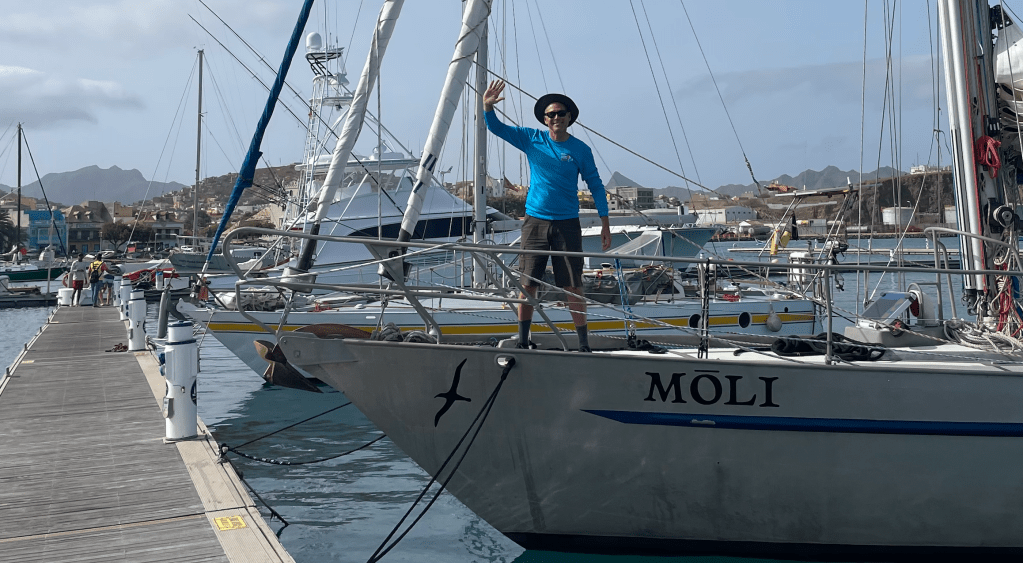
The next challenge was the marina, large as two football fields and nearly empty. It is unusual in that it is fixed in place with anchor and chain rather than pile driven posts, and with the ample surge rounding in off the ocean, its fingers move like tree limbs in the breeze. On our approach, two guys rushed down to take lines and help us Med moor stern to. Have I mentioned?—I’ve never done that—my native soil is the Pacific, where we don’t. Not to mention that Mo backs down with what what naval architects might call directional instability. And wind was 20 knots with a target behaving like a wind sock. There are other excuses to be made if you are interested. Instead I went side tie to the fuel dock for the night and by morning had lost two mooring lines to the chafing snap and twang of the surge.
The landing was otherwise unremarkable.
Madeira to Cape Verde
Miles: 1089
Time: 7 days, 7 hours
Average miles/day: 148
Engine hours: 54
There are purists among us who will lament our use of the engine on these legs, to the tune of 190 hours since St John’s. To these I will say 1) it’s been a light wind year and we have miles and miles to go and 2) fortunately, no purists are aboard.
The next leg will be the biggie of the summer—Cape Verde to Piriapolus, Uruguay, non-stop. About 4,000 miles. We will again spend at least a third of this in trade winds, but of note is that they are on the nose this time. Hatches closed. Poor Harmon is desperately in search of interstitial islands at which we might call so as to break up the days.


 Harmon and Randall's Voyage...
Leave a reply to NATHANIEL MONTAGUE Cancel reply