
Cape Verde to (somewhere in) South America
Day 10
Aug 3
Noon Position: 01 30.4S <– 30 40.5W
Course: SSW 6.3
Wind: ESE 16
Noon miles: 150
Total Miles: 1319
For all my complaining, we found our wind and were able, at noon on Aug 2, to slide under the lee of St Peter and Paul Rocks. I pinched Mo terribly, but our approach never came closer than 14 miles, and so for this, my second passing, their alien wonder remained below the horizon.
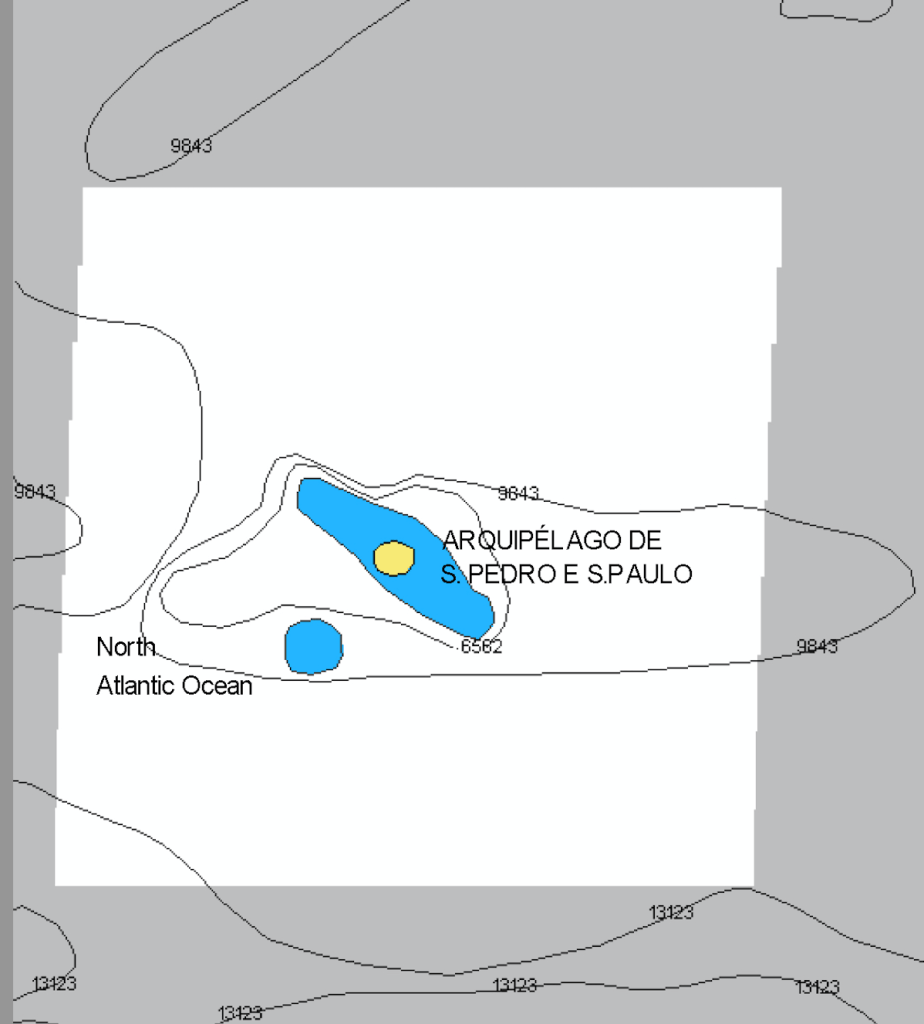
Wind continues to back slightly, averaging more 120 degrees than 130, sometimes dipping even into the teens. This should allow us to ease our course for the island of Fernando de Noronha a bit, but I don’t… Why give up ground so hard won?
—
“Where are the doldrums?” asked Harmon, with palms up and an expression on his face that suggested, “I’ve looked everywhere.”
It’s a good question.
I tend to think of the doldrums as a fairly narrow band of light and variable winds just N of the equator. The technical term for this area is The Intertropical Convergence Zone, commonly shortened to ITCZ. Here the two (northern and southern) trade wind belts converge, their air mixing, becoming unstable and rising toward heaven in great thunderclouds. At altitude, these winds then travel pole-ward, where they sink back to the surface and begin their equatorial migration anew. So, in fact, there is plenty of wind in the doldrums…it’s just moving straight up into the sky as it reaches this mid-planet hinge in the global wind circulation system.
But still, in my experience, the band is typically rather narrow and clearly defined. Steady wind to light and variable to steady wind. Initially I had thought we had crossed into the southern trades a few blog posts back when I described our rough passage through a large squall complex. After we punched through this, winds went due S and stayed there, even had a fresh dry sense to them.
But this was naivete. For days weather has remained unstable, here an open sky, there squall infested; winds light and muggy to strong and fresh, but never consistent, never quite in our favor, never enough E of S to allow anything but pounding close hauled and often in the wrong direction.
Then late on August 2, we began to pick up mammoth squalls again, first one here and one there, and then they became regular as punctuation, and finally as the sun set, we entered a squall system that spanned from horizon to horizon. Low black cloud, wind to 25 knots with pelting rain; then dead calm; then more heavy rain and another burst of wind.
(During this episode we crossed the line, zero degrees latitude, into the southern hemisphere.)
This massive system continued with us until close to midnight. When I came on deck, the sky had lifted; I could pick up a pale moon through high stratus. Later some cloud break. And the wind was again steady, now from the SE.
By the next day, the sky was empty; wind has remained steady and fresh. The sea is an electric sapphire blue with crashing white peaks. It looks like it could go on like this forever…
So, now I think the doldrums are not so tightly defined. That in the eastern Atlantic, at least, the area of confused airs can be quite large, and that in our case, our passage through the doldrums took 10 degrees of latitude and was bookended by our passage through these two, huge squall complexes.


 Harmon and Randall's Voyage...
Leave a reply to anthonyvlasto Cancel reply