Fernando de Noronha to Rio de Janeiro
Day 3
Aug 9
Noon Position: 10 04.1S 34 10.9W
Course: SSW 6.5
Wind: ESE 12
Noon miles: 142
Total Miles: 491
The authorities at Fernando were kind enough to allow us to fill fuel by dinghy and Jerrycan and, next day, to make a quick run to the market. Beyond that there was no compromise, and as neither of us were willing to be hulk prisoners for an unknown number of days while our visas processed, we departed at noon on the 6th.*
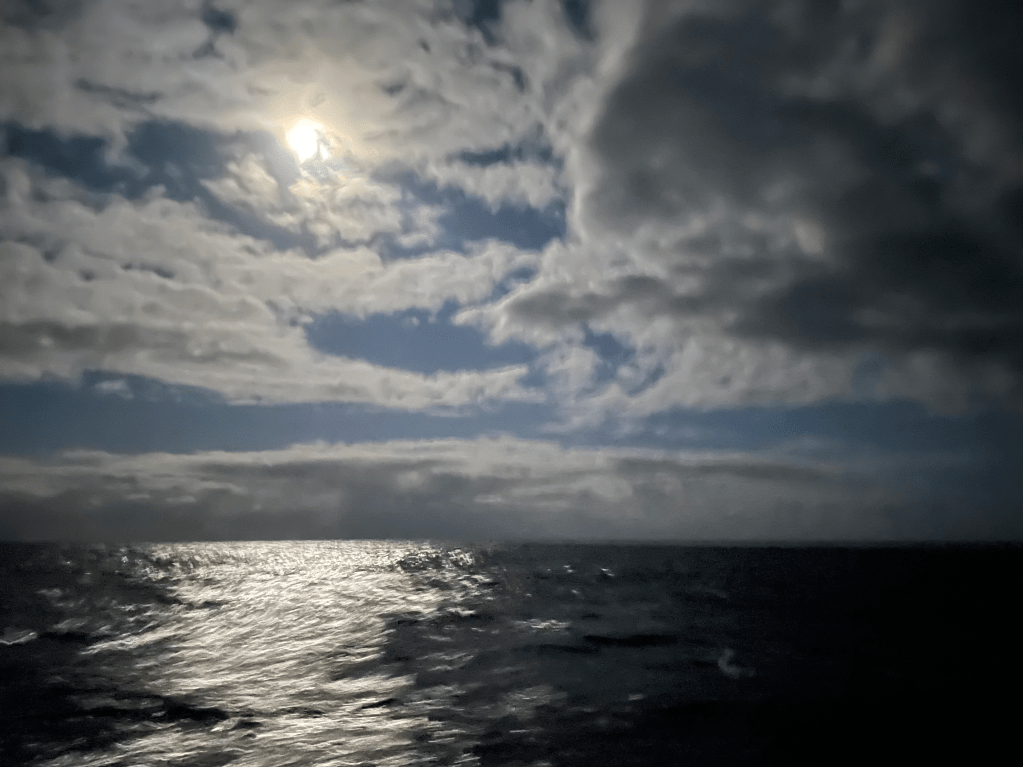
Weather upon departure was equally uncompromising. Our stay at anchor had been sunshine and wind. Now wind we had but from a chaos of squalls it would be impossible to describe. If one wonders why I make such a big deal of a little (or big) rain cloud, please allow me to say that the problem with squalls is that they monkey with the wind direction and velocity, taking it from its steady state, say 12 knots, to 25+ at the leading edge to 5 at the backside and back to 12 until the next one hits. When squalls come in complexes, one on top of the other, as here, that pattern continues, but is jumbled and there is less time between the repetitions. Sometimes it’s just one wham bang after another.
When Mo is on the wind, the difference between 12 and 25 is either slapping in two reefs or spilling the main until she thunders. Also, the Monitor needs re-tuning at each wind change. These changes call for active engagement, hour over hour, while the boat heaves and bucks her way upwind. It’s all well short of gale conditions, of course, but it’s still constant work throughout the day with few substantial breaks.
Two days in, conditions have eased, but are especially fitful in the late afternoon and into the early morning. By late afternoon, the sun’s heat has started the squall cycle even in a clear sky, and that heat energy can take the first half of the night to dissipate.
So it goes. We chose sailing after all—so bully for us.
—
The goal now is Rio de Janiero, 1000 miles as of noon today. Winds continue to be light and fitful, so figure at least a week.
On the very happy side, it is starting to cool a bit. Overnight temperatures in the cabin were down to 75 degrees. I had thoughts of reaching for a blanket.
—
It struck me today as I was watching the water go by that an ocean passage exposes one to very little geology. Right out of the box, this observation may strike one as being on the silly side of obvious. But compare an ocean passage to what you get from a drive across the US on I80, for example.
Heading east from the Pacific, you are taken first through the soft coastal mountains and then into the great granitic Sierras, which drop into the basin and range sequences of Nevada and parts of Wyoming, thence into the nearly endless plains, onward to the Appalachians** and finally to the Atlantic. And at wonderfully frequent intervals you pass road cuts revealing here the sedimentation of ages past or volcanic flow from the deep down-under, and still further maybe even hints of the slipping and faulting of massive structures. And all these views of rock in its various states speak to one thing: time’s effect on rock. To put it another way, rock is a record of time.
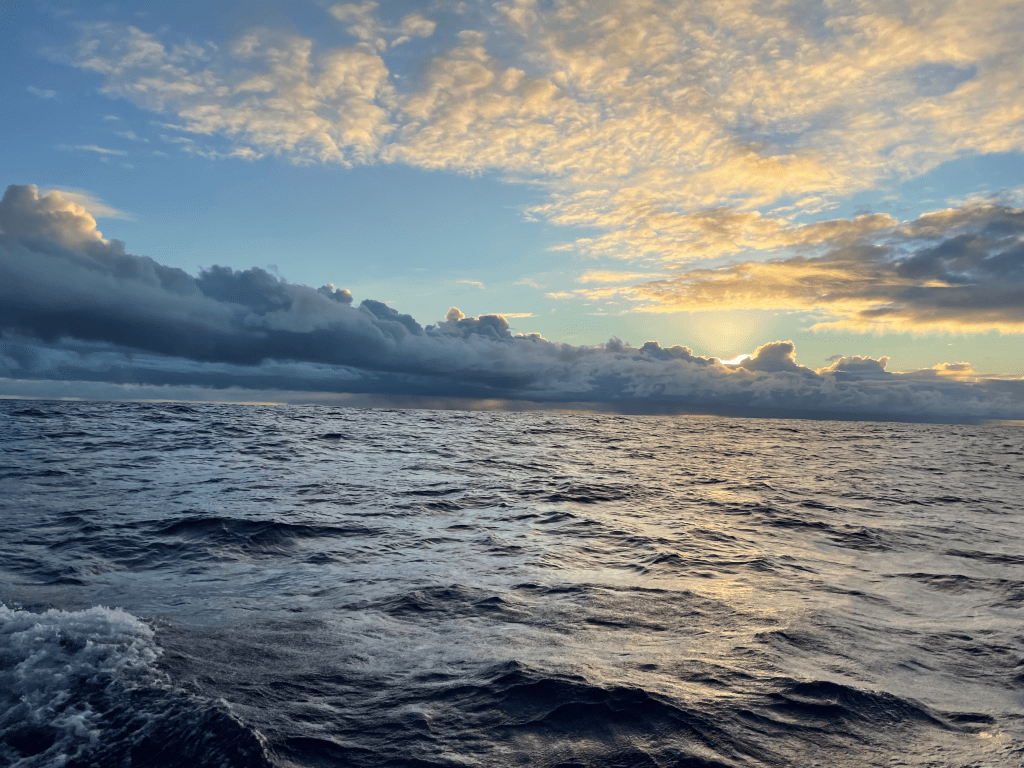
The ocean offers you no such opportunity to get at time. There is nothing in what I’ve seen of waves today that suggest a relationship with the last year, the last century, any eon past. It’s all just water, stunningly blue to black, variously perturbed, always predictably positioned below sun, moon, and cloud. There is, thus, no geology of the ocean, no way of scooping at random a cup of sea surface and inferring from it a previous age as any petrologist could do with most any rock he finds.
Is it this constant, immediate change as waves and currents sweep the globe combined with its timelessness that makes the ocean so attractive?
—
*As fate would have it, our visas were approved a few hours after we departed.
**I spelled this Appellations in the first post. 🙂 More on my spelling abilities anon.


 Harmon and Randall's Voyage...
Leave a reply to jolly6898 Cancel reply