On Flying Fish–Randall

Fernando de Noronha to Rio de Janeiro

Day 6

Aug 11

Noon Position: 14 59.9S  35 12.9W

Course: WSW 6

Wind: ENE 8

Noon miles: 151

Total Miles: 792

Fernando de Noronha to Rio de Janeiro
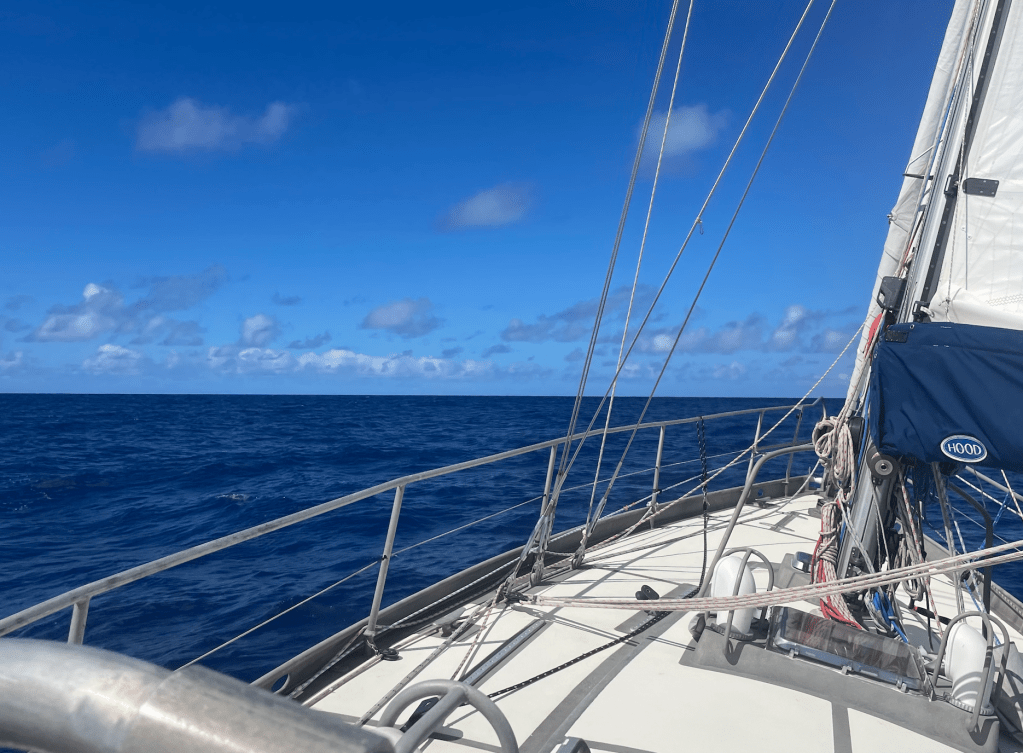
Added to the imaginary list of “Things that shall ever remain unknown”, the following: what is the longest ever flying fish flight? I will never know the answer. That fact does not submerge curiosity, however, and for hours I have counted as the fishes scatter before that predatious, black bottomed monster we know fondly as Mo. The fry and the awkward often T-bone the next wave with a cannon ball splash or manage a panicked cartwheel or two before collapsing back into their native element. But the older, larger, smarter, stronger fish can really sail.

Typically, they leap from a trough and power up the slope of a rolling sea. Then they go airborne, soaring across the next trough, banking slightly, reaching the top of the next wave where they dig the lower half of their tale into the water and accelerate anew. Out across the next trough and to the next wave head; drop in the outboard motor and off again. Four repetitions of about 15 seconds is the longest flight I’ve recorded, but surely there are longer. In fact, given an explorer’s temperament, a skilled fish could go for as long as he could hold his breath, the limiting factor being that a flying fish is, after all, a fish out of water.

They are few now, the flying fish. None in the scuppers for days, no silvery herds flushing into the sky in simultaneous, harmonized fright. Mostly the ones I see these days are the solitary bulls, the big, old birds—the loners—who’ve pushed to the outer edges of their territory in search of what I do not know. Maybe it’s something as simple as something more…

Speaking of birds, we’ve seen none since soon after Fernando. Not a one. And Sargasso weed dried up long before that lovely island. Lacking the above, we are bereft of neighbors, save for one family of dolphins that raced in Mo’s wake last evening.

Dolphins and ships. Ships we have with us every hour, headed in every direction and of every kind. Unlike Mo or her flying companions, a ship seems to proceed with a weight of deliberation worthy of the heavier planets. We pass them in silence, these heavenly bodies, officers of the watch not being a chatty bunch, and we mimic their reserve out of respect. Theirs is a profession, a serious matter; we are just here for fun. Their slow bulk on the horizon belies their speed; as they pass we watch in envy their 11 – 17 knots, their high bridge decks that get them away from the sound and smell of the engine, and their air-conditioned cabins. Oh, what we would give for an air-conditioned cabin!

For we are motoring now and in dead calm and the heat is upon us. It’s 91 degrees in the cabin. After two days (in current coin, riches beyond measure) of sweet, steady, tradewind sailing, we are passing through a windless section between weather systems at 6.5 knots and on a course of 200t. We will motor through this blue blob of stationary airs until noon tomorrow according to the forecast.

Fingers crossed on that one…
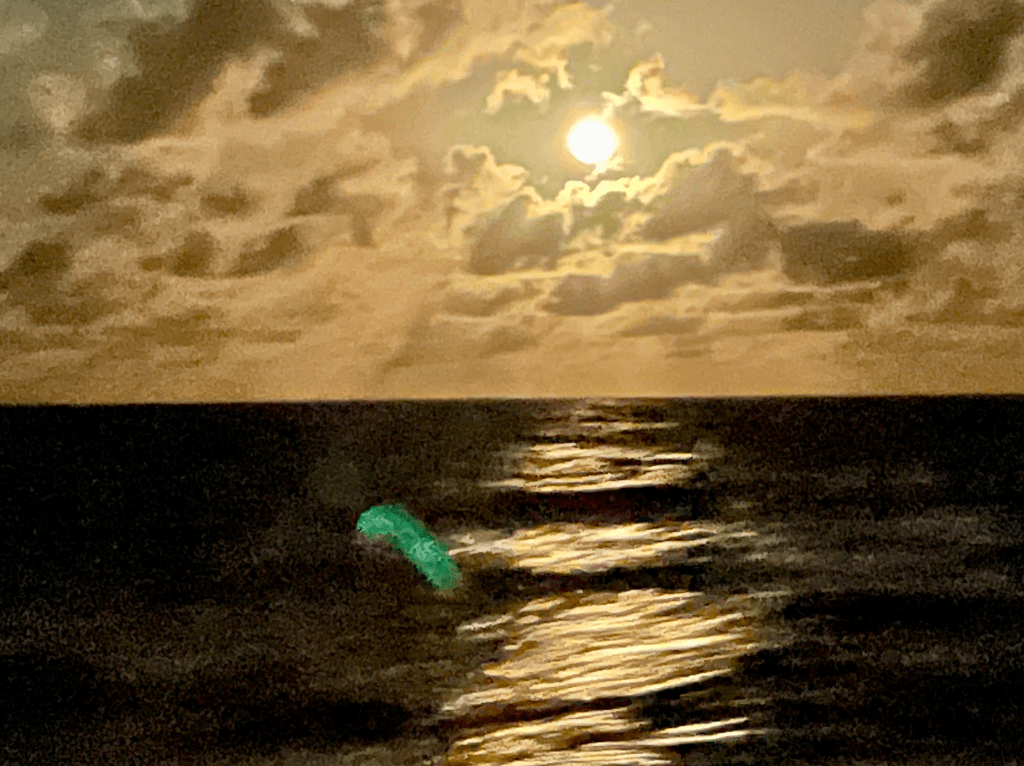
Moonrise. Painterly, I think. Because of the long shutter time. Can’t figure how to remove the green flash.
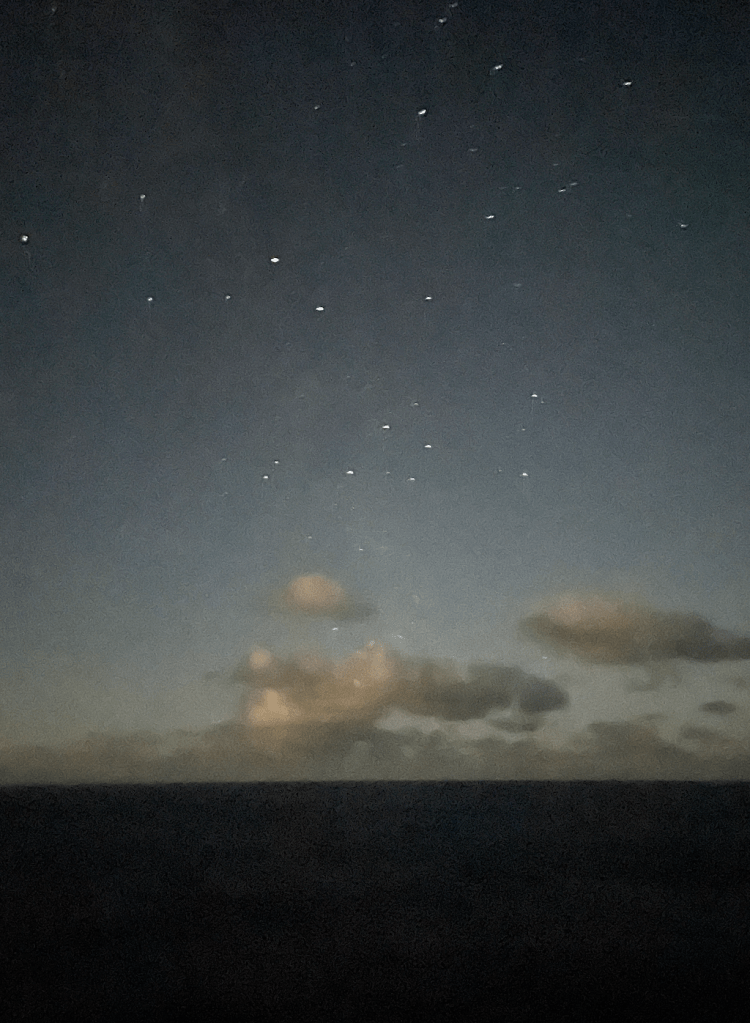
Southern Cross.

6 responses to “On Flying Fish–Randall”

  1. I’ve often watched the fish fly astounding distances between waves and wondered if there is any acknowledgment of a particularly good or long flight. No celebratory spiking of the football in the end zone moments, theres no time for that with predators on the prowl. But perhaps a self congratulatory “Yesss!” or a whip of a tail to a nearby companion to say, “Did you see that!?!” Which then inevitably brings up the question in my mind… “nearby companion? How do they make their way back to school when they’re all flying off in different directions at the slightest sign of danger?

    Clearly at sea there’s time to contemplate the mysteries of flying fish and many questions yet to be answered.

    May you and Mo find wind soon.

    Ben

    Like

    1. Funny, I too have wondered how they regroup after such long, disparate flights. No idea. Add that one to the list. Nice to hear from you, Ben.

      Like

  2. I echo the last comment about finding wind.

    Thank you for another excellent offering – you have writing skills to match your sailing ones.

    Like

  3. Thanks Randall and Harmon for taking the time to share your terrific expedition. I’ve been following your story since Alaska and enjoy every new report. The flying fish description reminded me of a question I’ve been meaning to ask you. As you will recall in Thor Heyerdahl’s book Kontiki, when they found flying fish on board in the morning they would soon become frying fish for breakfast. My question is when you are motoring along at 6.5 knots or so do you ever troll a line for fresh fish? The dolphin fish (dorado) are a common catch as are various members of the tuna family.

    I wish you all the best for full sails with fair winds, Peter

    Like

    1. Hey Peter, that is the most common question we get regarding these cruises and an oddly difficult one to answer well. The short answer is no, but the long is akin to Franklin’s own musings on this question…

      On my first cruise, a circumnavigation of the eastern Pacific in 2010-12, I fished frequently and caught frequently. It was a solo venture on a small boat, and I found one of my main frustrations with this fishing was that my catch was often as large as I was. A bill fish eight feet long, for example, dorado (mahi mahi) nearly six feet long. Excellent eating, but I couldn’t take away more than a half to a quarter of the meat, being alone and having neither refrigerator nor freezer, and the rest of the fish back in the drink.

      Dorado in particular was a succulent: as sushi, soft and sweet; then as a grilled steak, then as a crock pot full and cooked off, then dried. But I have a boat full of food. And given how beautiful the animals are, and the more so up close, that “waste”, over time, began to feel like the breaking of a primitive code. Surely there is no such code, and there is no waste at sea; the carcass over the side will be consumed by something, maybe even its own kind. And let’s also admit that my prey, being a pursuer of prey, has not the effete qualms of this well fed human. A half or a whole to him, and often, is all the better, and devil can take the hind most if he can wrest it from my hungry maw! But still, the choice to refrain from fishing while at sea has won out–at least for the time being.

      Given all this, it was surprising to me when, in conversation with my friend Adam, a commercial fisherman out of Homer, Alaska, a man who lives on fresh-caught cod all summer and takes an elk or a moose each fall to supplement his winter chow–it was surprising to me to hear him admit: “I don’t much like the killing, but I sure do like the eating!” We were both enjoying his elk stew at the time. So, I guess I am not entirely alone in my moral quandary.

      Of course, the above is nothing more than the rationalizing of an inclination, in the same vein, if the opposite direction, from that of Ben Franklin’s evolving attitude toward the eating of fish.*

      Harmon’s rationale is more succinct. It’s an absolute mess to clean a big fish on deck.

      *From Ben Franklin’s Autobiography: Hitherto I had stuck to my resolution of not eating animal food, and on this occasion I considered, with my master Tryon, the taking of every fish as a kind of unprovoked murder, since none of them had, or ever could do us any injury that might justify the slaughter. All this seemed very reasonable. But I had formerly been a great lover of fish, and when this came hot out of the frying pan, it smelt admirably well. I balanced some time between principle and inclination, till I recollected that, when the fish were opened, I saw smaller fish taken out of their stomachs; then thought I, “If you eat one another, I don’t see why we mayn’t eat you.” So I dined upon cod very heartily, and continued to eat with other people, returning only now and then occasionally to a vegetable diet. So convenient a thing is it to be a reasonable creature, since it enables one to find or make a reason for everything one has a mind to do.

      Like

Leave a reply to sailpuff Cancel reply