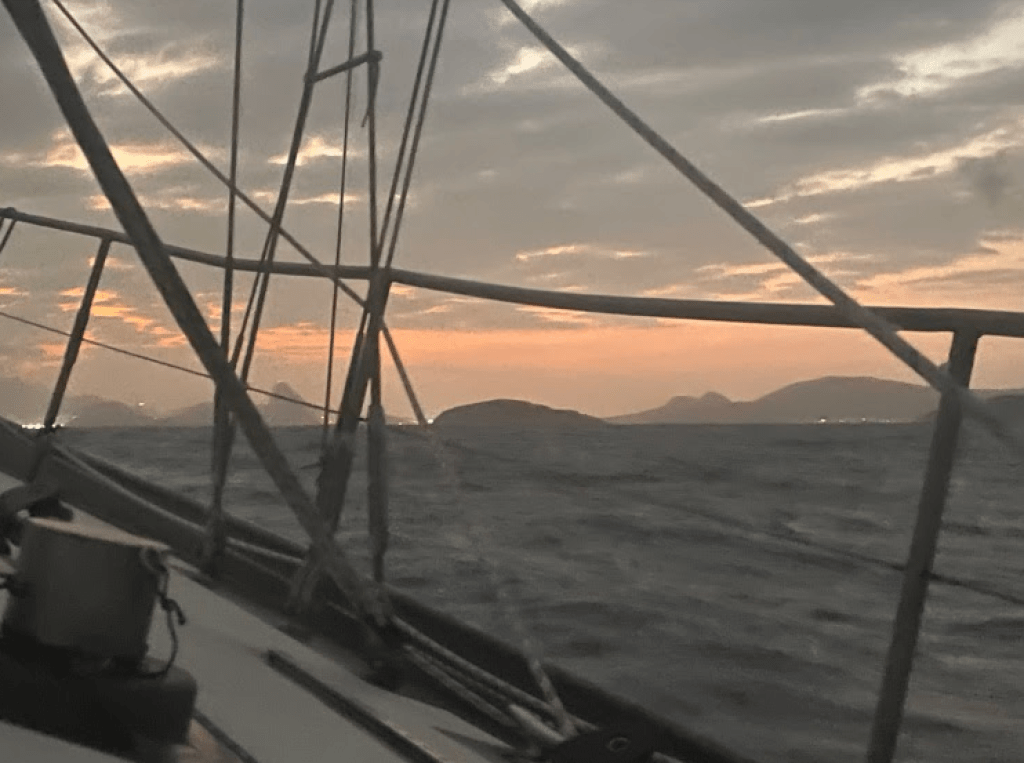
AT SEA THE DAY HAS RHYTHM. You stand your watch, four hours on and four off, and because this schedule pulls you awake at intervals of both day and night, your awareness of diurnal and astronomic transitions is heightened. Your watch may give you every sunrise that clouds allow, or every sunset. Above you in time the moon phases to full—rendering a headlamp on deck redundant—and then slowly dissolves, leaving a dome of stars so bright that the major constellations recede into an ocean of heavenly phosphorescence.
Meals are regularized to specific watches; so is most of your sleeping, split by necessity between four hours of waking. There are times when you both are up and working and times when one is in slumber, giving the other a chance to pursue in solitude his companionship with the boat, the waves, and the birds that roost overnight at the rail. Sail changes may be frequent, but if weather is favorable, they are left to the transitions between watches, for the sake of quiet below and the benefit of the help on deck.
Each day follows the same pattern, the same watches on the same boat positioned between the same endless wet and expansive dry, with the only difference being the intensity of wind and wave and the clarity or obscurity of sky.
It takes some time, usually a few 24-hour cycles from departure, for this sailor’s rhythm to establish itself. Early on you may find yourself unusually anxious; sleep may not come easily or at all; appetite may be dulled; you may find yourself rummaging through the pill box for something to induce calm. This is normal. To be effective, the rhythm needs some repetitions to settle in. It needs to have thoroughly sunk the land: the smells, the noise, the overnight lume of civilization; the sea needs to have transitioned from its nearshore green to its deep ocean blue; those waves that refract off the coast and confuse the water, you must get beyond them.
And then one morning you wake clear headed and in total comfort and even from your bunk you can feel the rhythm. The regular heave of a happy vessel now fully in her groove has been internalized, and you know and with intense satisfaction that you are now entirely at sea, that there is nothing left of that former world, that your existence is wholly within this present world, a world that is vast and powerful and alien and yet also elementary and familiar, strangely intimate and inexplicably your own.
And, just so, the rhythm commences. And each day is the same, expectedly so, admirably so. You wake and eat and sleep on the same cycle and you can neither imagine nor desire another. Within your gyrating gray capsule bounding over the great blue chaos, your day never changes. You would want it no other way.
—
BUT THE MOMENT YOU MAKE LANDFALL, this long established rhythm evaporates faster than spit on desert sand. There is no transition. The demands of life on the dry—the ringing phone and pinging texts, the taxis and tours, the lunches and dinners with friends with too much food and too much wine—are immediate, and those things that were easy and regular the day before have trouble walking themselves unassisted as far as the To-Do list.
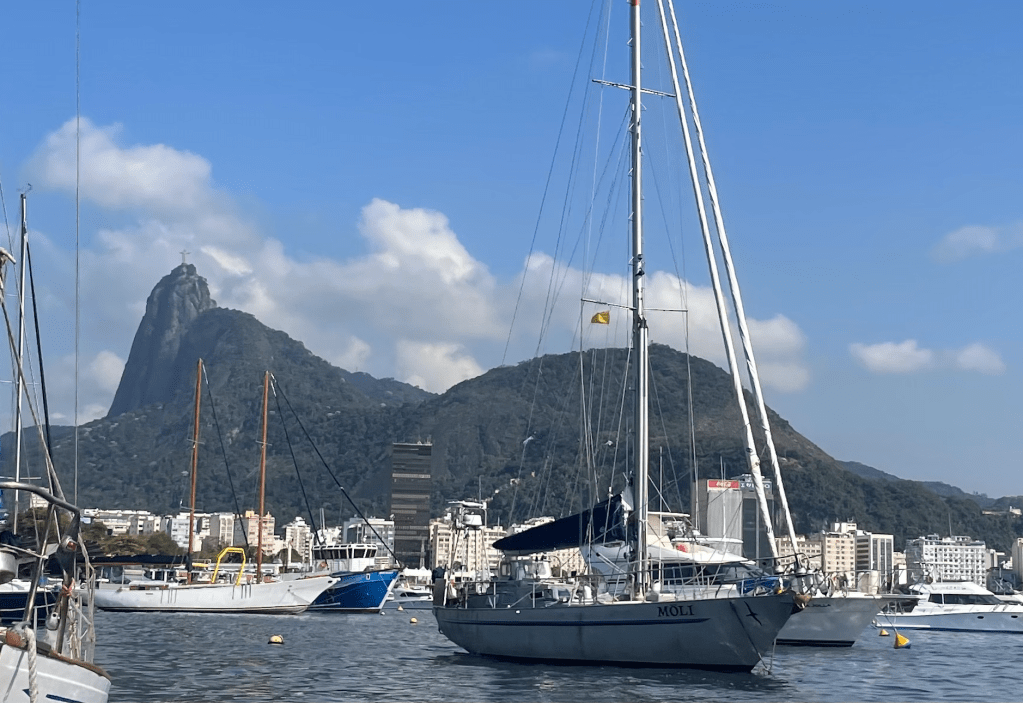
Which is to say that you have had no blogs in a full six days because we made landfall in Brazil on the 16th. Rio de Janeiro. The famous Iate Club de Rio de Janeiro, where the moorings are safe, the food is good, and every last damned word is in inscrutable Brazilian Portuguese.

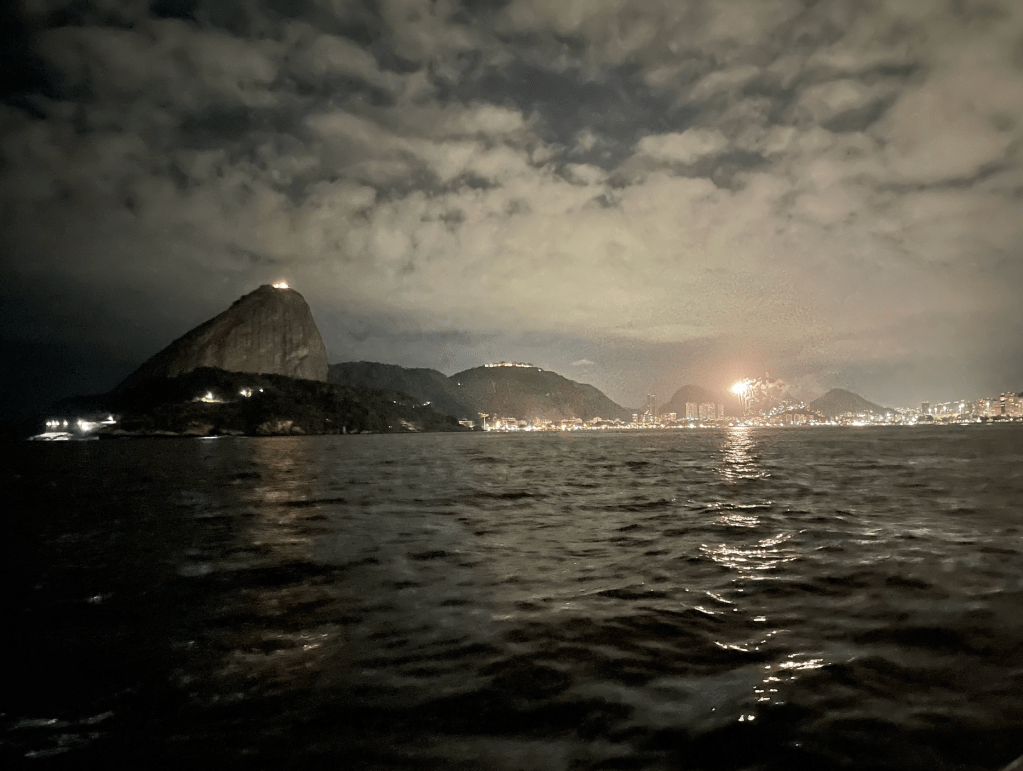
It is a most remarkable landfall, too. If you ignore that the Golden Gate Bridge fails to span the rock-bound opening, then the entrance into the main harbor and the quick left turn into Ensenada de Botafogo is incredibly like entering my own. The high hills here are higher and not sedimentary but granitic, the bay is smaller, the metro area is greatly vaster and distributed differently over the land, but the shape, the lay of water over land and the hilliness all make this a twin to San Francisco Bay. There was a giddy rush, a sense of returning to home waters, as Mo squeezed between the danger buoy and Forte da Laje; in fact, she is nearer the antipodes of this voyage. That fireworks greeted us as we ghosted into glassy-still and inky-black Botafogo only heightened the sense of welcome.
The intervening days have been a rush of cleaning (boat, clothes, self: repeat), checking into the country (three offices, nine forms and counting–each day I learn of another), meeting our host at the club, Carlos Raposo, and his host of friends, touring the city.
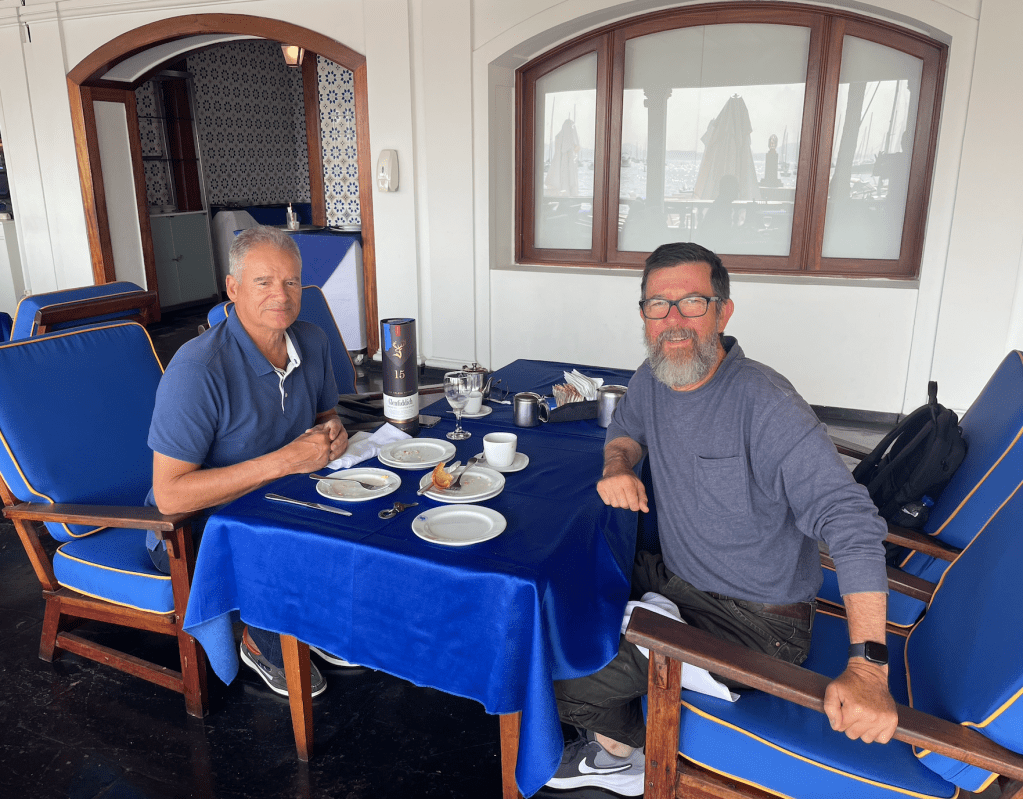
By now Harmon has flown home. I follow tomorrow. Moli will remain here, gently knitting at her mooring, checked twice weekly by Carlos’s crew.
We return to continue the trip in early November.
Which is to say that you should expect this blog to take a break for the next couple of months.


 Harmon and Randall's Voyage...
Leave a reply to CHUCK FULTON Cancel reply