Leg 4, Blog 4, November 23, 2025, Latitude 33
To borrow the title from on of my favorite authors Daniel Handler (Lemony Snicket), the collective “we” (Mōli, me, Randall) went through a wee difficult period these last few days – although nothing anyone would or could call serious. I provide five vignettes below.
Background: As we continue to make our way south, we are slowly losing the tropical balminess of central Brazil. Within five days, the daytime temperature has cooled ten degrees from the mid 80’s to the low 70’s and shows no sign of stopping there. We left Rio at Latitude 23 and we are now at Latitude 33, meaning we are losing a degree of temperature per degree of Latitude. The ocean temperature does not correlate to outside air. The ocean was 72 we left Rio, went up as high as 76 and is now down to 69. As Randall describes it, the cooler water comes from the deep sea upwelling. In San Francisco, our lower water temperature is a result of colder water coming in from the Japan area. In Brazil, the warmer water is a result of the Brazil Current which is fed by the South Equatorial Current which brings warm water from Africa, but it gets cooler as it heads south.
To bring you up to present, this last 24 hours seems strange because the wind is under 20 knots, the seas have flattened, we are not living in a martini shaker and we can actually sleep. Wow, sailing can actually be enjoyable!
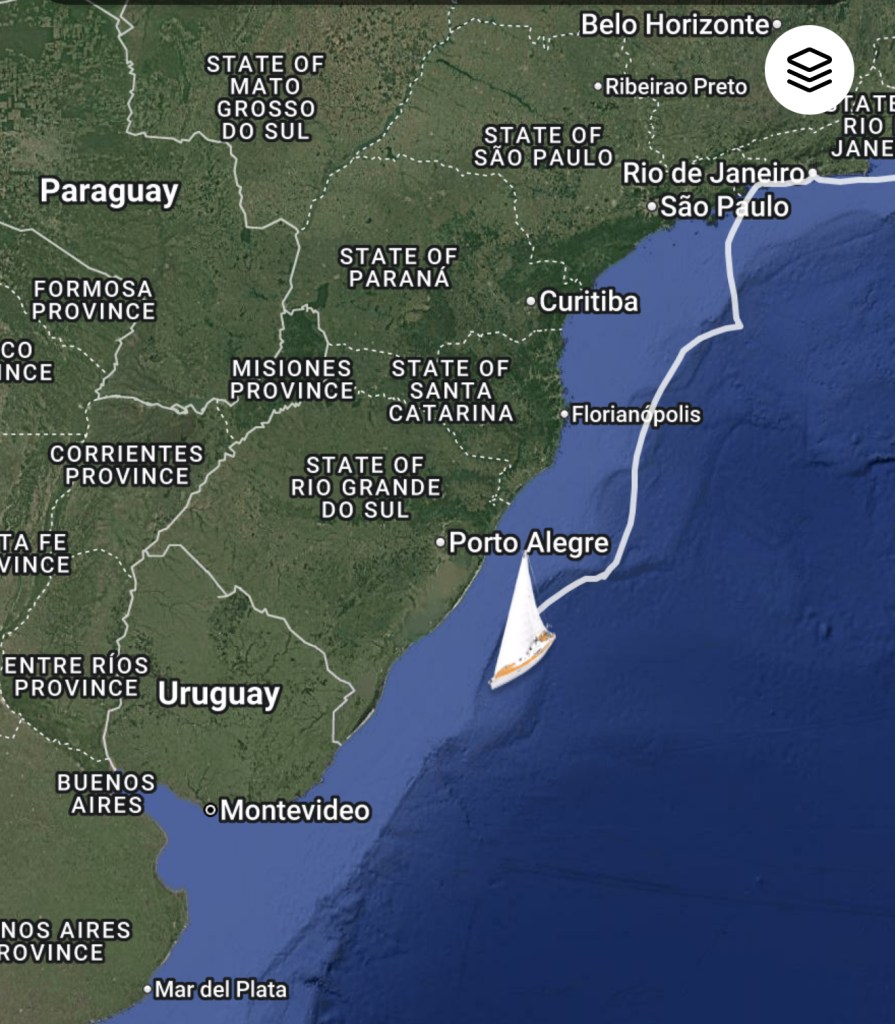
In the spirit of fun, I offer these five vignettes or life aboard Mōli before we achieved our present state of calm serenity.
- THREE DRAM NIGHT
Starting on about November 19th, the seas picked up. Temperature was 80’s in the day and 70’s at night. Wind picked up to 25+ on a close haul. We were achieving great speed which for us means 7 to 8.5 knots. What’s not to love about that? Little noticed was the 5 to 10 foot swell we were heading directly into. It seemed a small price to pay for the great progress we were making.
Before dinner on the 19th I noticed that creeping feeling of heaviness and doom set in. I didn’t overthink it, and went right to the medicine chest and downed 1/2 of a dose of old fashioned “original” (drowsy) Dramamine. That’ll get me through this I thought.
I wasn’t feeling any better after “dinner” which for me was another 1/2 dose of Dramamine and for Randall was a can of white bean soup that was never opened. The pill had the intended effect and I was able to achieve sleep, albeit in Randall’s bunk, as the V-berth would have been unthinkable due to the crashing waves and aggressive pitch of the boat.
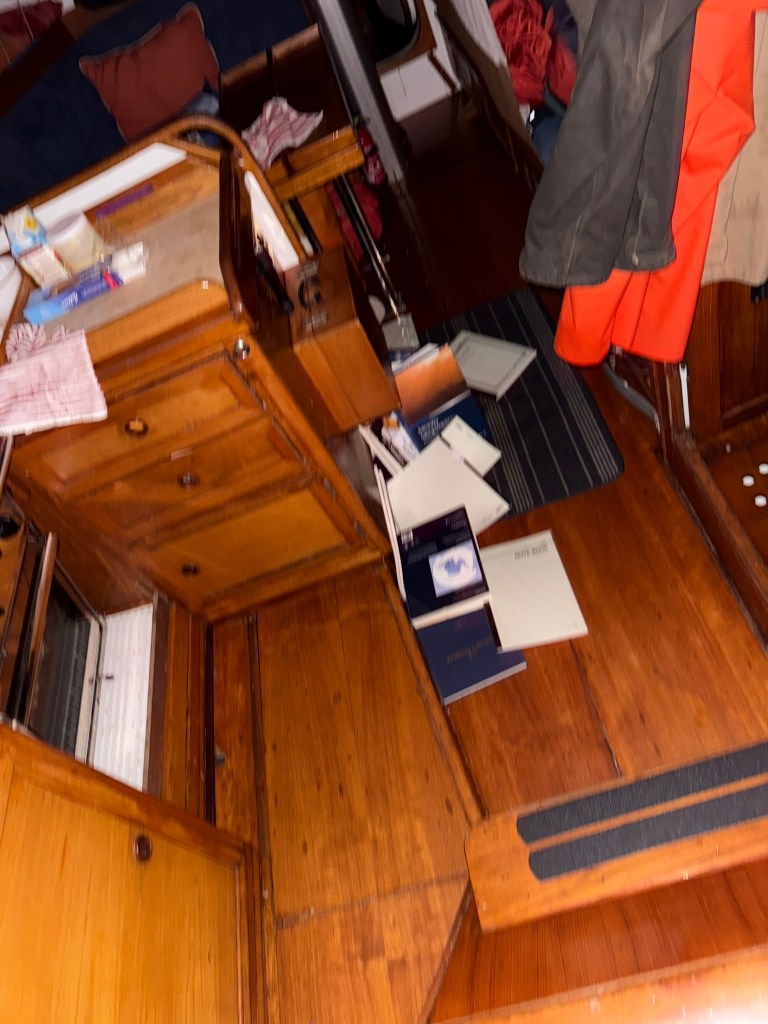
Above: I woke up in time for my 2200 watch. I was “there” on watch but my stomach was still somewhere else, so I took my third dose of Dramamine and my second headache pill. While I had zero appetite, I was not nauseous (I just felt like crap) and was ravenously thirsty. We continued making great strides in speed and in distance so there was no need for us to crack off the wind. Who cares if the boat was pitching wildly, left to right, fore and aft. After all, this was not a storm, just heavy weather in our favor. When all of Randall’s books flew out of his starboard bookshelf (again!), this seemed like a non-event to us both and a small price to pay for our performance.
Somehow I made it through my watch and it was time to crash at 0200. Still quite doped up, I threw down my sleeping bag and pillow on Randall’s bunk and went right to sleep through the heaving. As the boat sped forward, we would sometimes shoot over the wind waves. Our speed did not allow time for the water under us to catch up so we would crash down into the sea. This is not an uncommon occurrence going into weather. But at some point our speed was high enough (9+ knots), the waves were high enough (5 to 10 feet?) that we shot over a big wave achieving a semi-airborne state and then crashed down into the sea below. Boom, crash, bang.
Even in my inebriated state I woke right up. Wow, that was a big one and that did not sound or feel good. If we did not sustain damage, we certainly would if that kind of pounding kept up. I did not panic, but I did take a mental note of where my PFD was located, where we kept the ditch bag etc. With one eye open, I looked up and saw Randall take out the flashlight and survey the interior and then exterior of the boat for damage. We mumbled a few words to each other and as best I could tell, he was not finding anything wrong, so back to sleep I went. “What, me worry?” I thought to myself in my best Alferd E. Newman voice (Mad Magazine).
2. A BEND IN THE GENOA POLE
By the evening of November 20, the wind had not let up (blowing 20 to 25, but the sea state calmed as the wind had shifted. Life was better!

This gave us time to enjoy our good progress. Heading almost directly downwind now, Randall set up the wing-on-wing with the port Genoa pole.
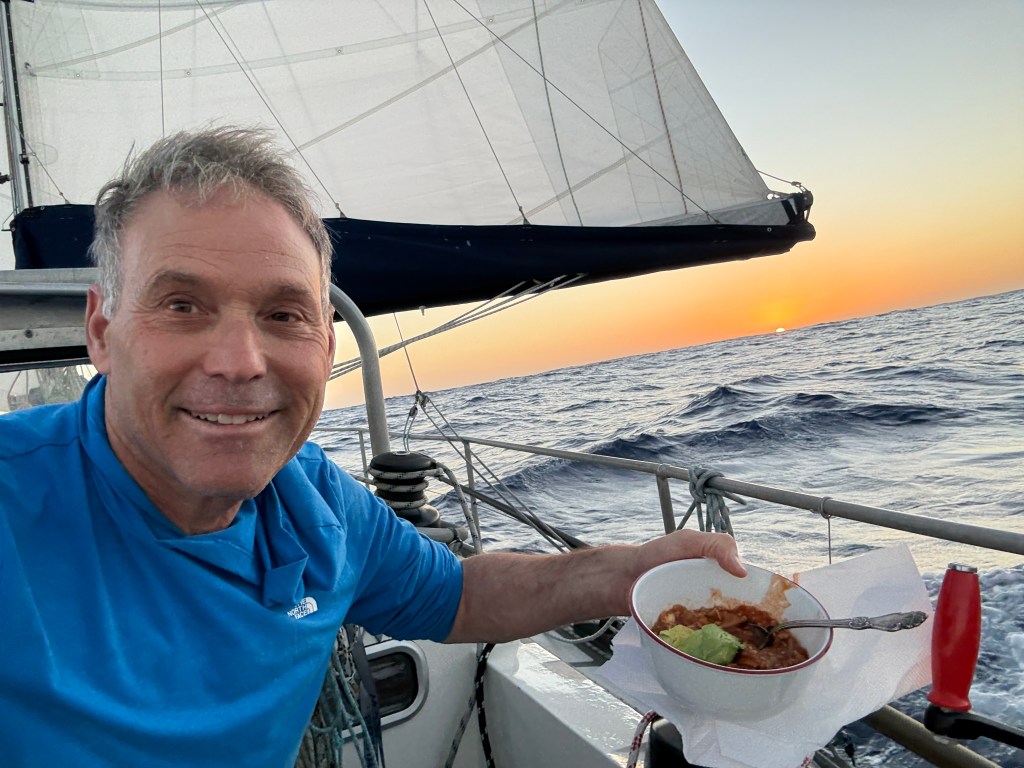
Life was, in fact good. What can I say? Blasting along at 7 to 8+ knots in calm seas. We could bask in the warm weather (mid 70’s at night). Best of all, our hunger returned and I made enchiladas which we ate on deck as we watched the sunset.
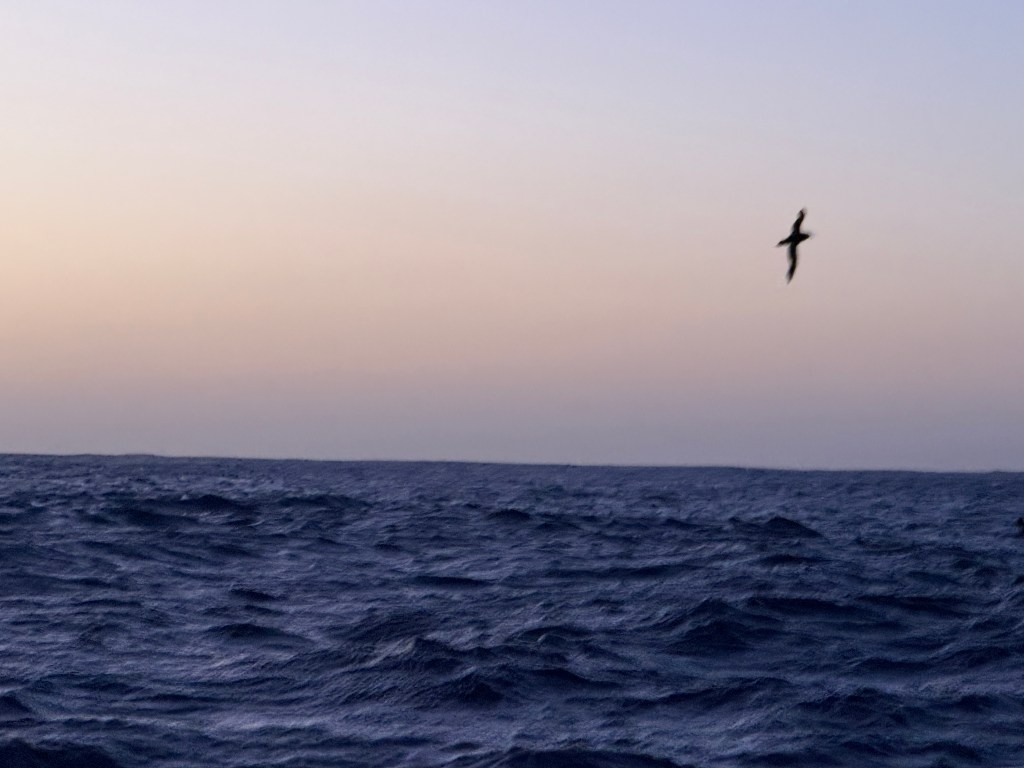
Above: What a grand night. After the sunset, what looked like a black-footed albatross flew by. I must say that this is not a confirmed sighting as I do not know my birds that well and Randall did not see an albatross until 2 1/2 days later. The picture could be some sort of petrol or shearwater.
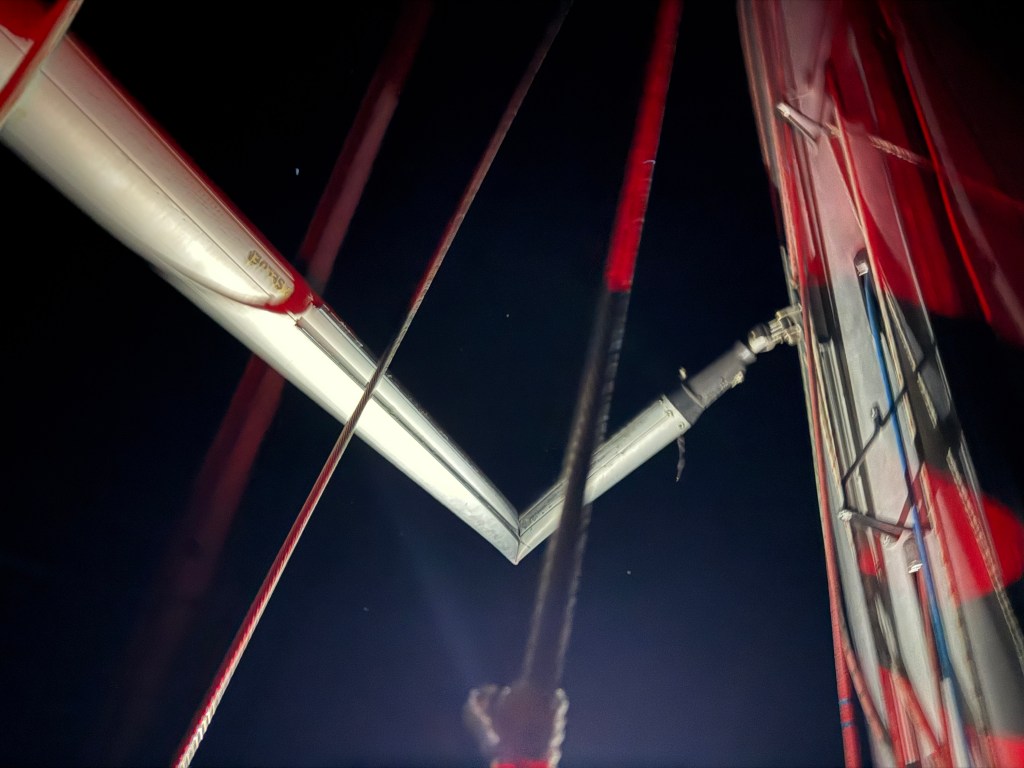
Above: I came on watch at 2200. It was a clear, beautiful night. Wind was blowing 18 to 22 knots (gusting to 25) and we were flying along at 8+ knots with only slightly reefed sails. We had not needed to make a sail change since earlier in the day as the wind was so steady. As Randall prepared to go below deck for a sleep, he said for me to let him know if the wind blew a consistent 25, as that would entail a sail change.
Randall went to sleep and I sat there loving the 8 to 9.5 knots Mōli was hitting in the warm breeze, I did not notice the gradual creep up to a consistent 25. And why worry as the boat was handling the wind so well? Until it was not. At some point the wind gusted above 25 and as best we can tell, she rocked and rolled and the Genoa pole hit the water causing the pole to bend and the boat to begin a broach. Dang. It was sure nice as long as it lasted. Note to self – if you are achieving incredible speeds in a high wind, high sail mass environment, and you think it is because of your incredible sailing skills, TAKE IMMEDIATE HEED and power down before it is too late. Lesson learned! Sorry!
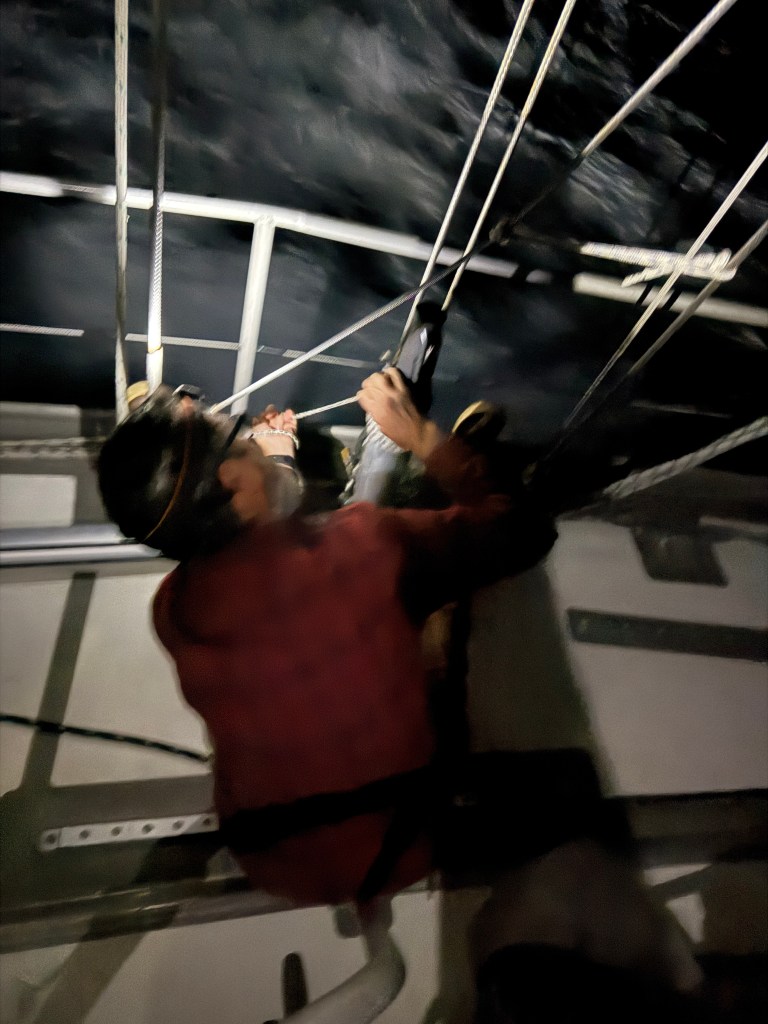
Above: Randall woke up, and we immediately put the boat on autopilot and disassembled and then secured the broken Genoa.
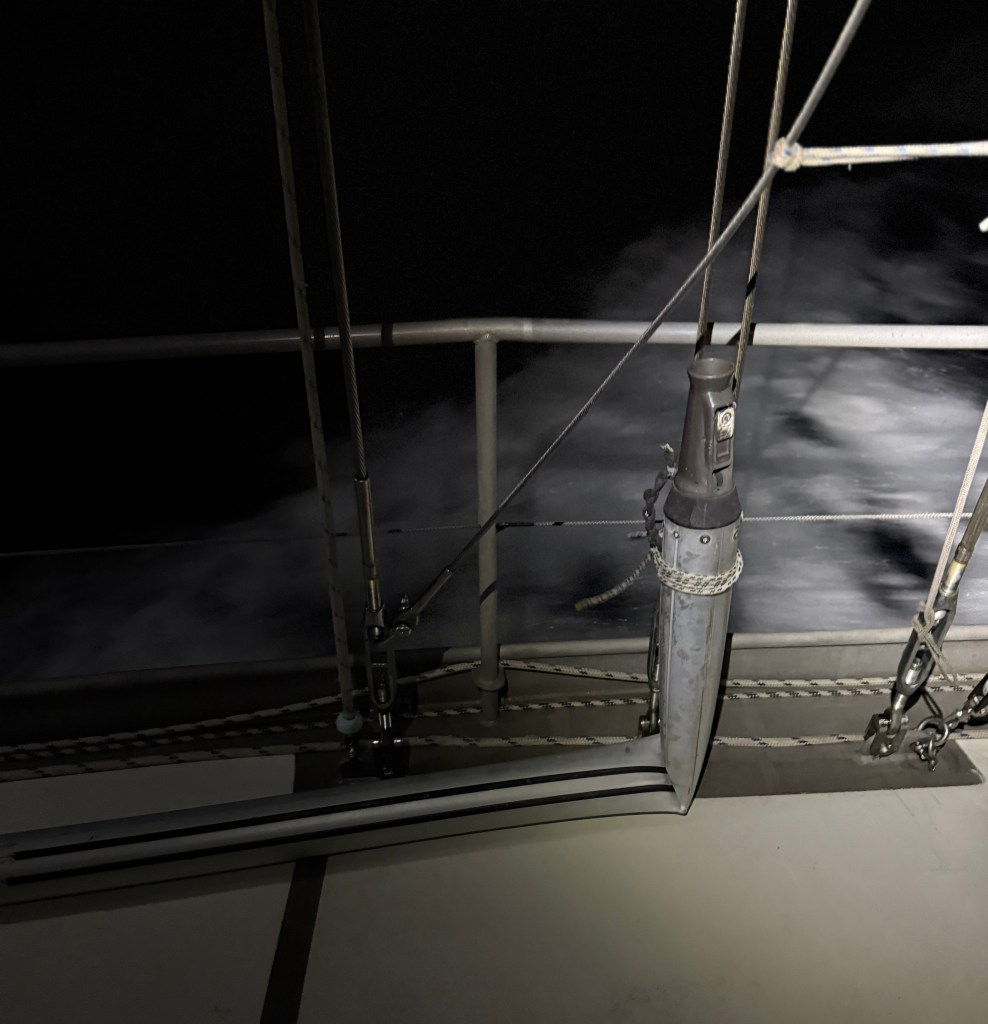
Above: It’s an 18 foot pole with a bend at around the 15 foot mark. We think it will be reparable at our next stop in Piriapolis, Uruguay. Maybe they will put a metal sleeve around it. In all Randall’s years with Mōli, this has never happened. Sorry (again!!)
3. AUTOPILOT FAILURE (yes the new bigger, stronger and more expensive one)
Followers of this blog will no doubt be aware of our struggles with Mōli’s autopilot since the beginning of our journey. They are numerous and painful.
Most sailboats are controlled primarily by a tiller or a ship’s wheel. Taking the helm of a race boat in high wind is one of the most exhilarating and enjoyable experiences known to man. Blue water cruisers mostly rely on some sort of windvane system because there is generally not the time or manpower to steer manually 24 hours a day, for days or weeks at a time. Use of an autopilot takes a lot of energy that is not always abundant on a blue water sailboat.
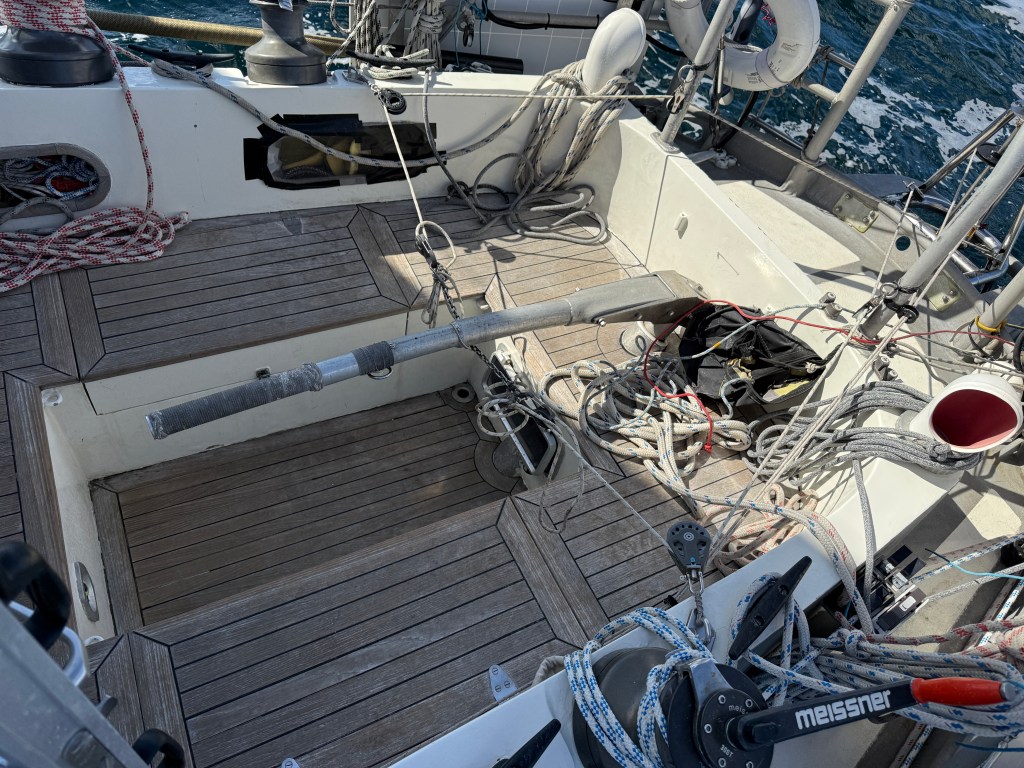
Above: Mōli is somewhat unique in boats that I have sailed on in that she is generally controlled by autopilot or windvane. The tiller is under-leveraged meaning that it takes a great deal of strength to accomplish normal steering. Adding to the difficulty is that the cockpit is undersized so it is difficult to get the leverage to operate the tiller. Consequently, the tiller is used mostly in port, in emergency, or in-between autopilot and windvane.

Above: So there we were at 0630 on the morning of November 21st (of course I had just come on watch). It was blowing 32 knots and we were howling along at over 8 knots using the autopilot to steer. Apparently this caused too much stress to the system and the auto pilot went off-line, way off-line. Did I mention that Randall, before the beginning of this leg, had just upgraded the autopilot with a new and bigger system that seemed destined for greatness?
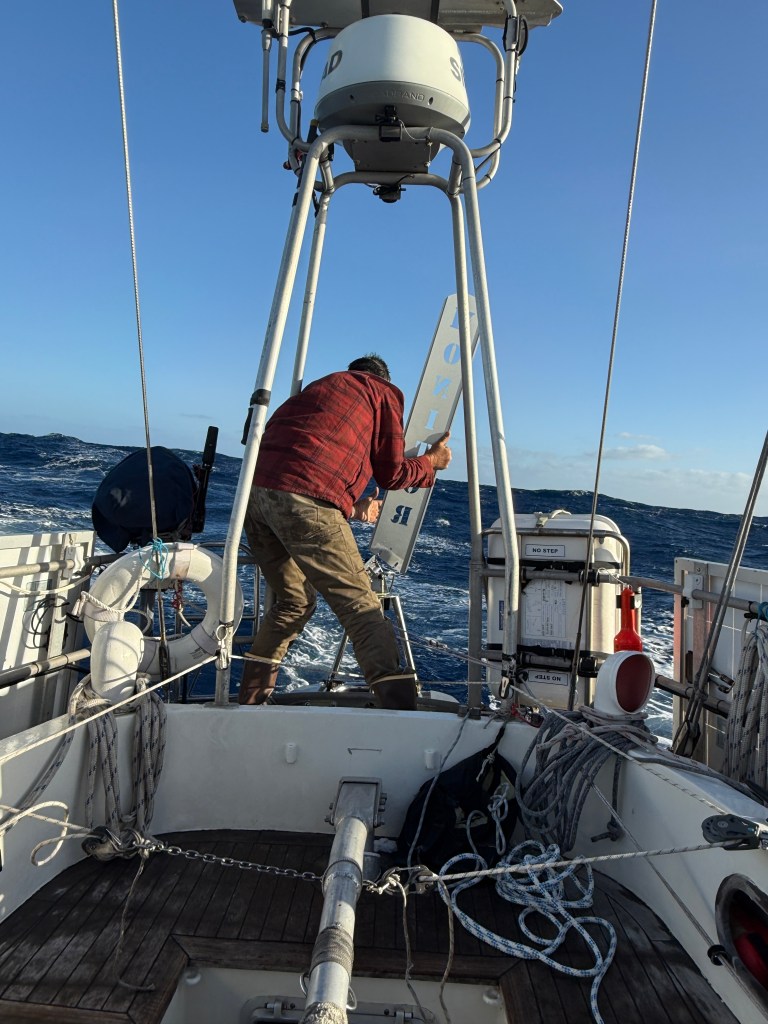
Above: Oh well, with the failure of the autopilot it was time to get the Monitor windvane out of the head and onto its frame.
Above: Randall adding the final adjustments moments after activating our Monitor.
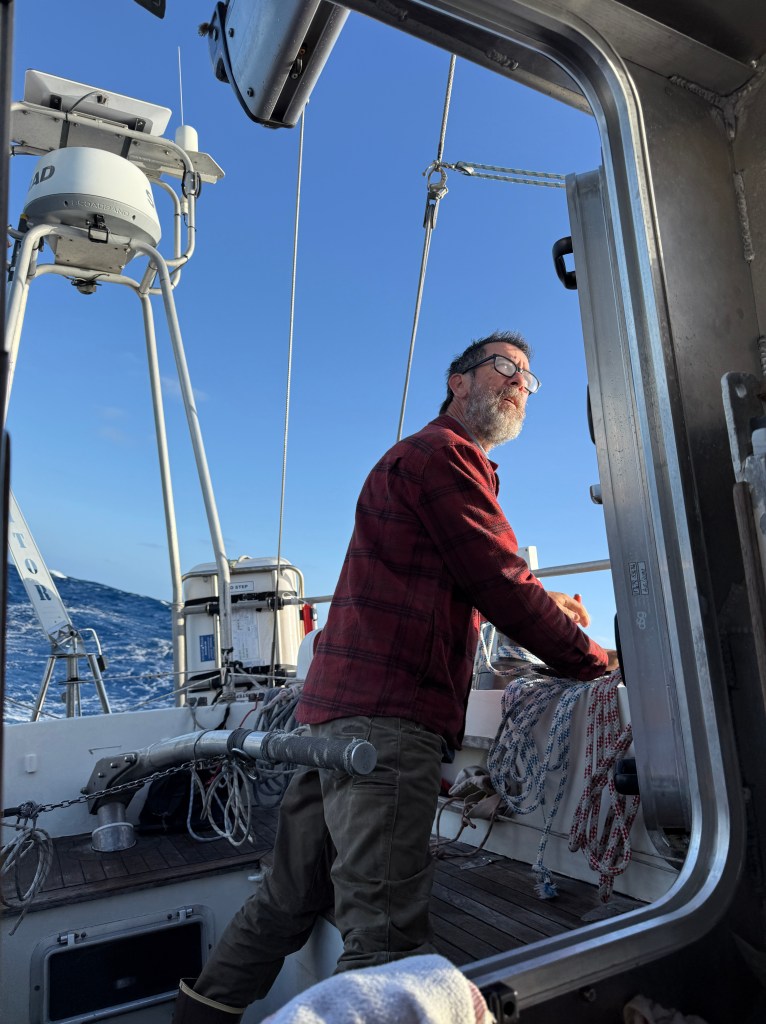
Above: Making a couple of final sail adjustments.
Above: We are back on track and sailing hard and fast. The autopilot still functions in light to medium environments, so it is not completely out of service. More on this later, I am certain.
4. FRACTURED TALES OF NAVIGATION
Randall’s navigation skills are strong and correct 99.9% of the time. And like any master navigator, he has a plausible explanation for that .1% when wind does not meet forecast.
Last (Saturday) night I awoke for my 0200 watch with perhaps 90 minutes of sleep under my belt. Admittedly groggy, and just the slightest bit out-of-it, I crawled out into the cockpit of this beautiful but cold clear night to greet Randall at the end of his watch. I noticed that the boat was traveling at a slow rate of speed, perhaps 3 knots or less.
“Gee Randall, we are going awfully slow” I offered. He nodded in agreement. As we are not purists, and with more than 30,000 miles to cover on our trip, we had at the start of our venture, tacitly agreed to turn on the engine when our speed fell under 4 knots.
At that point I looked at the compass and noticed that in addition to going slow, we were heading north instead of south. “Gee Randall, if I didn’t know any better, I would say we are heading in the wrong direction”. “Oh yes” Randall replied, “I tacked too early and the wind has not yet caught up to us”. “How long has this been going on?” I asked. “For a little while”, Randall replied, not particularly worried about the situation. I mean, at 2:15 in the morning on a beautiful star filled night, what is there to worry about?
Experience has taught me to tread lightly on issues of navigation with any skipper, much less one as gentle or experienced as Randall. “Gee Randall, maybe we should do something about this?” I offered. “Like what?” he replied. “Like maybe start the engine?” “Why would we do that?” Randall replied. “Because we are going in the wrong direction?” I said softly. “But that would mean I would have to take down the sails, undo the Monitor, and take out the Watt and Sea (our hydrogenerator)” and then we would be motoring into the wind”. “Well it’s either that or we head for home.” (north) I said.
With that Randall sighed (or groaned). We turned on the engine, took down the sails, removed the Watt and Sea and reversed course to south. With that Randall went to bed.
PS … the wind did reverse itself about 90 minutes later.
5. WHEN MARLIN’S ATTACK
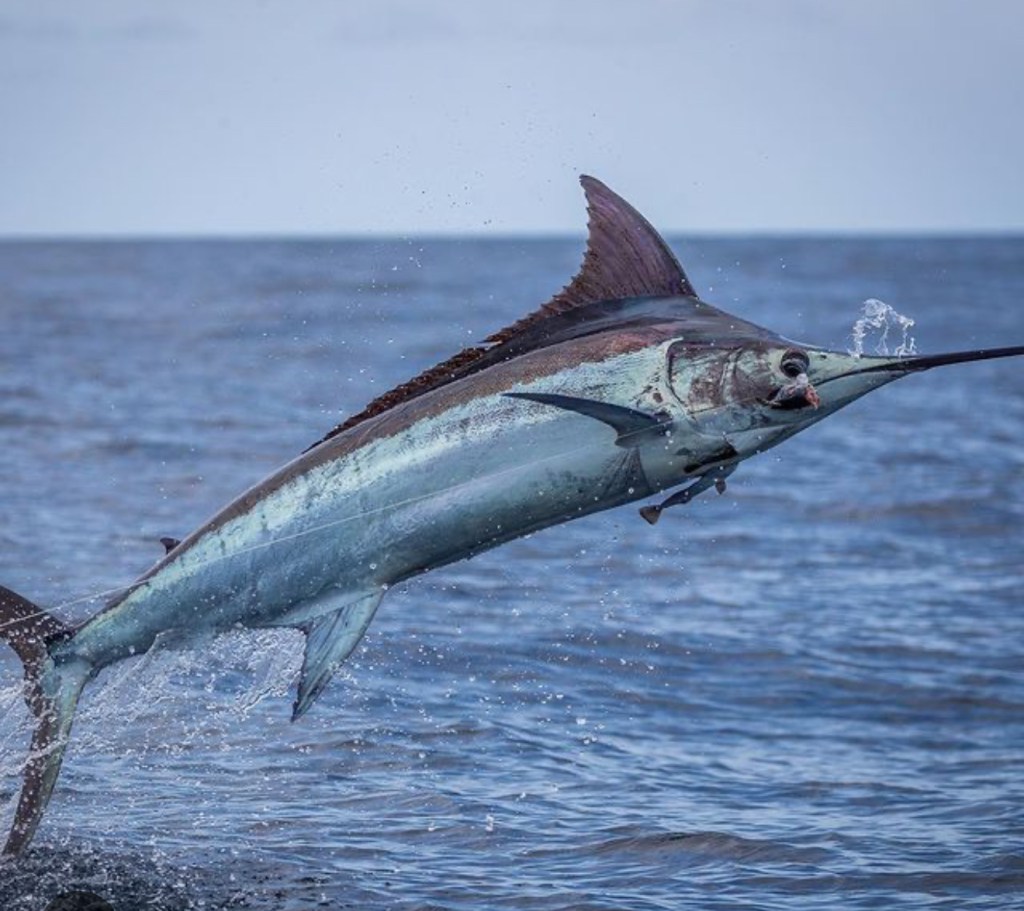
I have never been a fan of marlin fishing. It one of the ultimate big game fishes that offers a rare opportunity to reel-in a truly majestic, almost prehistoric aquatic creature. Marlin fishing is reported to be one of the most exciting challenges facing any angler because they are huge (up to 14 feet long and weighing up to 1,800 pounds) they are athletic and one of the fastest fish in the world with some species swimming up to 50 miles per hour. I copied the below picture from an Atlantic blue marlin guide.
While reeling one in might provide a once-in-a-lifetime experience, marlin is not considered an eating fish as they often contain high levels of mercury and other toxins that are harmful to humans. They make great trophies and the fish is often “given away to the locals”. Interestingly, as we traverse the Atlantic, we see many small islands from the Azores to the Cape Verdes that rely on marlin tourism.
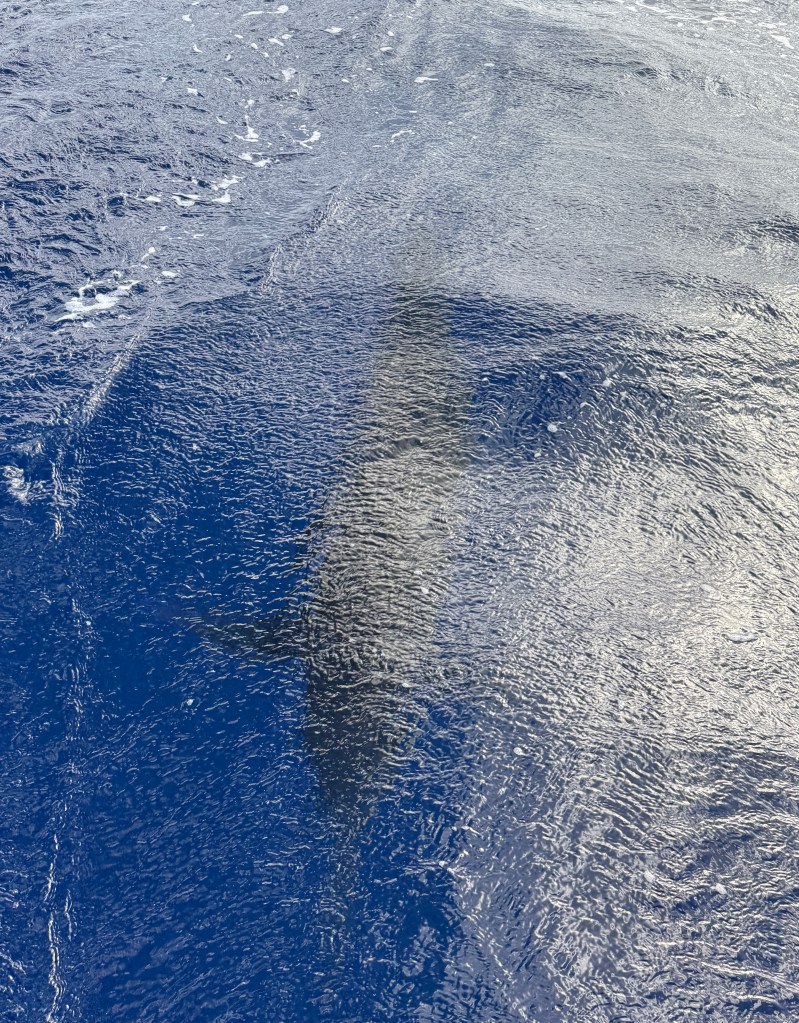
Above: On November 22nd at 0730 (yes, I’m on watch again), Randall approaches the stern to do his business and gives me a yell to “get out here and see this marlin attacking our Monitor (Windvane)” (yes, the one that we had recently put in operation to replace the errant autopilot). I run out and shot the above picture of our “friendly, neighborhood blue Atlantic blue marlin” lurking just below the surface. By the time I got out there, “he” had stopped attacking us, but he continued to follow us for another minute or two. I would estimate that he was about 10 foot long and rather thick and meaty.
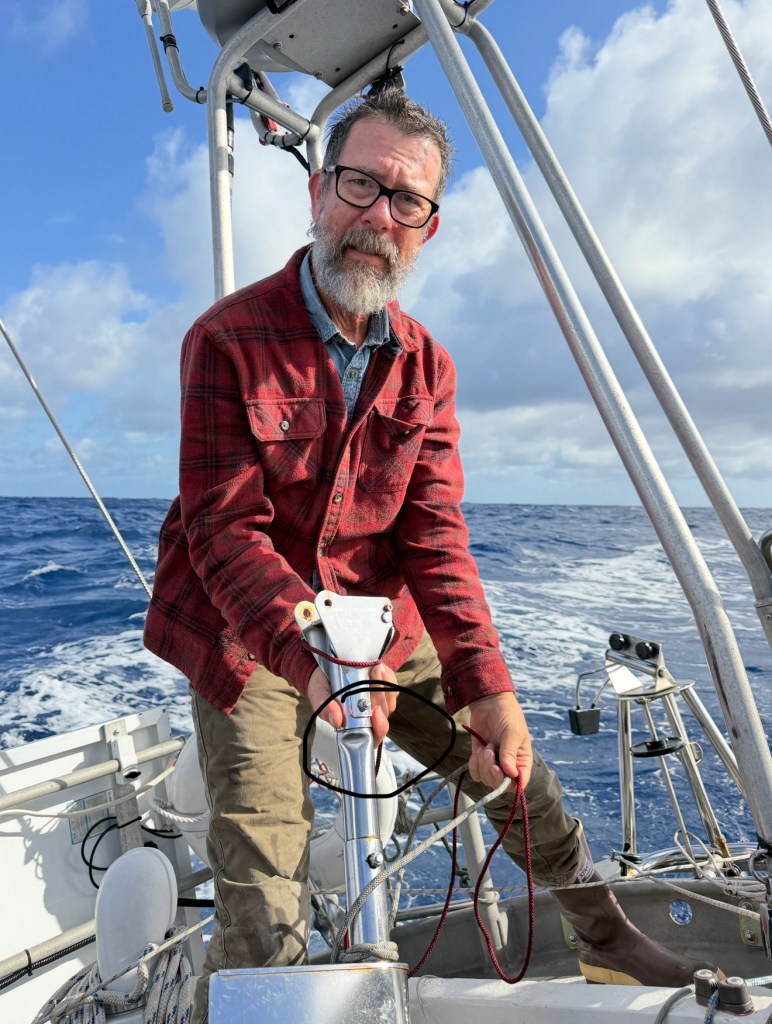
Above you can see that our friendly fish bent the rather thick and stiff extension pipe that extends from the windvane to the pendulum blade (at the bottom center of the picture – this is the mechanism that generates the physical power to steer the boats main rudder.
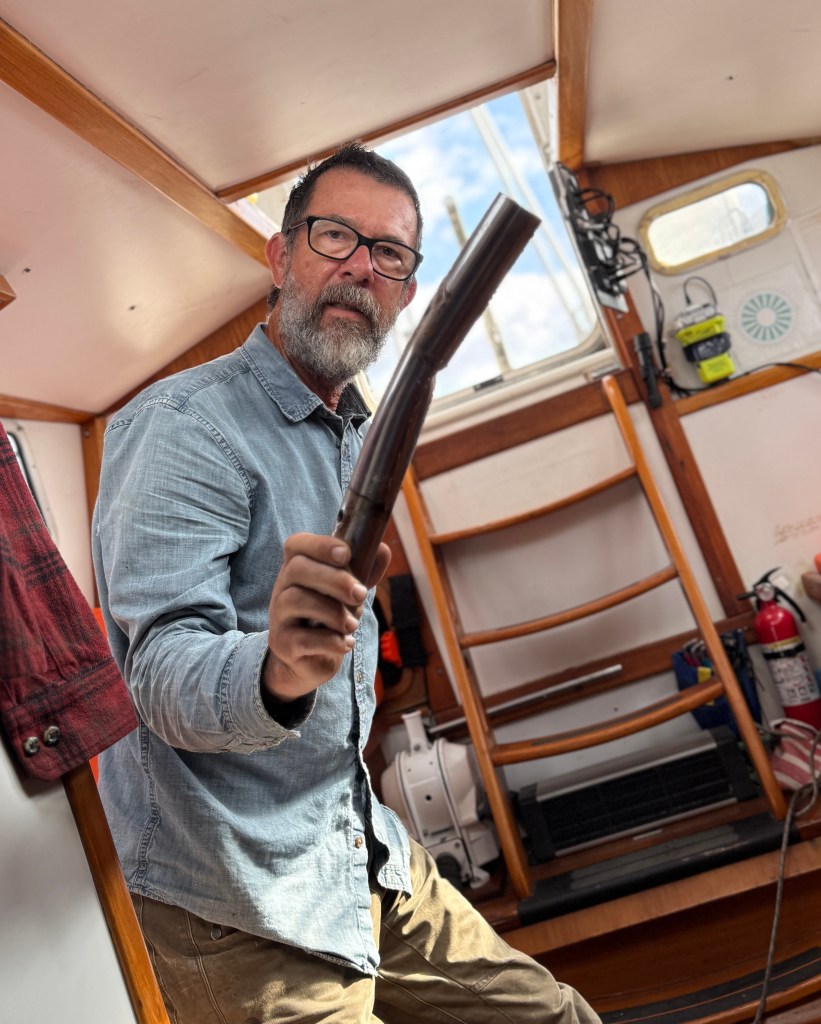
Above: This is a better view of the bent tube that can take the stress of many thousands of pounds of pressure that the ocean can generate, but somehow can not handle one errant and rather aggressive marlin.
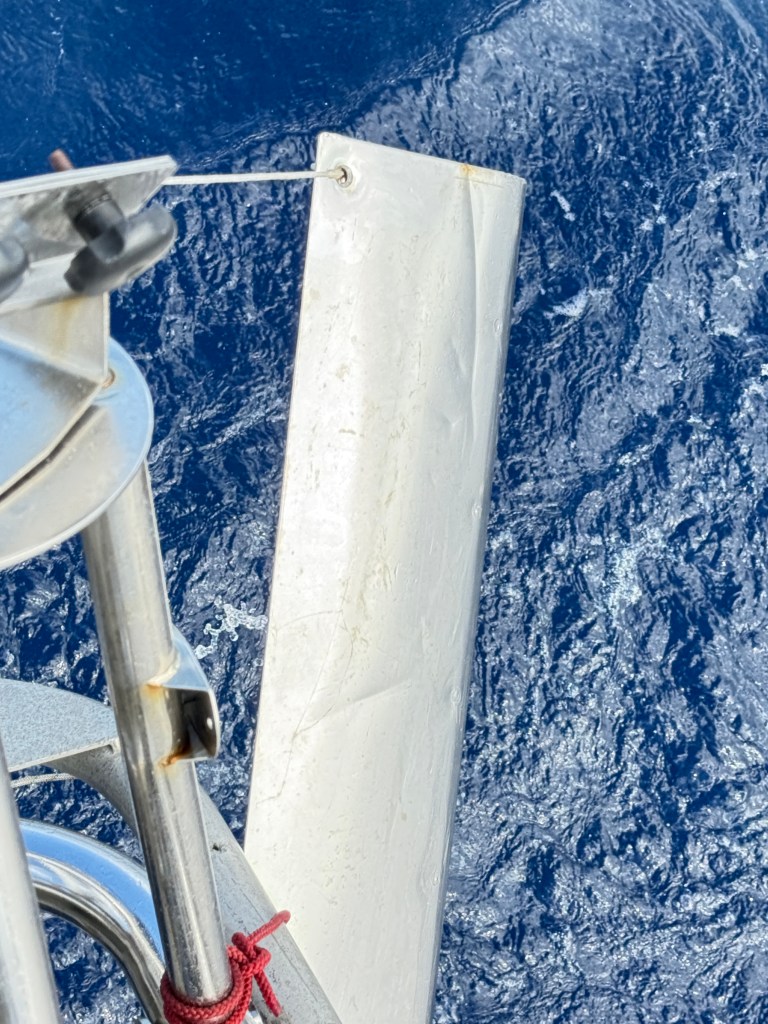
Above: Marlin’s have a “sword” or bill called a rostrum, which is an elongated upper jawbone they use to hunt. They use it to slash through schools of prey like tuna or mackerel, stunning them with a side-to-side swiping motion so they can be eaten easily. The bill isn’t used for stabbing, but rather acts like a club or scythe, or a rudder killer extraordinaire.
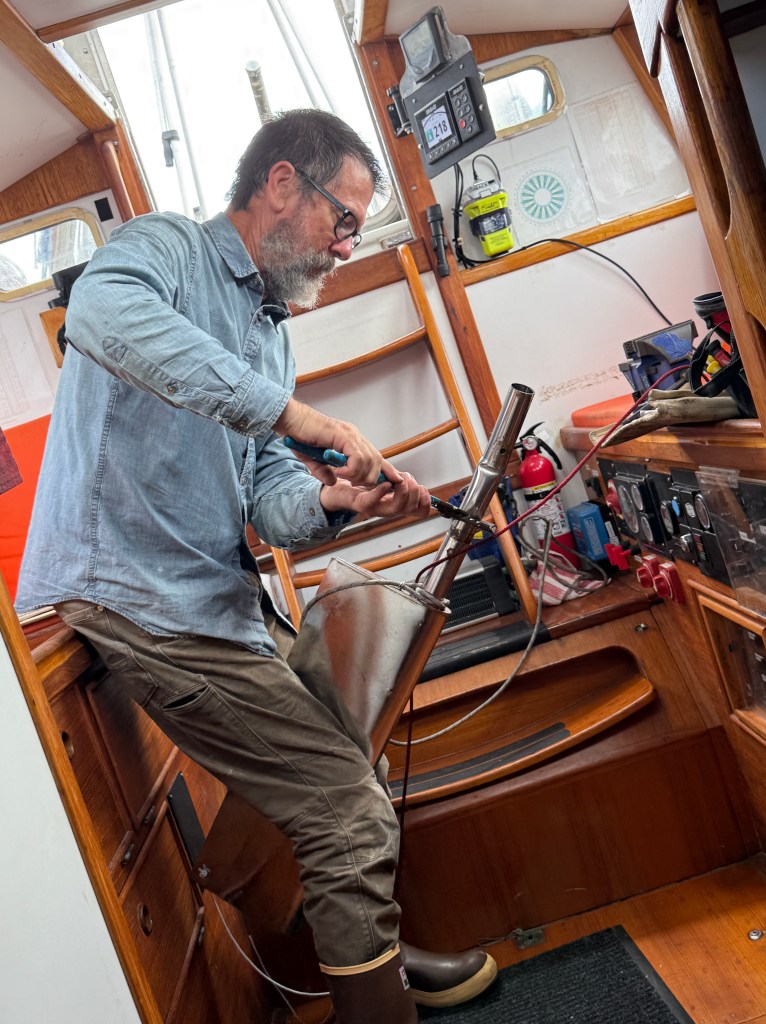
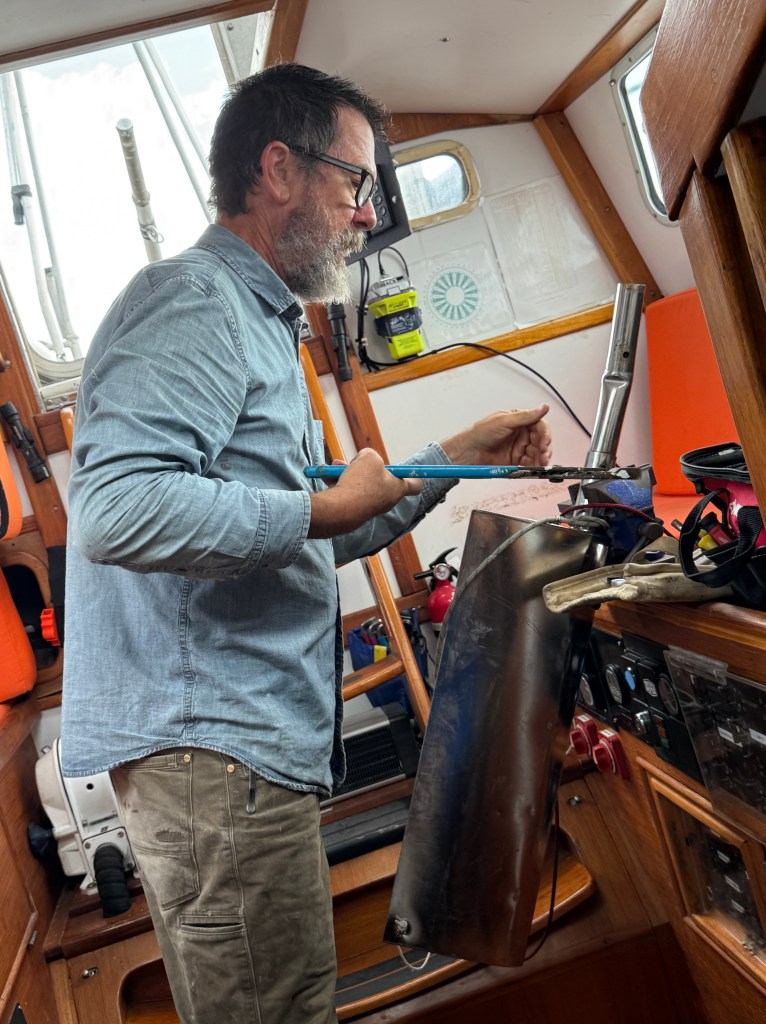
Above: Been there, done that. Interestingly, this is not the first time Randall or Mōli has fallen victim to a marlin attack. On one of Randall’s Figure 8’s he suffered a similar fate. Perhaps it was the same marlin? In less than 30 minutes, Randall was able to remove the bent pipe, go under my bunk and retrieve one of three extra pipes, take out the old one, install the new one and make the Monitor operable once again.
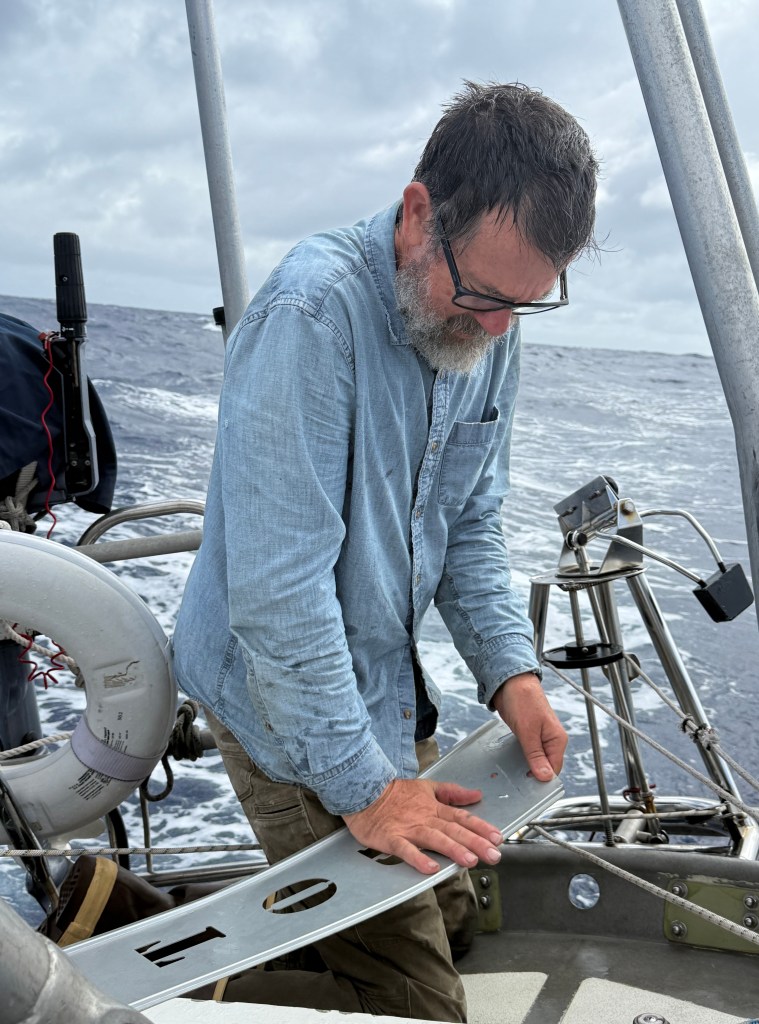
Not sure how the windvane got bent during this attack, but somehow it happened. Randall was a bit hesitant to switch out the plastic windvane for the new and improved aluminum. “What happens if it gets bent?” he asked Suzy Savage at Scanmark International? “Bend it back!” she advised Randall. And so he did and on we sailed.
There you have it. Randall and I hope you enjoyed these tales of the deep. We are less than 30 hours from Uruguay. Next stop is Pirenópolis. See you there.
Happy 2nd birthday Poppy!
Welcome home for Thanksgiving Jorun, Henrik and Ulrika (Ingrid already home), and all of you readers circling home for your own Thanksgiving. Randall and I still wondering where we will be – if you have any friends in Uruguay please let us know!!


 Harmon and Randall's Voyage...
Leave a reply to Chuck Fulton Cancel reply