Leg 4, Blog 7 – December 19, 2025 – Latitude 52
The Falkland Islands are a self-governing British Overseas Territory known for their rugged landscapes, abundant wildlife (penguins, seals, albatrosses), and sheep farming, with the capital Stanley on East Falkland. They are a subject of a long-standing sovereignty dispute with Argentina (who call them Islas Malvinas), marked by the 1982 war, but remain under UK administration, with most inhabitants of British descent.

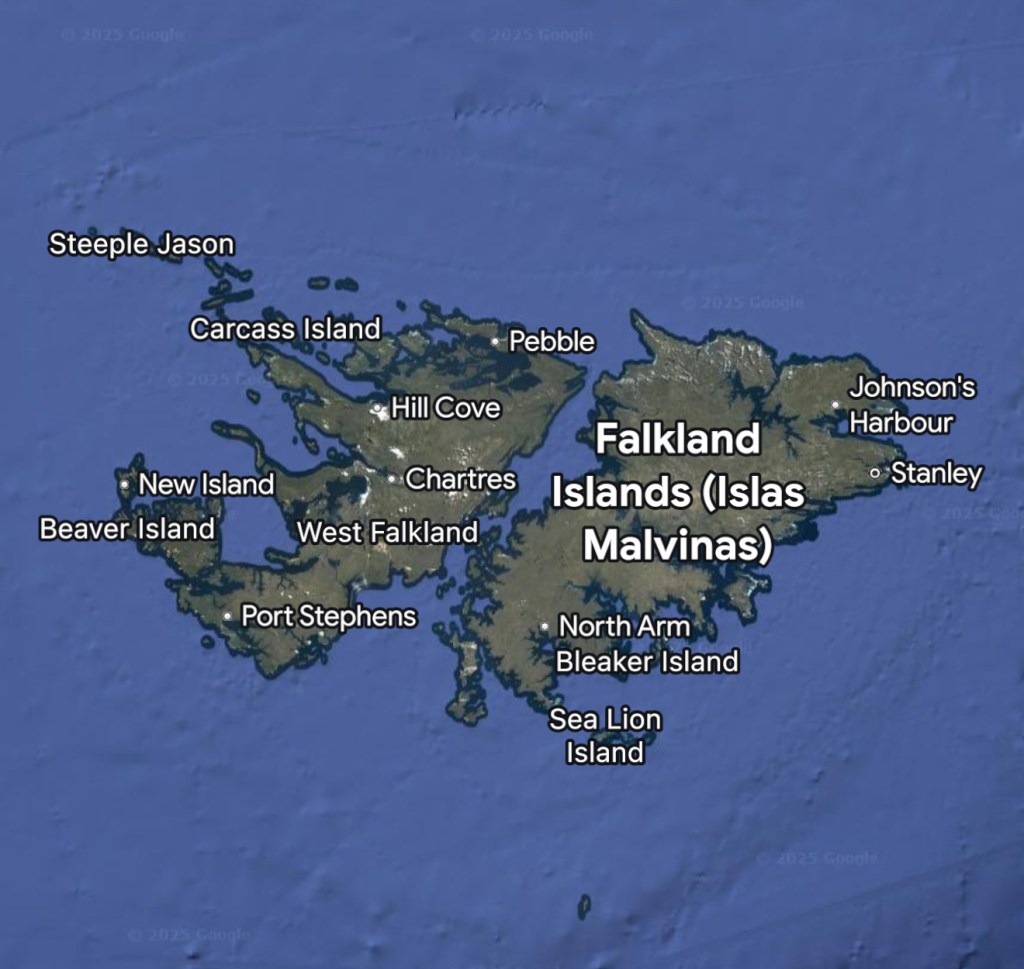
We had a pleasant and uneventful sail in. The weather got gradually colder and dryer.

Above: This is when we first spotted land. Randall, in his previous journeys has been in close proximity to the islands on two past occasions, but he never stopped.
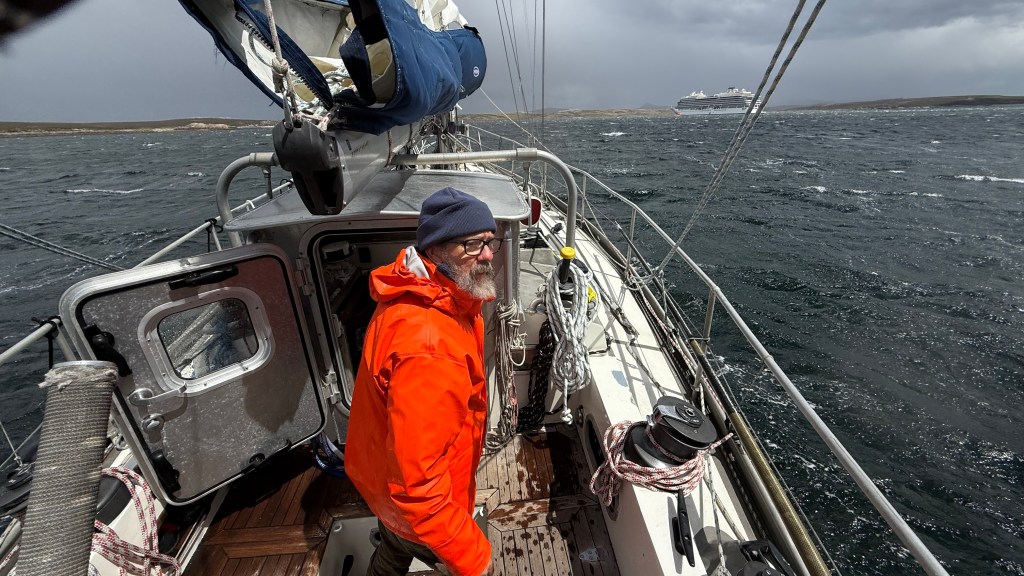
Above: As we approached Stanley, the wind picked up to 30 knots. Randall was already thinking of alternative anchorages if conditions proved too rough. Interestingly, this it the first harbor in a long time that we approached in daylight (what a luxury). Coming in at night in these conditions would have proved nearly impossible. Off to our right is a cruise ship anchored outside of the harbor.
Above: As often happens, once inside the harbor, conditions moderated and Stanley appeared before our eyes. Even though the journey had been only one week, we were anxious to land.
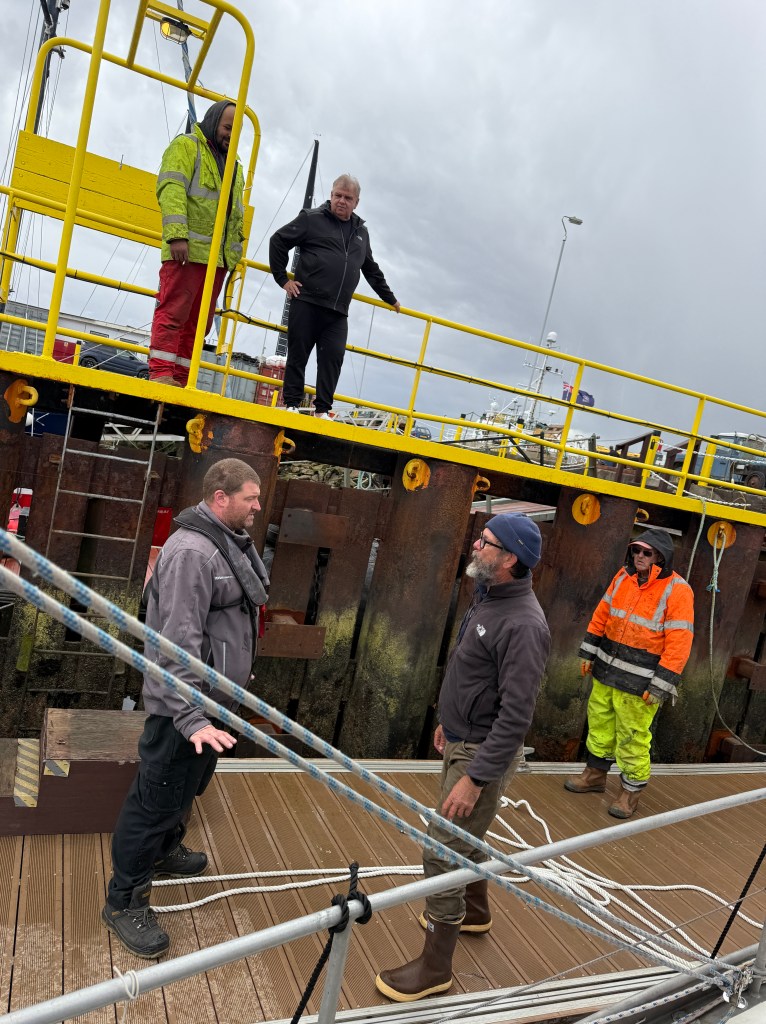
Above: Here we are just seconds after we landed. Most sailboats have to anchor in the harbor and take their dingy to come ashore. Pulling up to a dock or pier is much preferred by most due to convenience. Randall was able to get this privilege due to a referral to a local “fixer” by the name of Paul – we got his name from our pal Victor (Piriápolis) who was referred by Carlos (Rio). You get the picture.
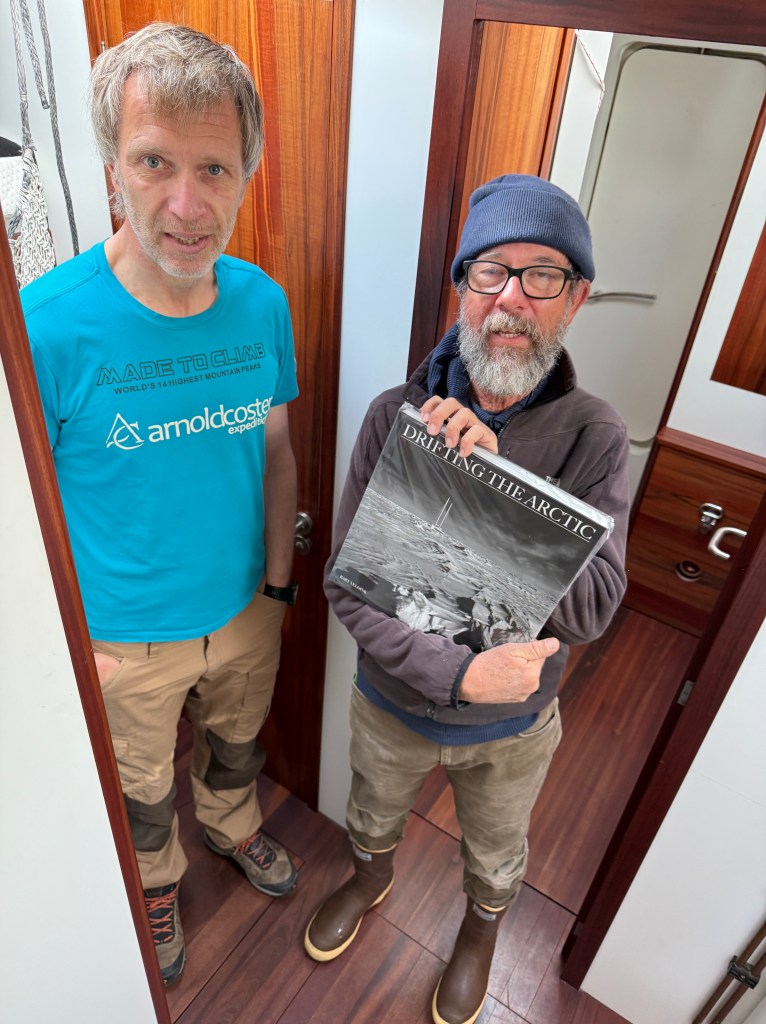
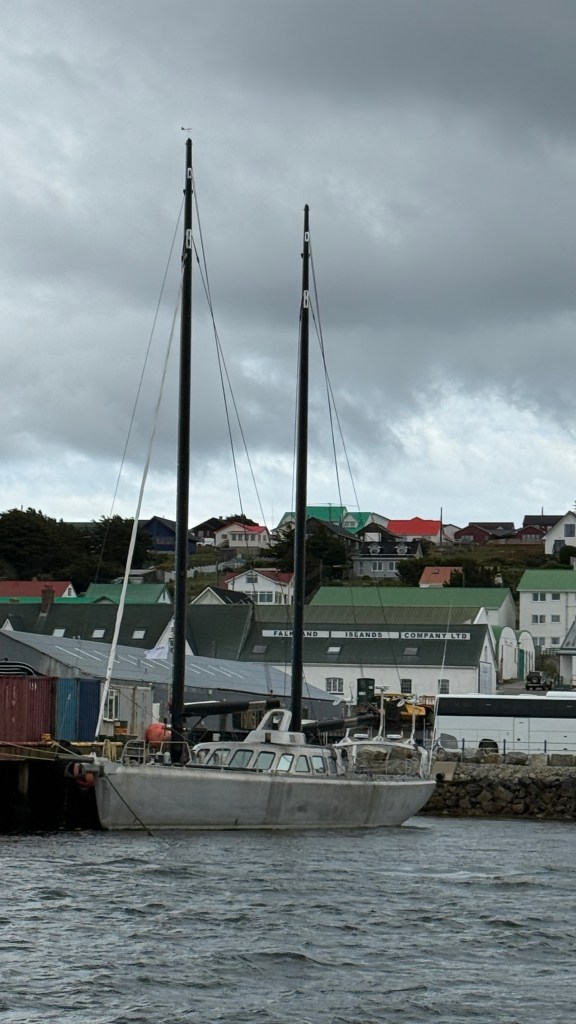
Above: We could not help notice the massive the aluminum NanuQ docked directly across from us. Randall and I were sniffing around the boat and out pops her owner, Bart who recognizes Randall (they had never met) from his Figure 8 exploits. Several years ago in the Arctic, Bart froze himself in for something like 18 months (solo!). He wrote/commissioned the most amazing book of photographs I have ever seen. Here he is giving one to Randall. Should I add that this is Randall’s dream to be frozen for a winter or two….?
NanuQ is a Polar Expedition 78 that has a fully retractable keel, rudder, drive train & propeller, which allows the boat to be frozen into the ice without risking damage. The aluminum hull plates are 25mm thick and 40mm in some areas. The rig has two free-standing rotating carbon masts with furling carbon booms. Each wingmast can rotate +/- 140 degrees using hydraulics with an array of 20 solar panels mounted on each side, totaling 40m2 of panels for generating power. Wow.
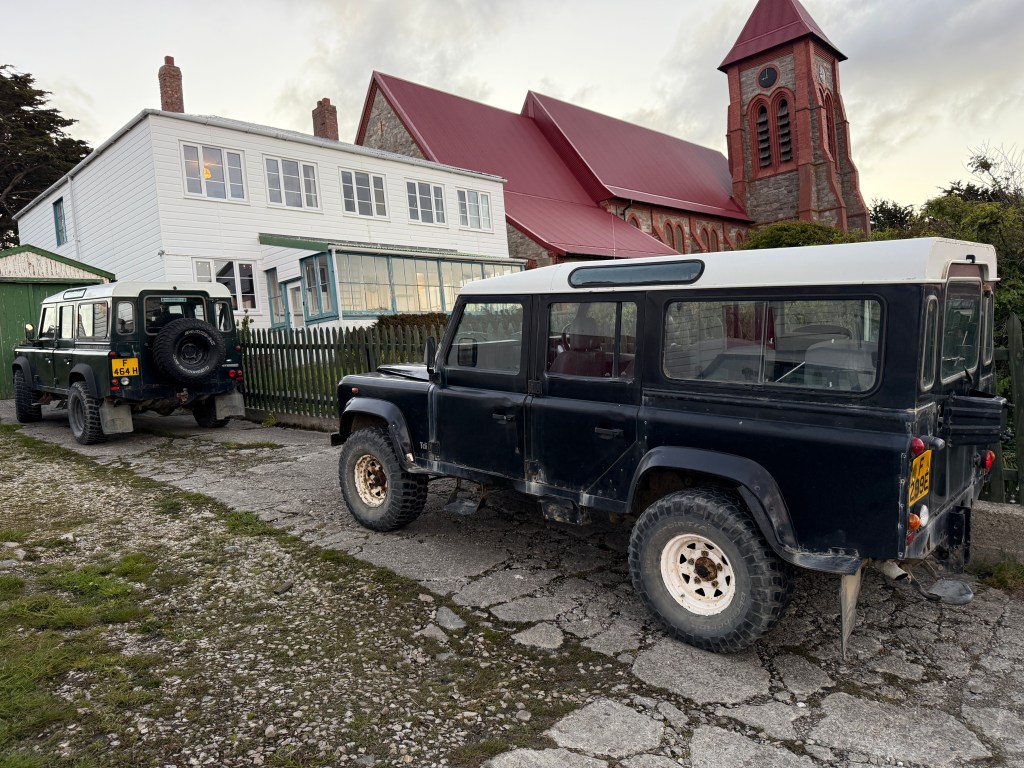
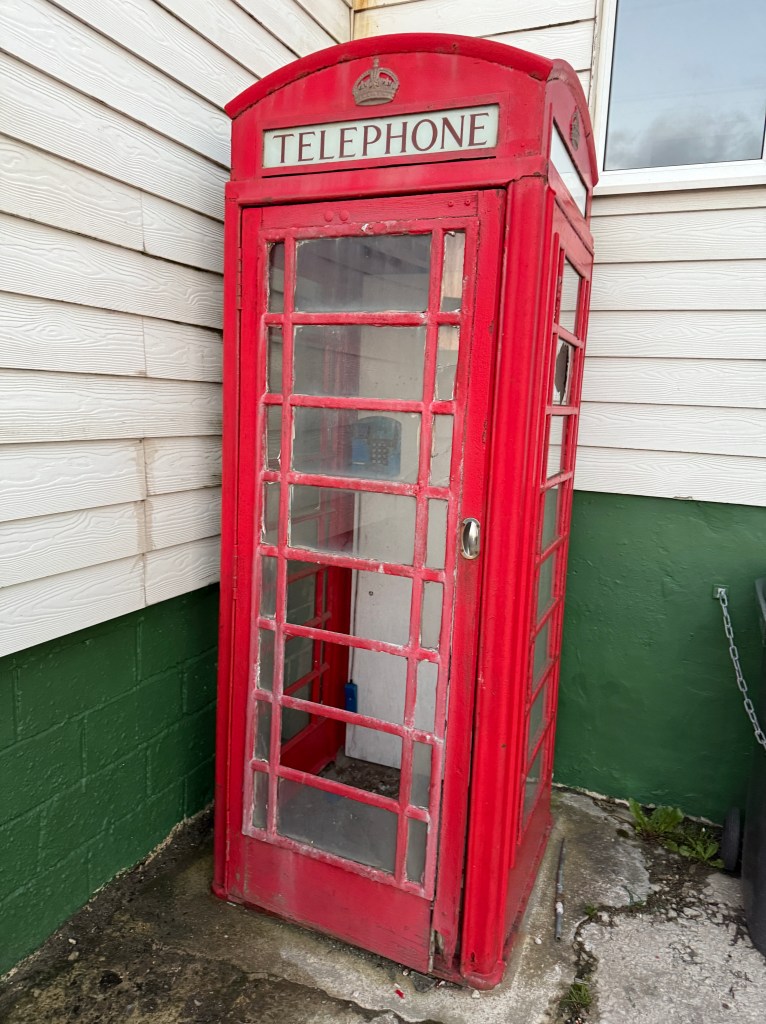
Above and Below: To the untrained eye, Stanley exudes the feel of an old-fashioned British coastal town. We loved seeing the abundance of Land Rovers – everybody seemed to have one or two. We also loved the traditional telephone booths -while not functioning, they were not put out of commission so long ago. So fun to look at.
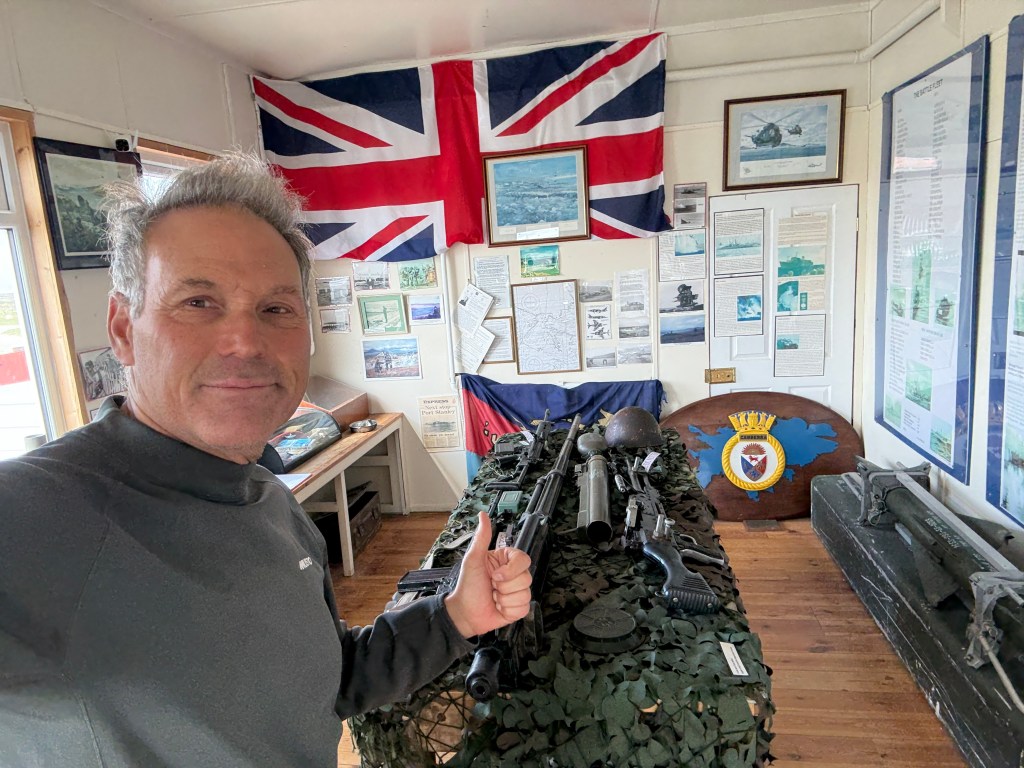
Above is a small field museum set up to commemorate the Falklands “war”. According to the Imperial Was Museum, the Falklands conflict was a short undeclared war between Argentina and Britain that took place from April 2nd to June 14th in 1982. It was fought over the sovereignty of the Falkland Islands (Islas Malvinas), South Georgia and the South Sandwich Islands.
Argentinian forces invaded the Falkland Islands, followed by South Georgia and the South Sandwich Islands. Despite being 8,000 miles away, Britain sent a task force of warships and merchant ships to the South Atlantic. Fierce fighting in the air, at sea and on land culminated in the surrender of Argentinian forces in South Georgia on April 26th 1982 and the Falkland Islands on June 14th 1982.
The conflict lasted 74 days and cost over 900 lives (225 British and at least 675 Argentinians). The outcome of the conflict was arguably a turning point for the leadership of Margaret Thatcher (up!) and for Argentina’s President Leopoldo Galtieri, who was removed by his own Government following the defeat. https://www.iwm.org.uk/history/cold-war/falklands-conflict
Our guide who studied in a remote boarding school near the museum shortly after the war reported an abundance of rifles and machine guns left to fallow by both sides. He and his friends were free to shoot the armaments until they were collected by the authorities long after the conflict ended.
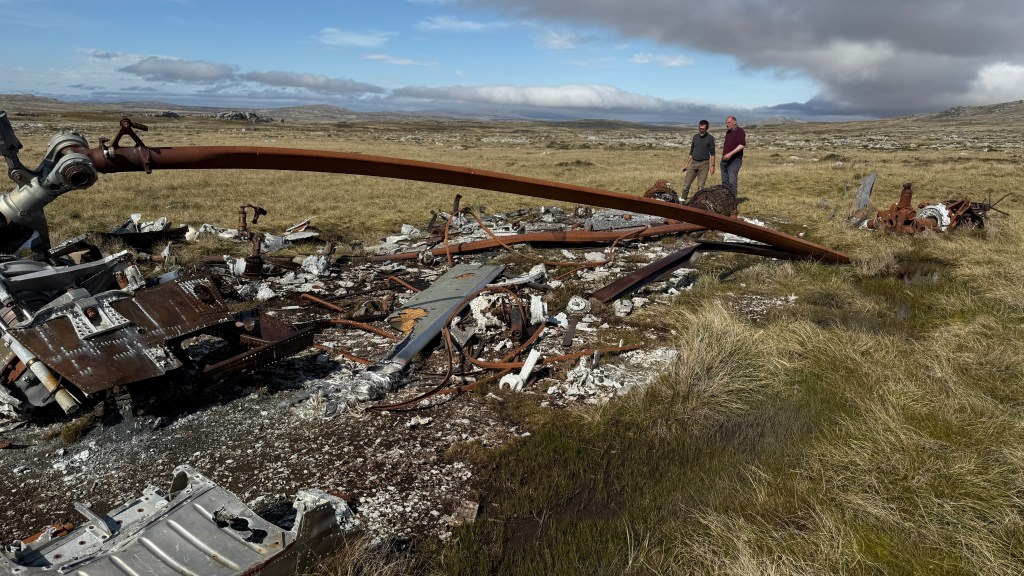
Above: There are surprisingly few war ruins or relics on the island. Above is the wreckage of an Argentine Chinook helicopter that crashed or was destroyed during the war.
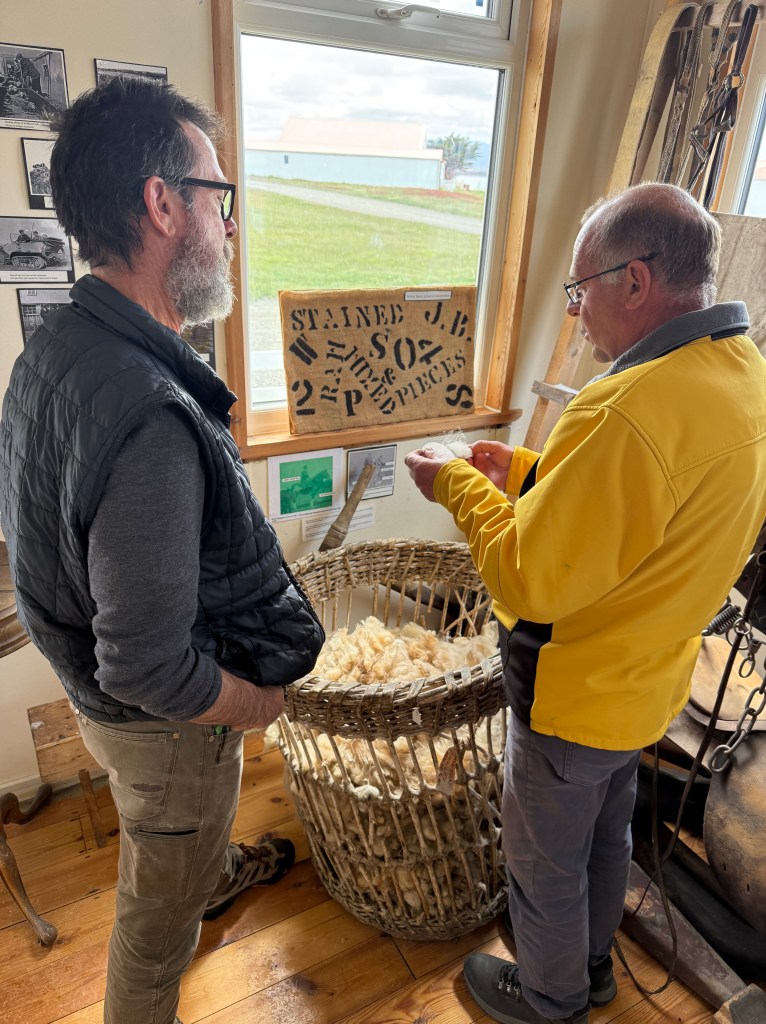
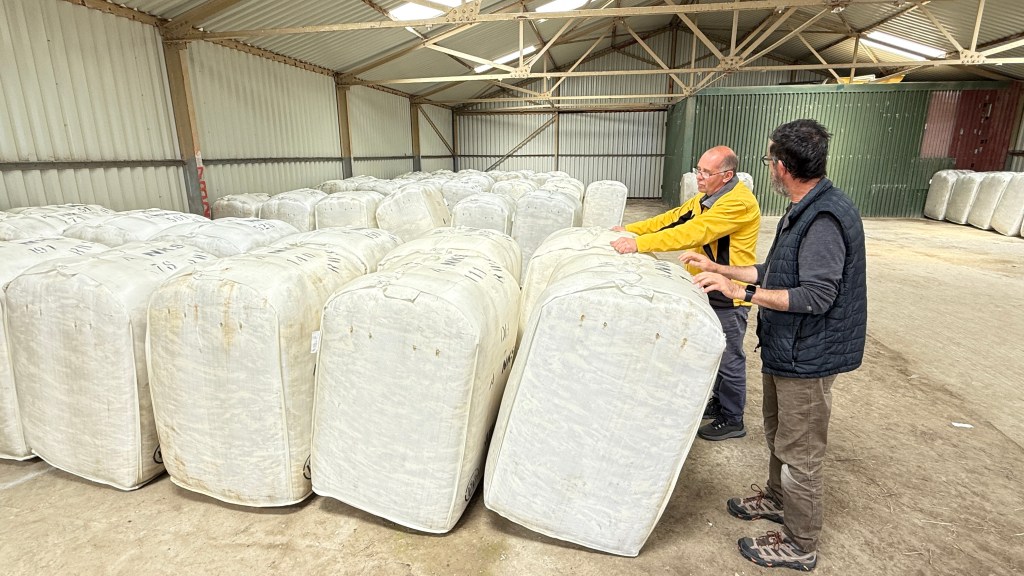
Above and Below: While fishing is now the dominant industry in the Falklands (oil coming soon!), wool farming remains crucial, contributing significantly to the GDP and employing many. Islanders in fact do not export any lamb for consumption. It is wool only! Below, Randall and our guide sorting through bales of wool.
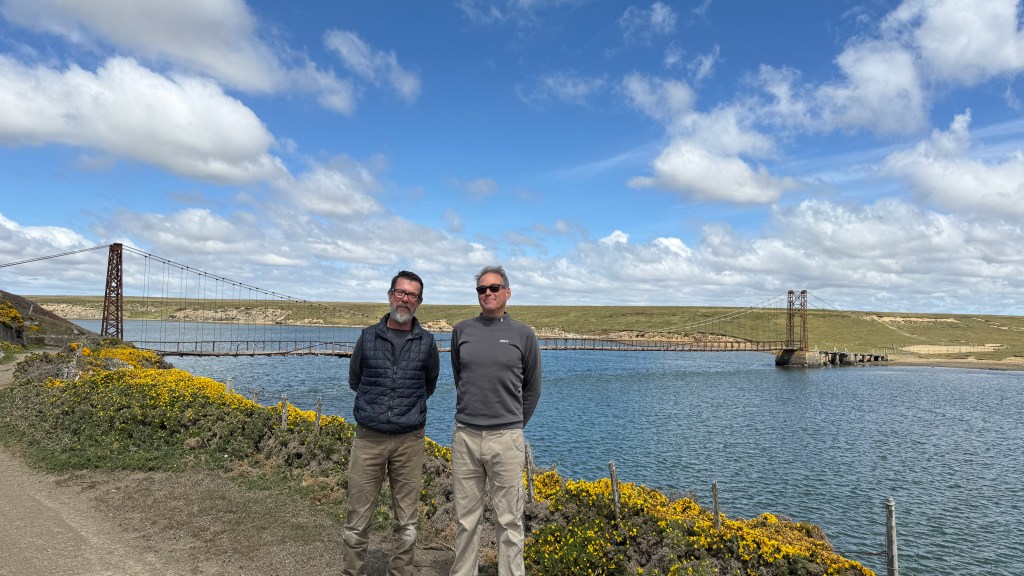
Above: Every country seems to have their “bridge to nowhere” . The Bodie Creek Bridge was built by the Falkland Island Company in 1925 to get sheep across from Walker Creek to Darwin to shear. There was so much money back then in wool (think WWI and beyond) that it paid to construct this 400 foot suspension bridge that was designed and manufactured in London. It is the worlds southern-most suspension bridge, and unless someone fixes it up, it will be the last!
HERE COME THE ELEPHANT SEALS!
The Southern Elephant Seal visits the Falkland Islands for breeding, pupping and molting. Males arrive around September for territorial battles, followed by females for pupping (late Sept-Nov), with pups staying ashore for several weeks before returning to the ocean. Adults then come ashore again in summer (Jan/Feb) to moult. They are the world’s largest seals, known for their impressive size and loud, constant chorus of sneezing, belching, and flatulence.
They have remarkable diving capabilities which are reflected in some of their physical traits. Very large eyes, containing high densities of rod cells, aid them to see in low-light conditions. Their highly sensitive vibrissae (whiskers) detect subtle movements in the water, crucial when foraging in the dark depths of the bathypelagic zone (1000 – 4000m), where sunlight doesn’t penetrate the water column.
Both sexes are extremely robust with thick muscular necks and a substantial layer of blubber. The male’s most distinguishing feature is their inflatable proboscis, which develops at sexual maturity and is used to produce vocalisations, especially during the breeding season to assert dominance and establish their territory.
Their extreme size limits their terrestrial movement. Like other phocids they cannot support their own body weight and utilize their hind flippers when moving. Instead, when on land they get around by rhythmic undulations of their body known as, ‘galumphing’.
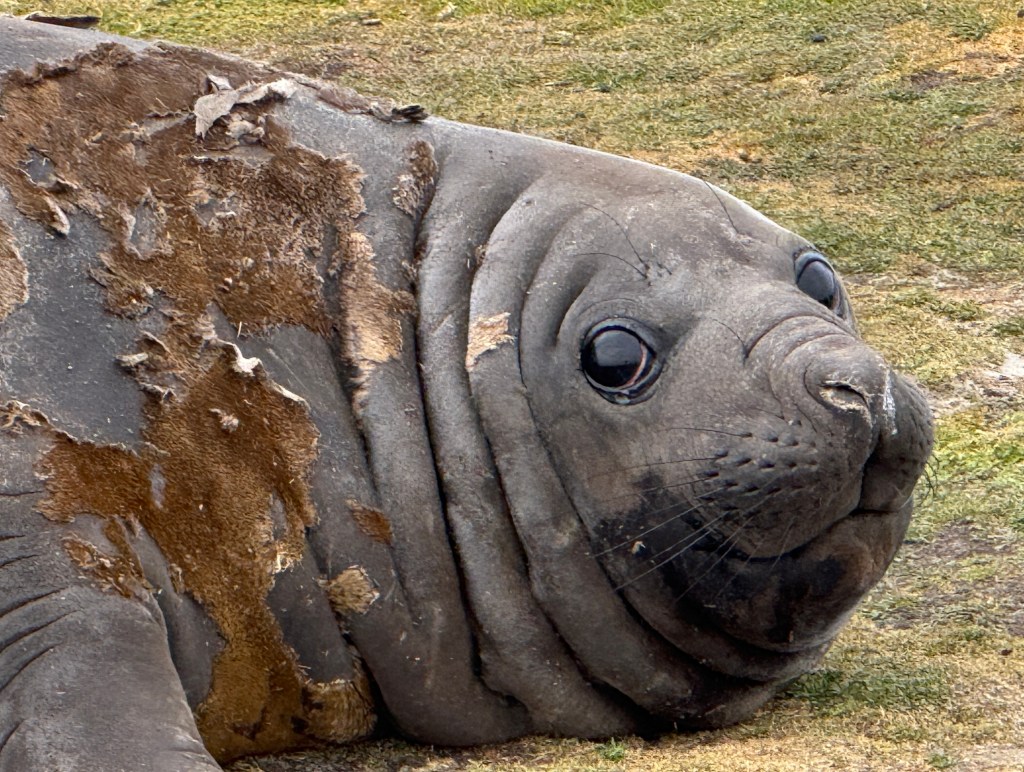
The day after we arrived, I headed out to Whale Point to see my favorite pinneped. On the beach were mostly mothers and babies a couple of months old, with some “teenagers” and just a few males. As you can see, they are moulting into their summer coat.

While their open mouth makes them look angry or growling, they are really just yawning!
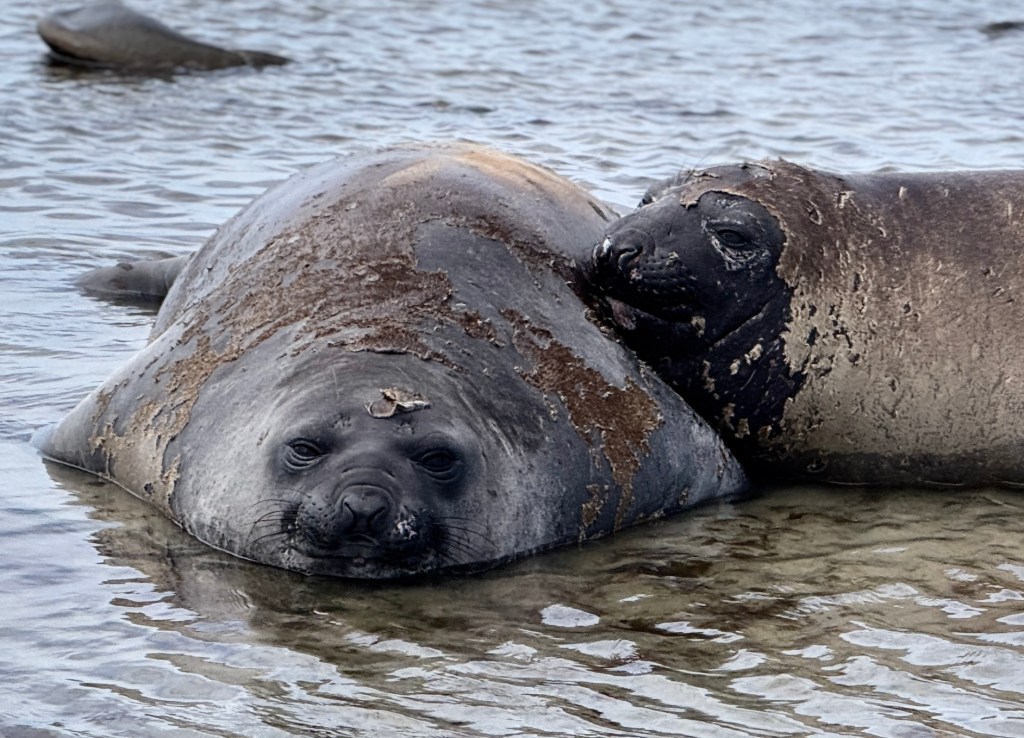
They are mostly just relaxing.
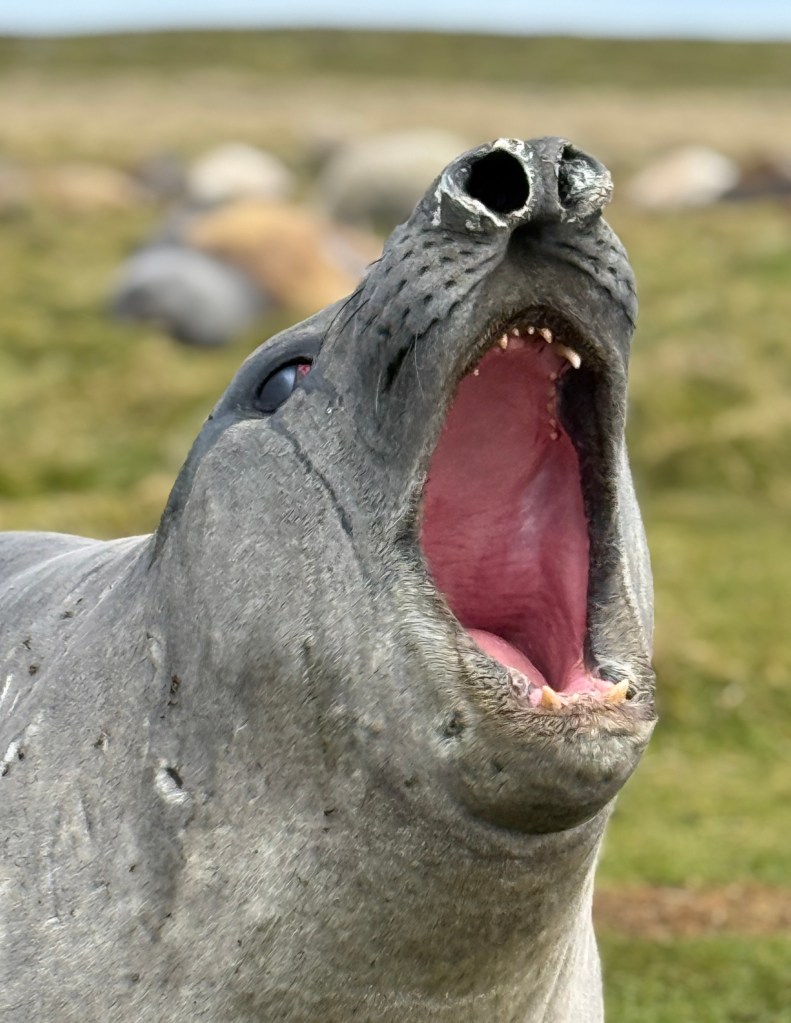
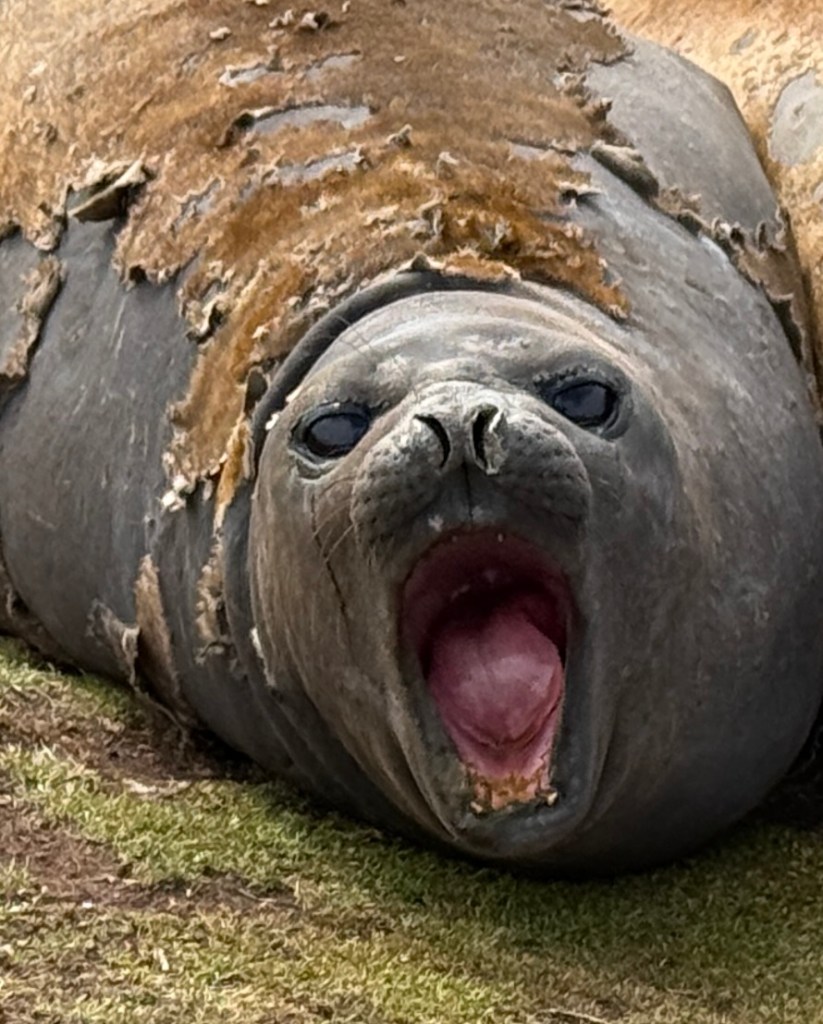
Above: They love to lay on the grass and sneeze!
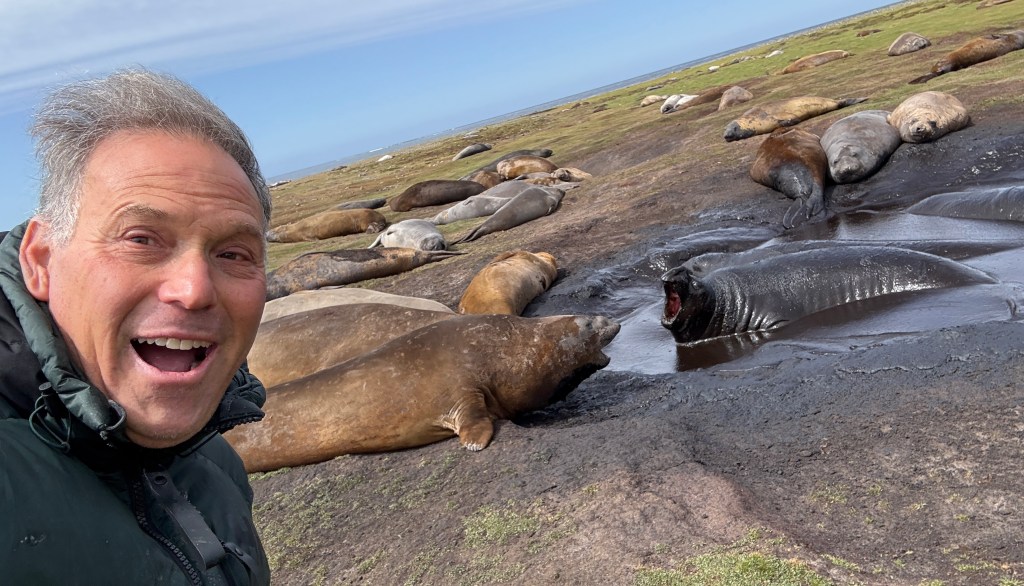
Above: They seemed to absolutely love the mud bath.
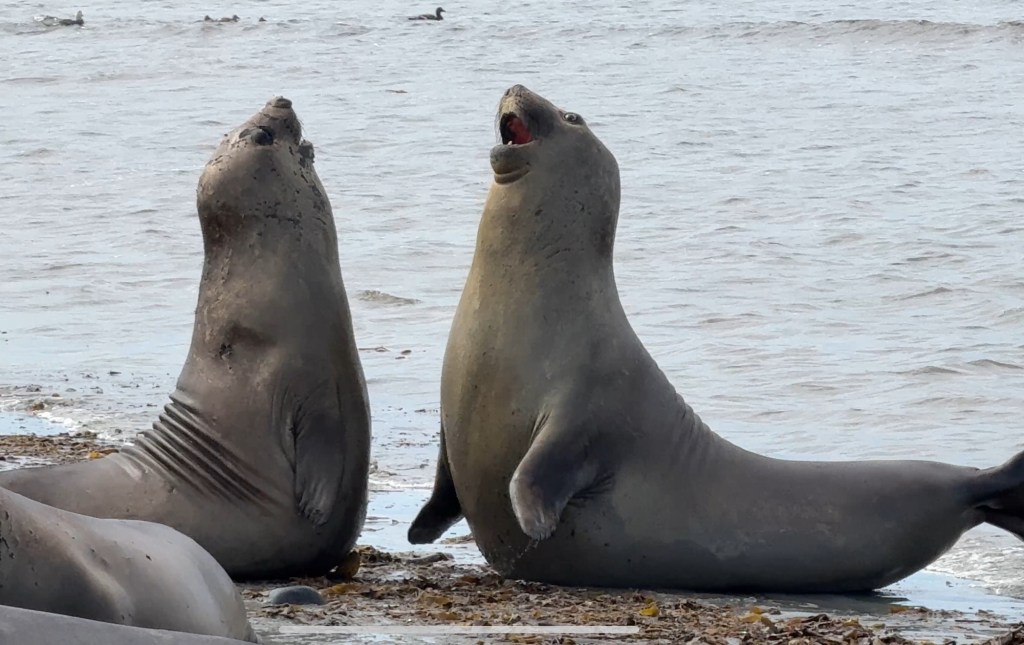
These are “teenage” males actually a year or two old. They are learning how to fight, but seem to be having an enjoyable time playing with each other.
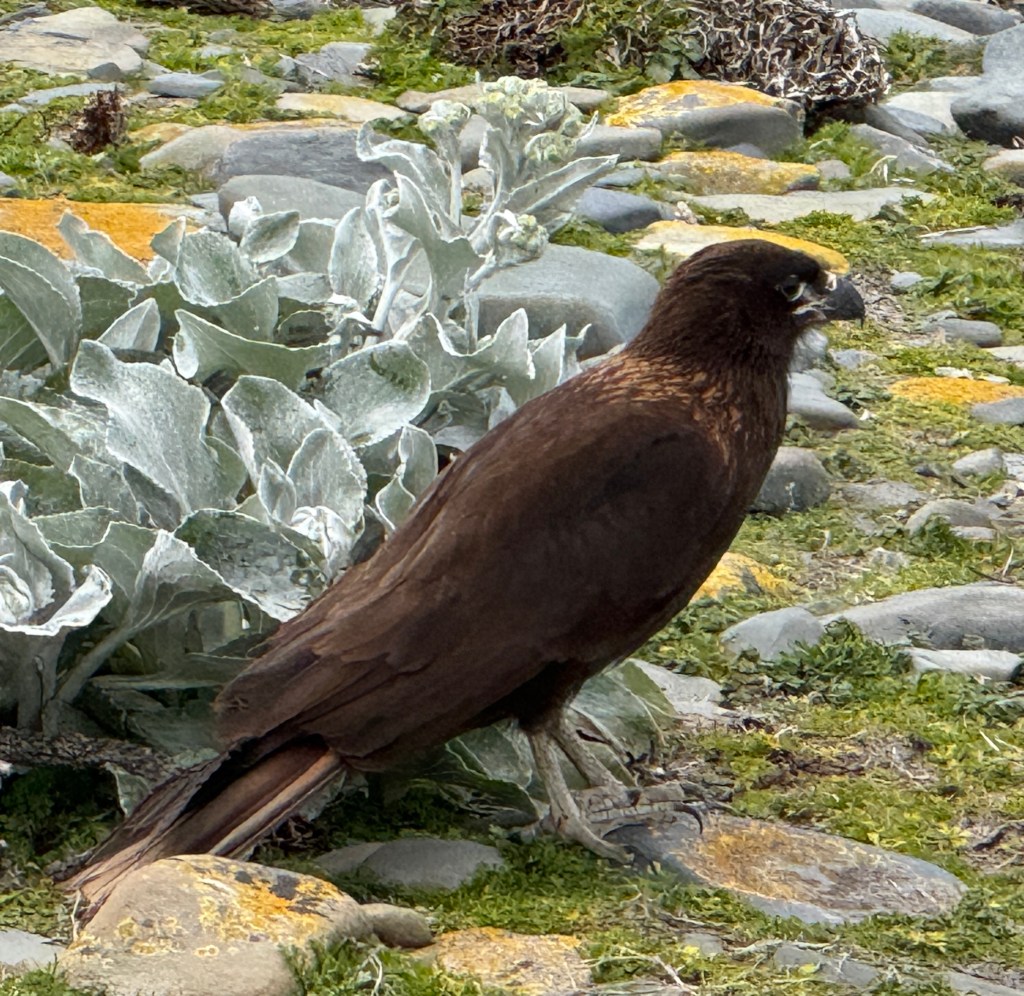
Above: This is a Caracara bird – known as a bird of prey that are known for their intelligence and curiosity. They are primarily scavengers, but can work in groups and can solve complex puzzles to find food.
Above: Here is our friendly Caracara helping the elephant seal to shed (also known as getting lunch!
Please standby for the Penguins!!
Thank you for following!!


 Harmon and Randall's Voyage...
Leave a reply to tcgibb Cancel reply