Leg 4, Blog 9, December 31, 2025
The Falkland Islands are famous for their penguins hosting five breeding species: Gentoo, King, Magellanic, Macaroni, and Rockhopper, with around one million penguins nesting there annually, making it one of the world’s best locations to see penguins. Within two days, two trips to two parts of the islands, I was able to see them all and take these pictures with my phone.
The Falkland’s have so many penguins because of abundant, nutrient-rich cold waters (thanks to Antarctic currents) providing plentiful food (krill, squid, fish) plus the absence of major land predators.
1. GENTOO PENGUINS
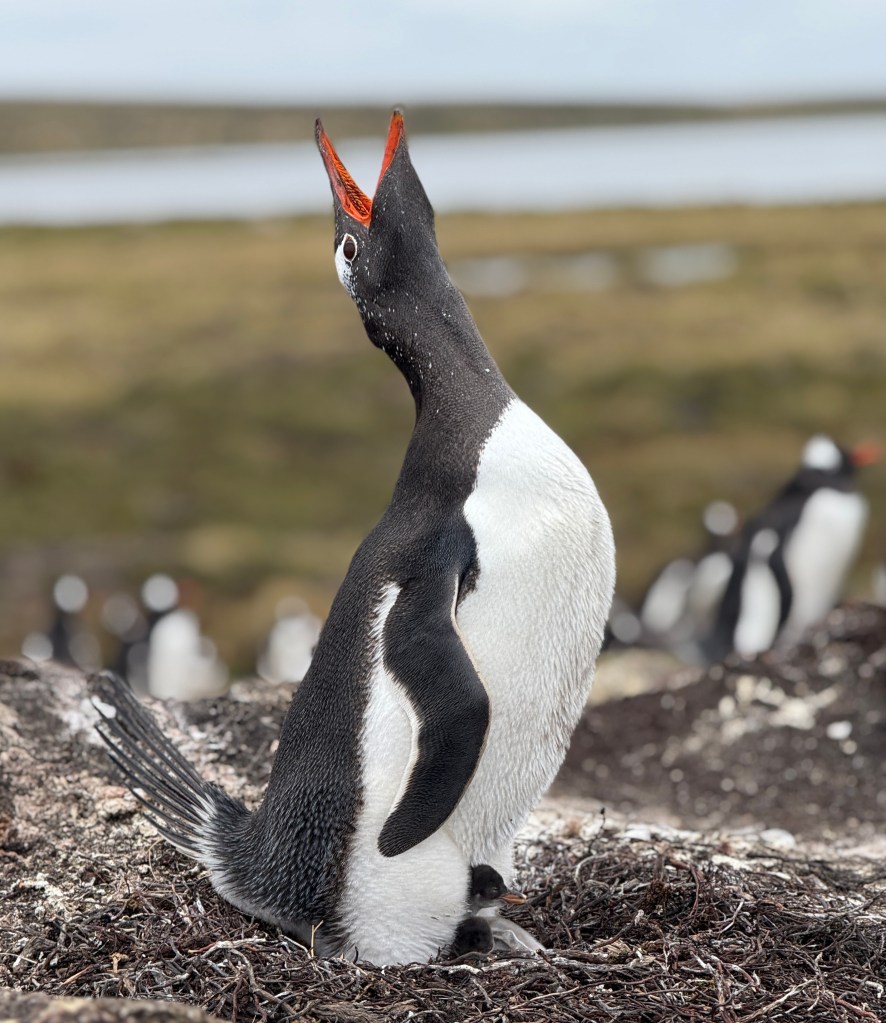
The Falklands hold the world’s largest Gentoo penguin population, with over 121,000 pairs counted in a 2010 census, making them a crucial global stronghold for the species. They have a striking white bar across the top of their heads, a long orange-black bill, and orange feet, with silvery-white undersides.
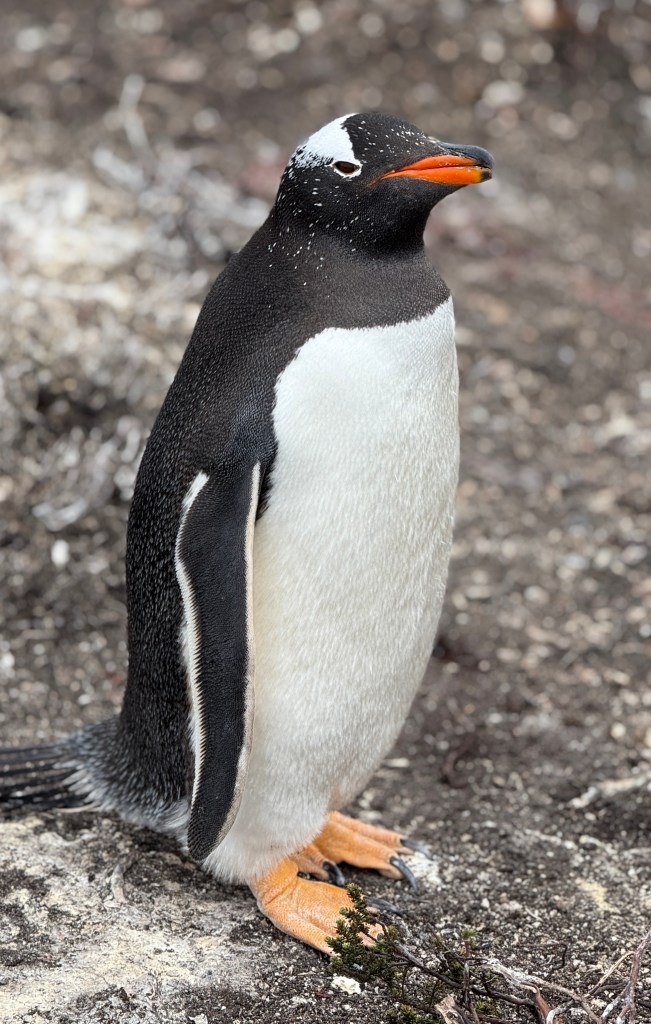
Unlike some polar species, Gentoos live in the Falklands all year, with colonies spread across the archipelago.
Gentoo’s build prominent nests from piles of pebbles and twigs, often in dunes or grassy areas that eventually turn barren from overuse. Both parents share incubation and chick-rearing duties.
A baby penguin is most commonly called a chick, but can also be referred to as a nestling, and a group of them huddling together is known as a créche.
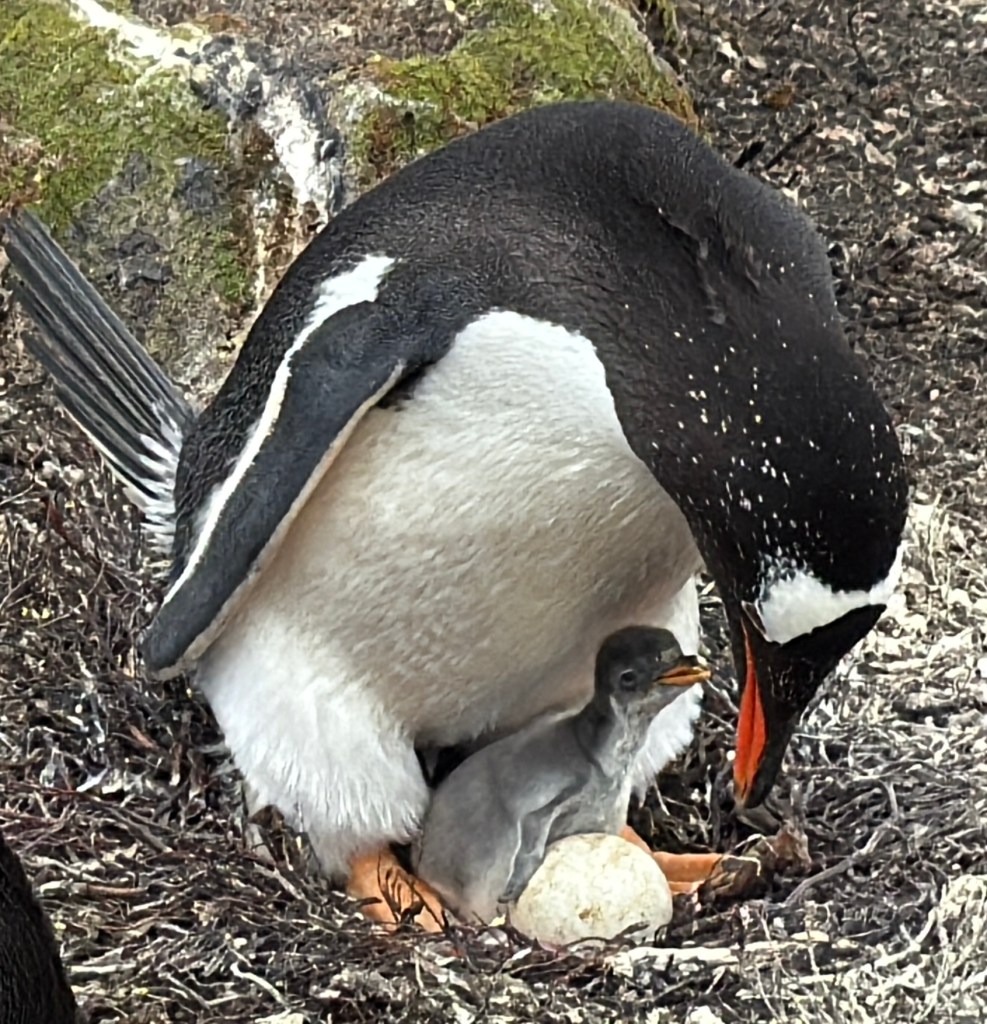
Gentoo penguins are dedicated parents, co-rearing their two chicks by sharing incubation duties, then both parents feed them regurgitated food until the chicks grow and then form protective “crèches” (daycare groups) for safety allowing adults to forage, with chicks becoming independent around three months old. Both parents diligently feed and guard their fluffy chicks for the first month before the crèche phase begins, ensuring the young grow quickly and learn essential survival skills before fledging.
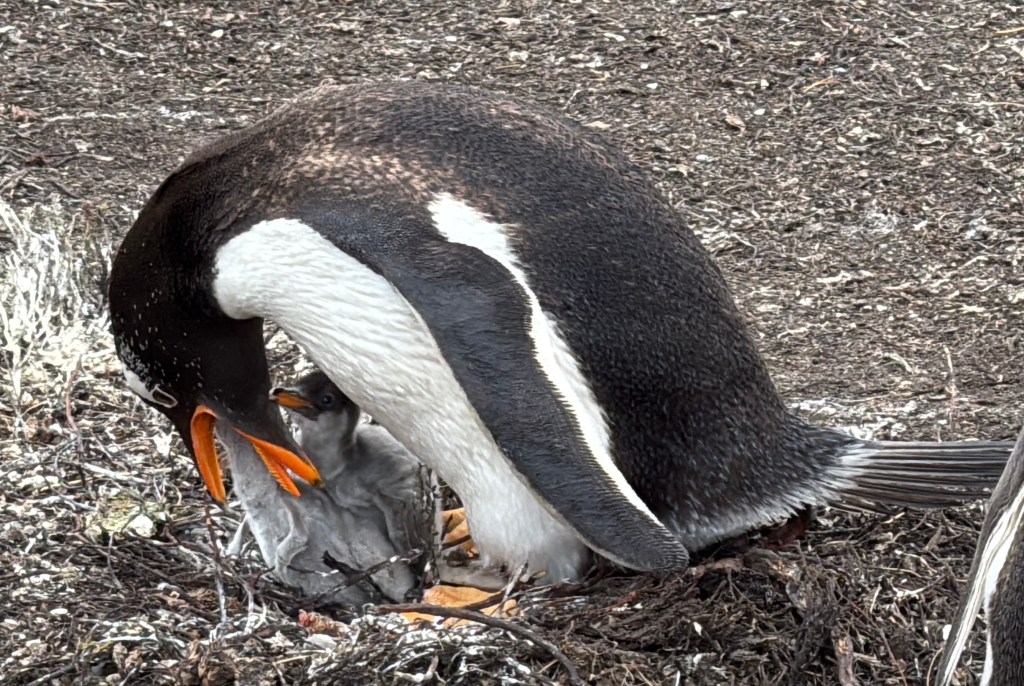
Watching the mother or the father feed their young is such a moving experience. I can only imagine doing this with my kids!
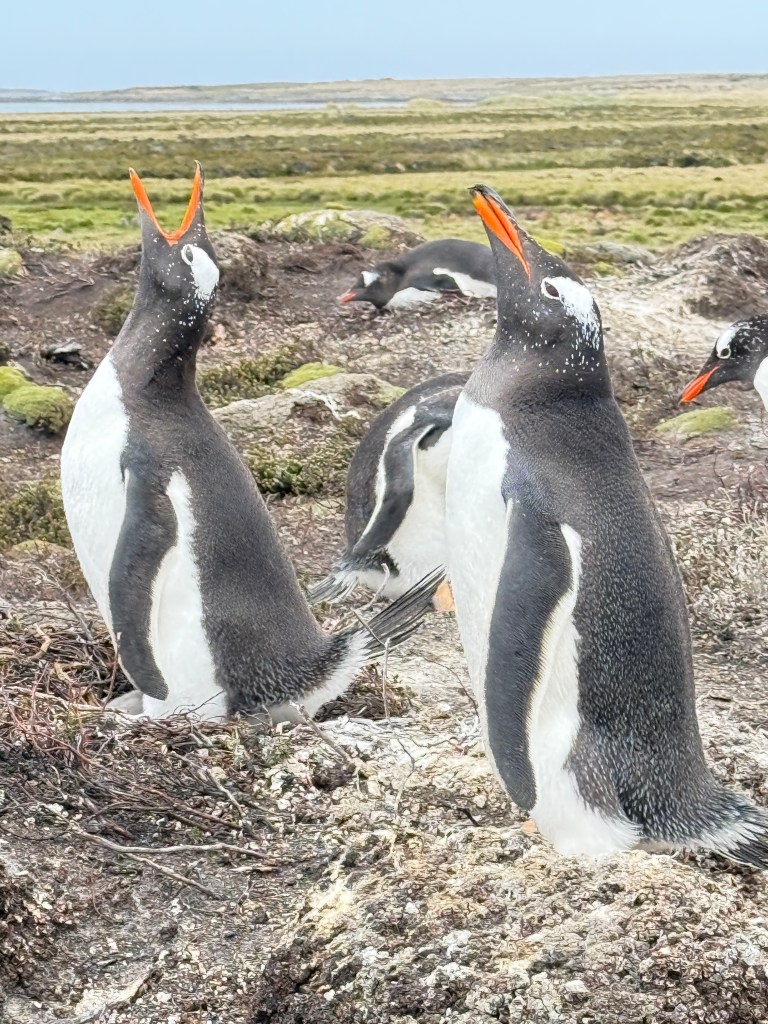
Gentoo penguins make a loud trumpet, honk or bray sound. This distinctive call is an individually identifiable “song” essential for communication within their large colonies for purposes of mate recognition, courtship display, pair bonding and territory defense.
2. KING PENGUINS
The Falkland Islands hosts the worlds second largest colony of King penguins (South Georgia Island being the largest). Standing almost three feet tall, they are the second largest of the penguin species (only Emperor penguins are taller at up to four feet).
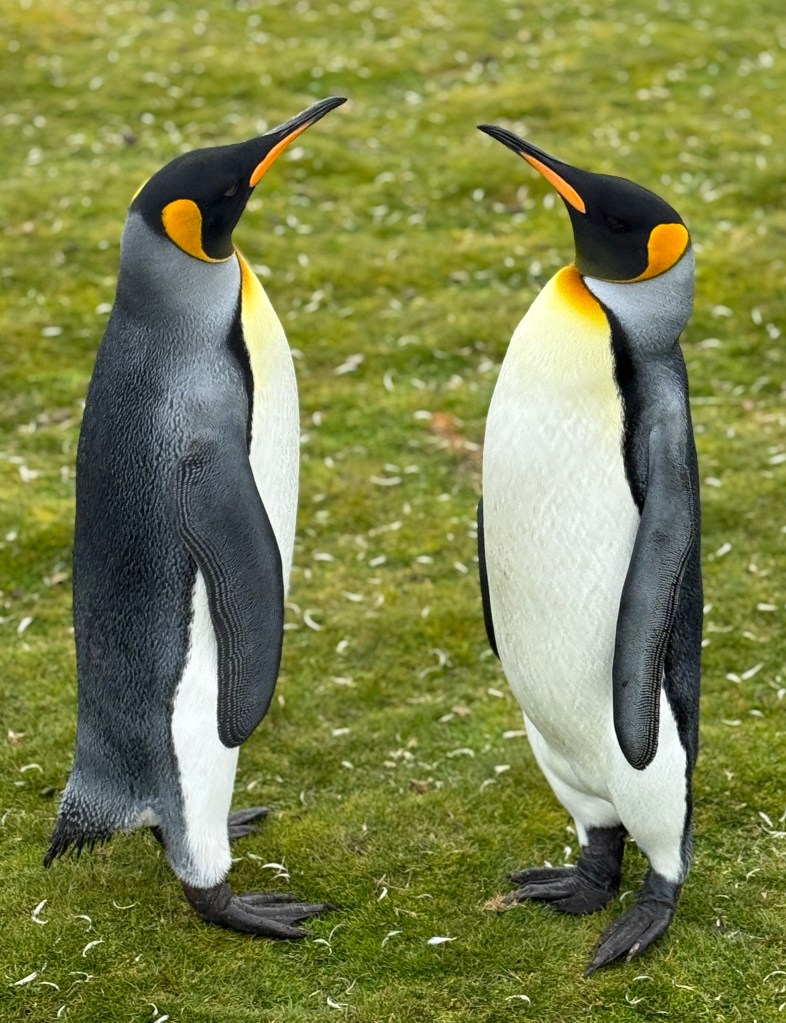
Above: King penguins exhibit an almost eerie, human like behavior in the way they walk, stand, and communicate with their friends and loved ones. More on this below.
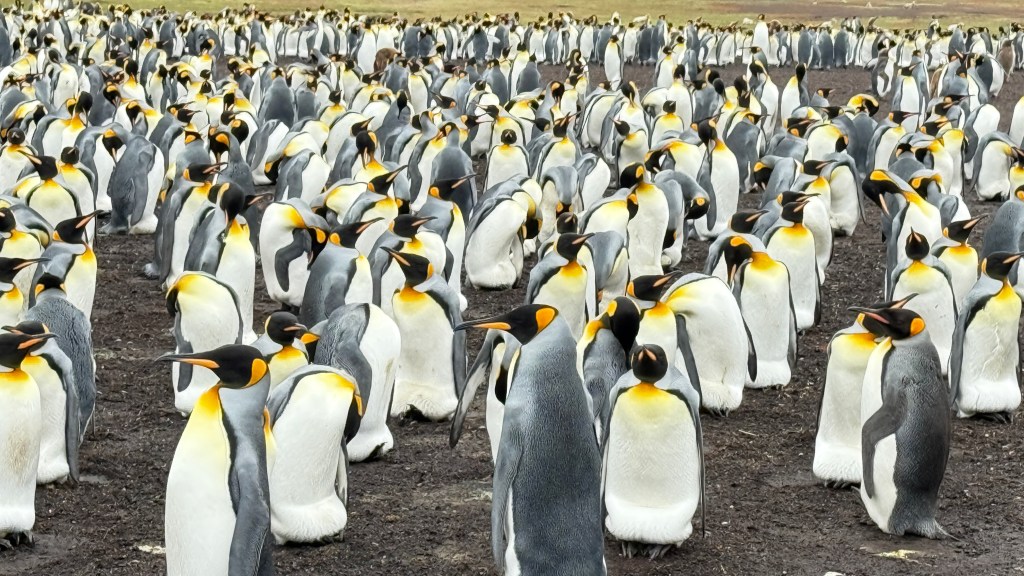
Above: A king penguin colony is a vast, noisy, densely packed gathering characterized by thousands of birds year-round due to their long breeding cycle. They huddle for warmth and form communal chick crèches for protection, but unlike other penguins, they carry their single egg on their feet instead of building nests, creating distinct areas for breeding adults, moulting birds, and young chicks.
King’s stand tall, are well-adapted to cold, and are easily identified by their bright markings and fluffy brown chicks that look like different species.
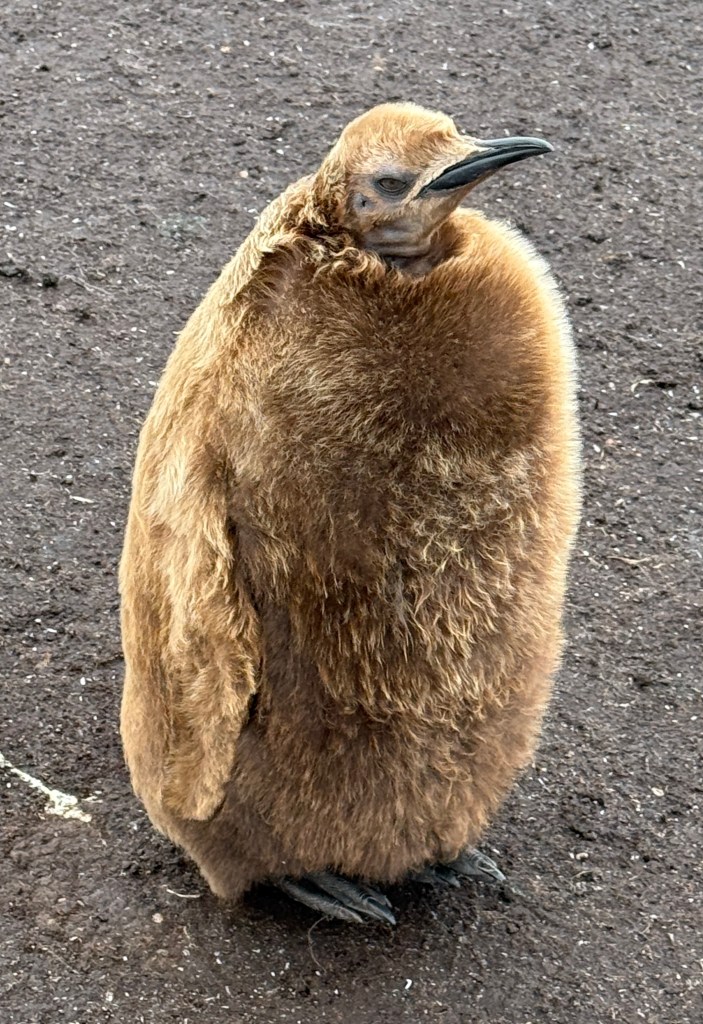
Above: Prior to the moulting process, the “teenage” King looks cool and regal in their brown feathery coat.
Below: Once the moulting process begins, the King appears scruffy, disheveled, and grumpy-looking as it undergoes a “catastrophic moult,” where it replaces all of its feathers at once on land over a period of two to four weeks. During this time, the penguin is unable to enter the water to feed and relies on its fat reserves.
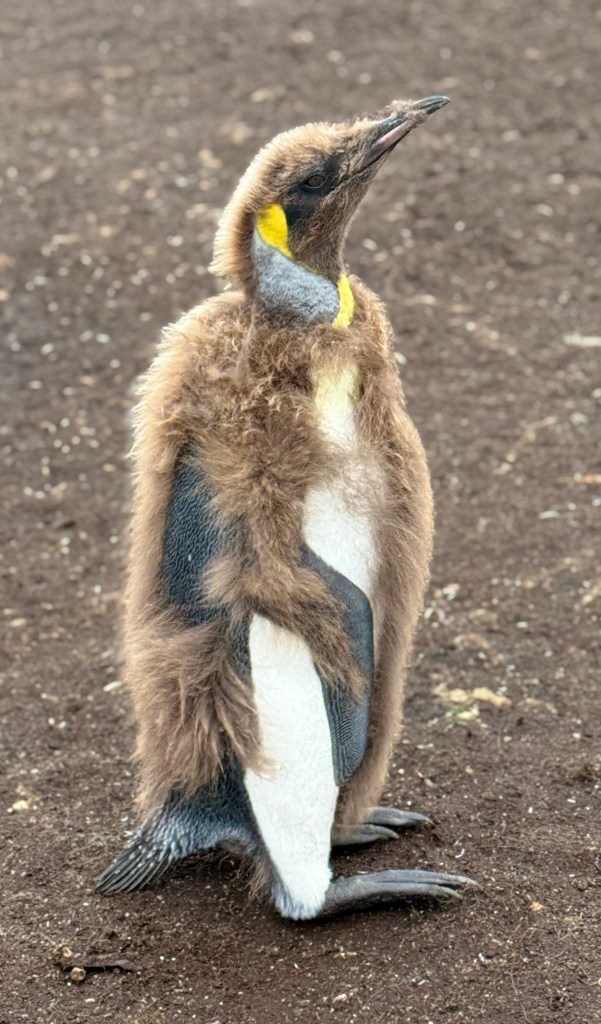
Above: That awkward, in-between time…
I found it fascinating that the moulting Kings sequestered themselves off in one location, together in their teen angst with feathers all over the place.
The above King is nearing the end of their moulting process. Almost an “adult”!!

King penguins exhibit several behaviors that humans often interpret as “human-like”. They form strong, long-term monogamous bonds with partners. Both parents share in the responsibility of protecting and feeding their young. They are naturally curious and often approach humans to investigate. In harsh weather they huddle together to conserve heat, taking turns moving between the warm center and colder outer edge. They can stand in one place for quite some time, just contemplating penguinhood.
Above: This might seem obvious, but King penguins flap their wings at each other primarily for communication, establishing dominance, defending territory, and during courtship rituals, using these powerful wing beats as visual signals to say “stay away,” “this spot is mine,” or to assert fitness to potential mates in their crowded colonies. They will flap way before they will peck.
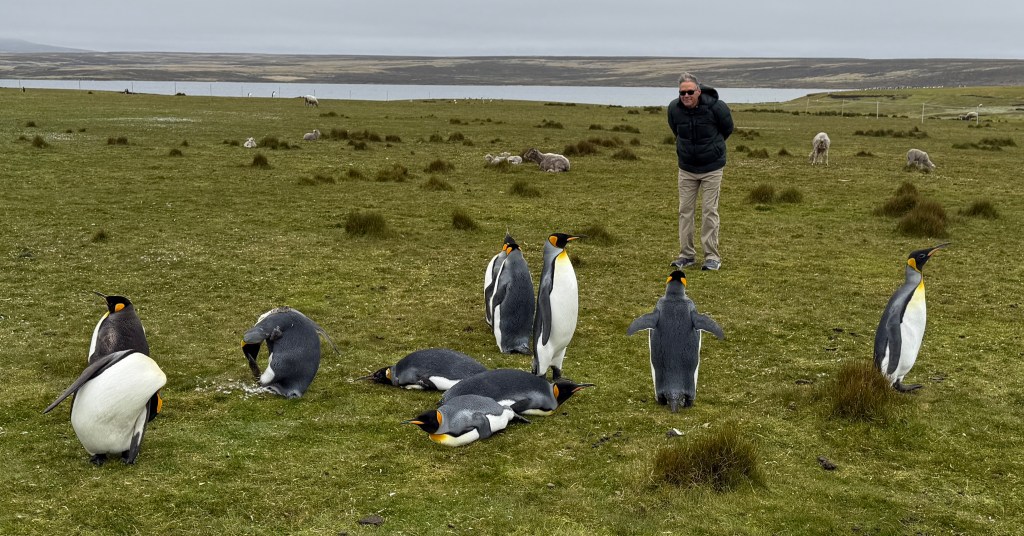
Above and Below: Randall and I were virtually alone in the vast King colony. Each of us, in our own way, strived to make our own connection without disturbing their peace.
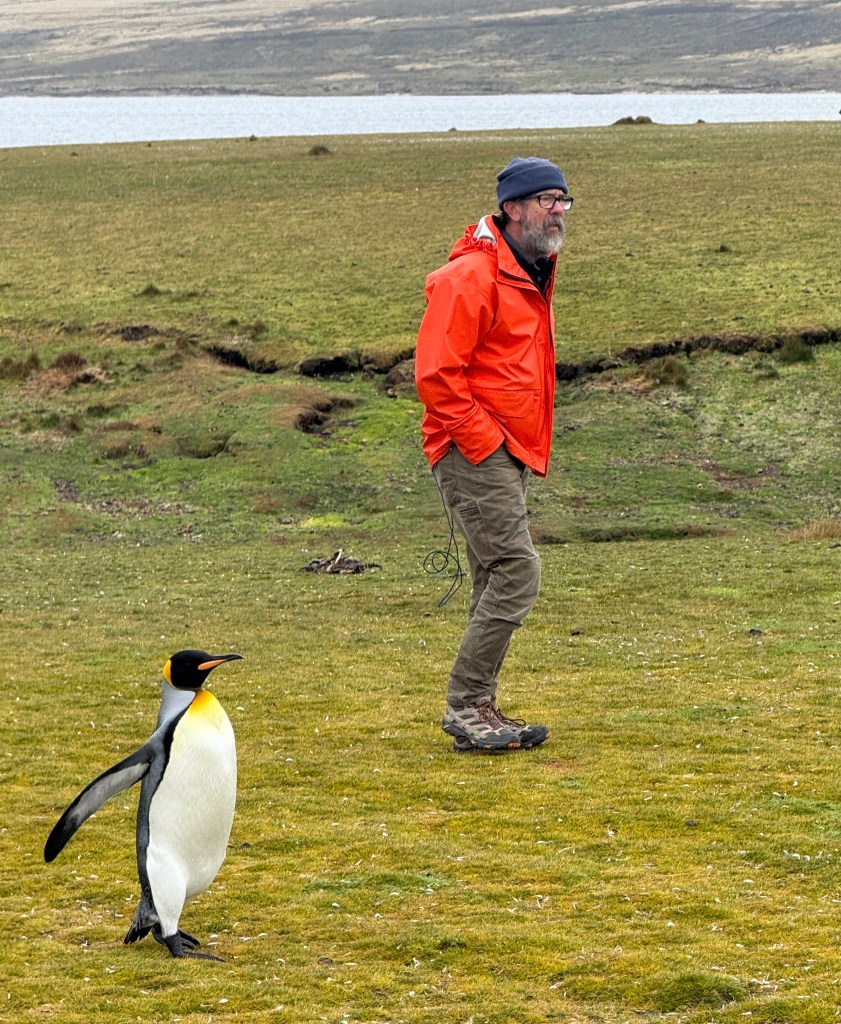
Above: I got the biggest kick out of watching these four Kings as they walked, talked and argued with each other. Reminds me of my friends and family (no names!!)
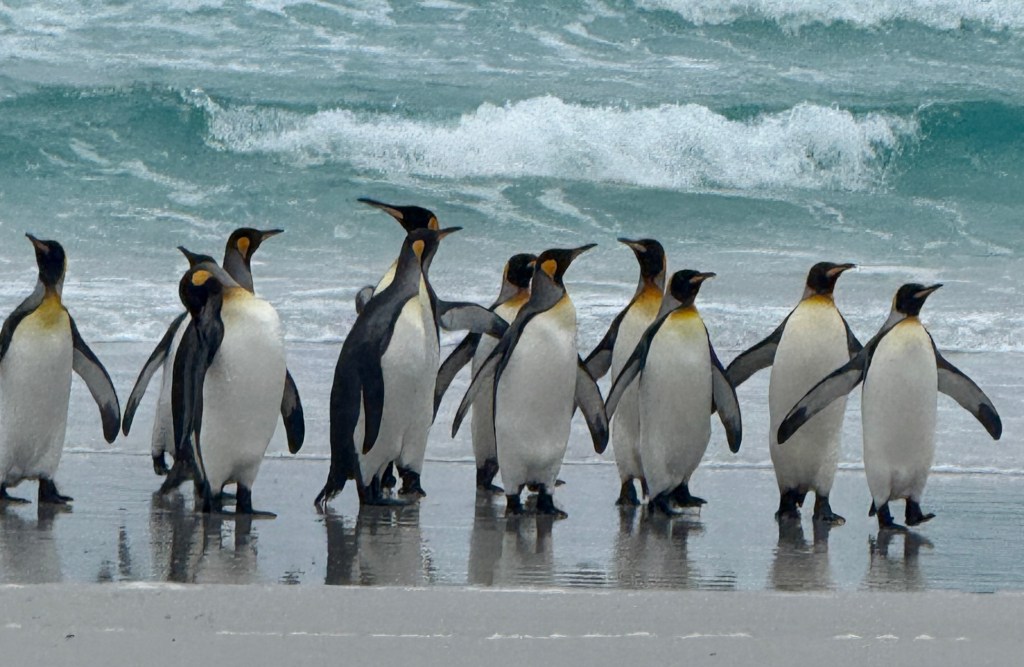
Down at the beach, it became clear that the penguins were more in their element in the frigid water than on land. They loved hanging out on the deserted beach. They would walk around, and then at some point when they were ready, wade into the surf and swim away.
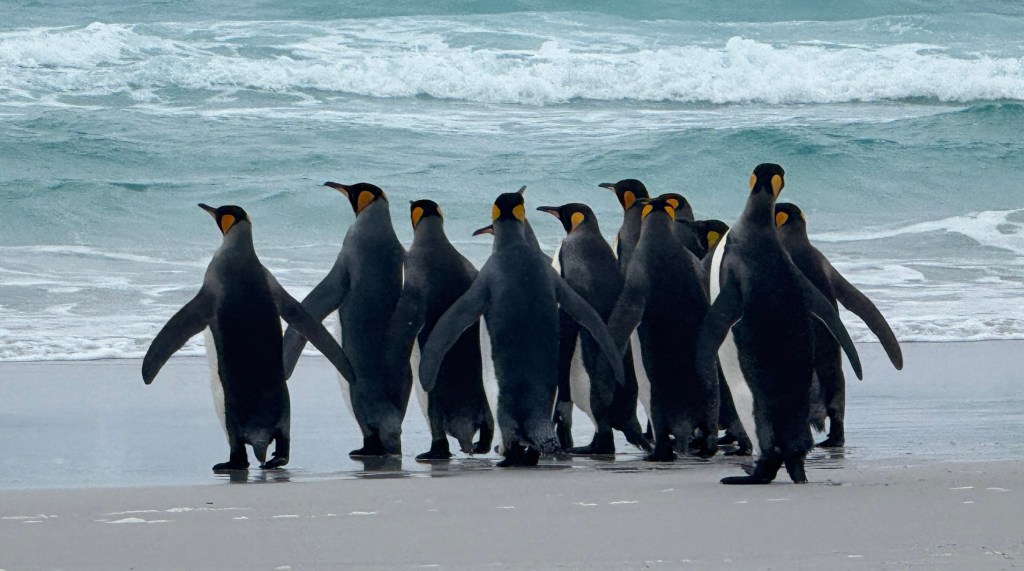
Above: Settling in for a swim.
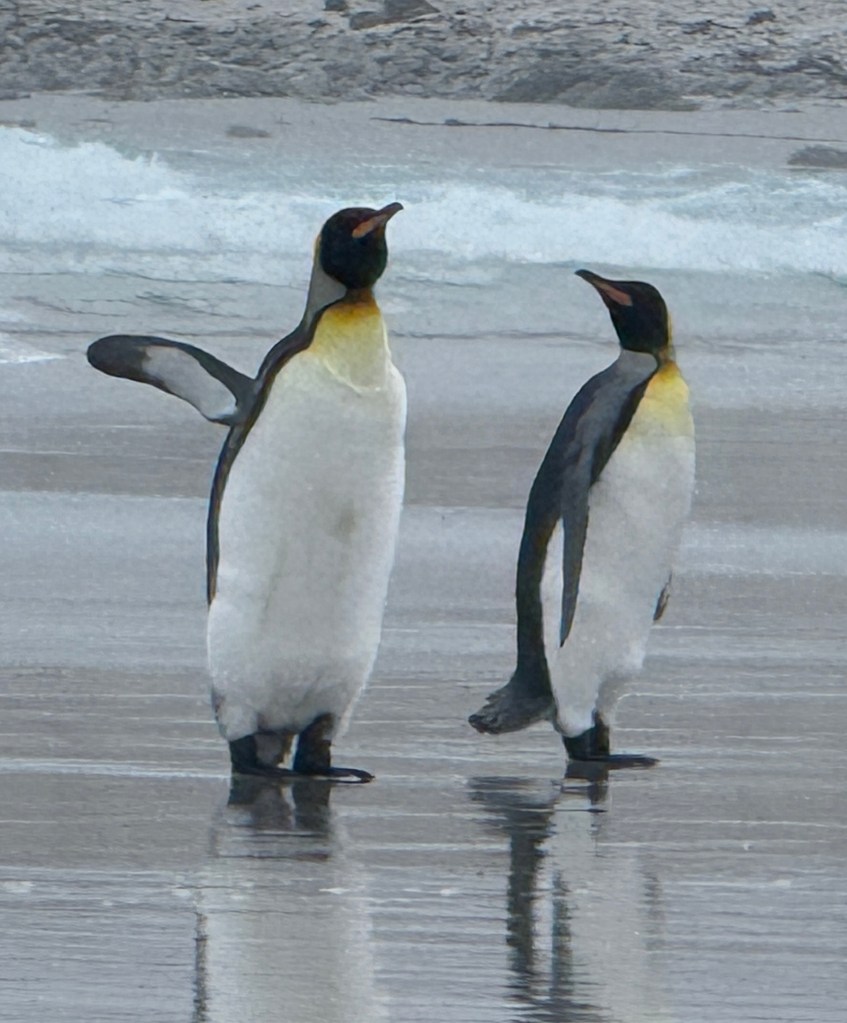
Above: A husband and wife (I think) having a chat before their swim.
Above: This is one of my favorite videos. Five friends just out for a walk. Enjoy.
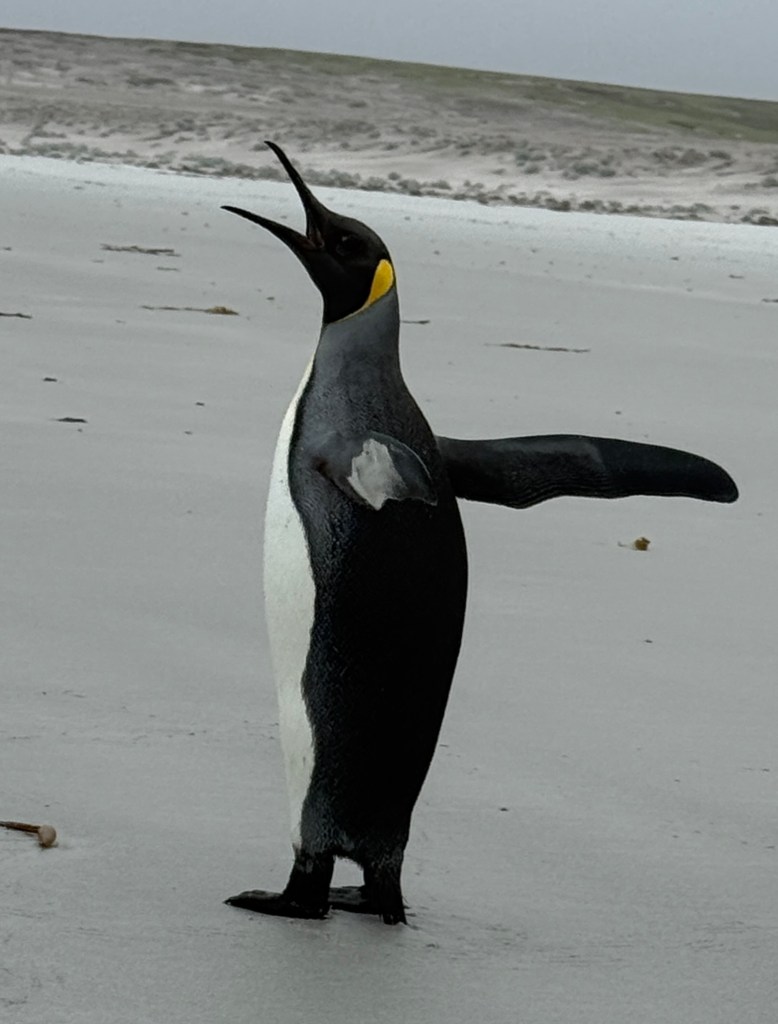
Above: I know the feeling!!
3. MAGELLANIC PENGUINS
While I could not find an estimate of the number of Magellanic penguins on the Falklands, I did not see them in any great numbers. As noted below, they are also more shy so I did not pursue them.
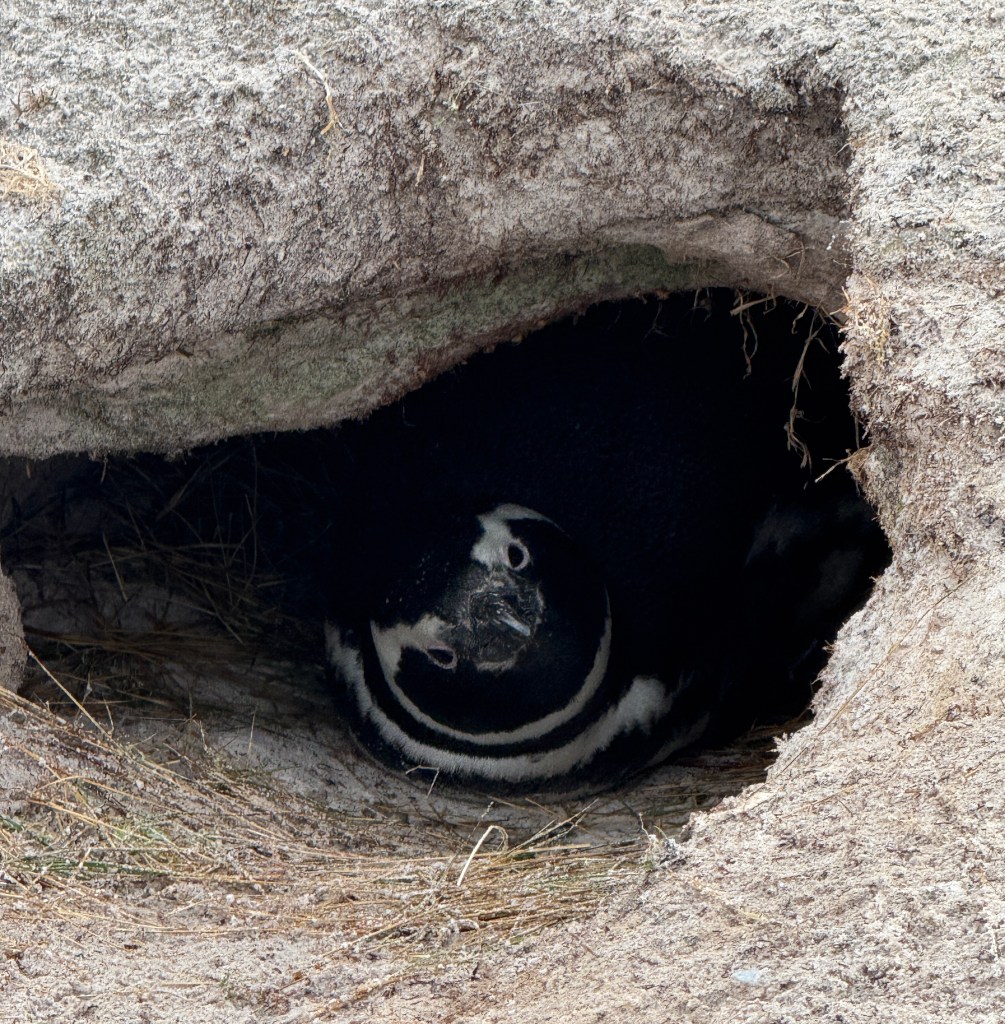
Magellanic penguins in the Falklands are summer visitors, known for their distinctive black-and-white “tuxedo” with two black bands across their chest, their shyness and their loud donkey-like calls. They nest in burrows dug in peat near the coast (picture above), often near sandy beaches They are shy compared to other penguins, retreating quickly if disturbed. Like the other species, their diet includes fish, squid, and krill, caught while strong swimming at sea.
4. ROCKHOPPER PENGUINS
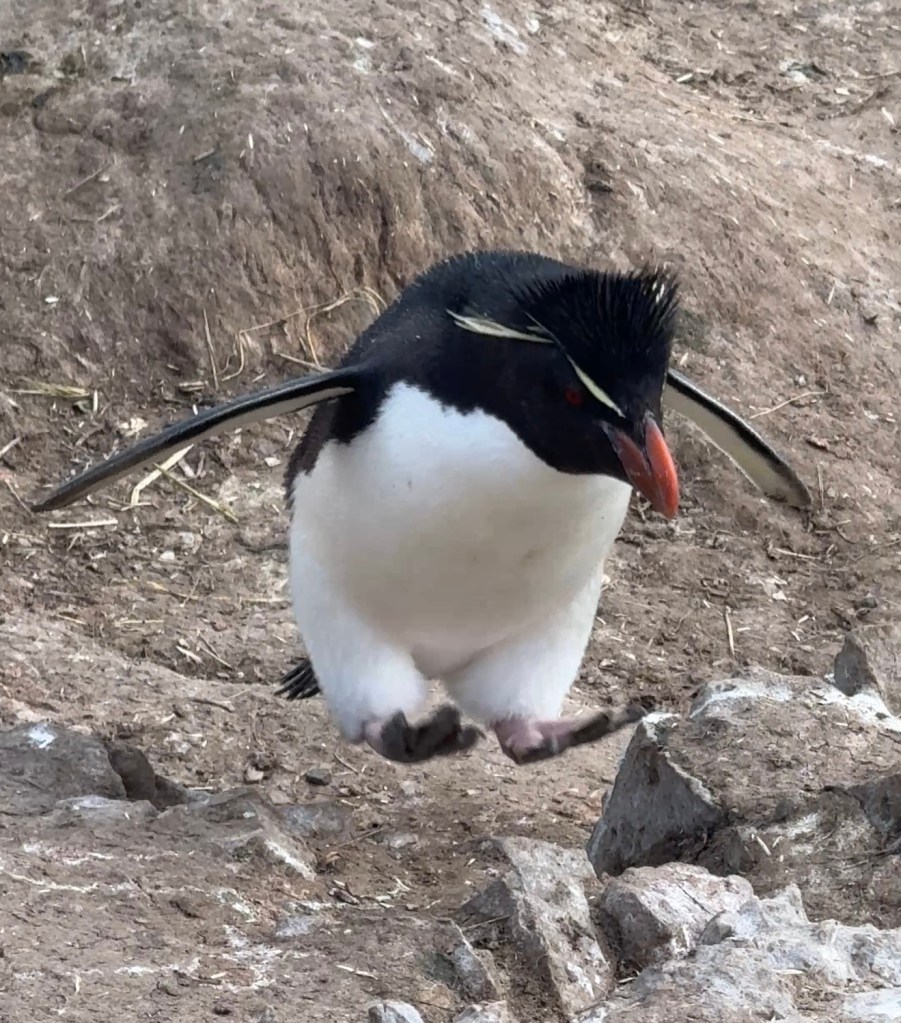
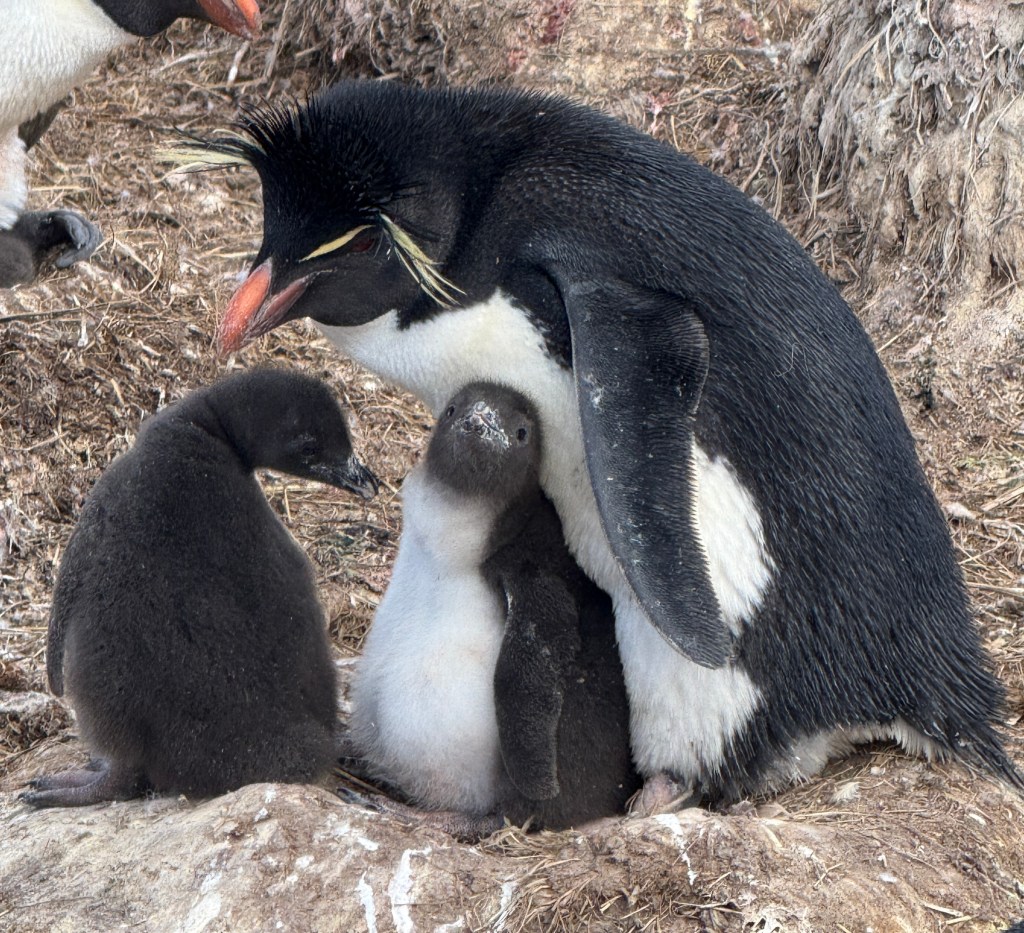
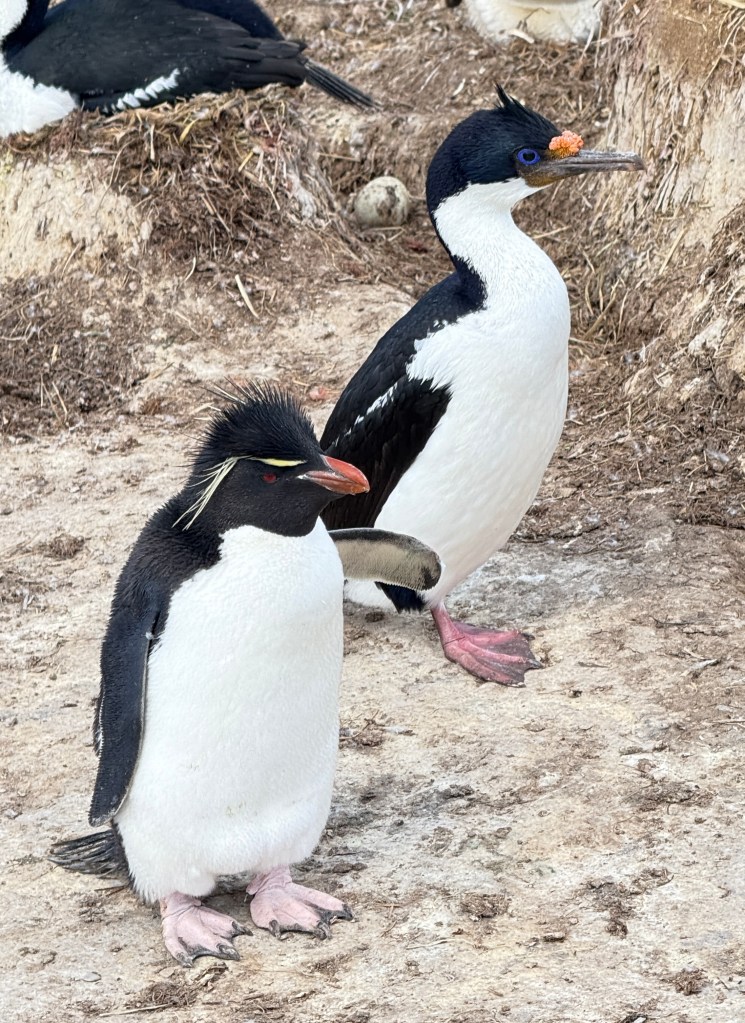
The Southern rockhopper penguin is the smallest Falkland penguin at 12 to 18 inches tall. It is charismatic and popular with tourists and wildlife visitors. Rockhoppers are very agile – named from their habit of hopping up steep cliffs with both feet together. They do not seem bothered by people. One of two crested penguins found in the Islands (the other is the Macaroni penguin), they can be identified by straight thin yellow eyebrows with yellow-white plumes above their red eyes
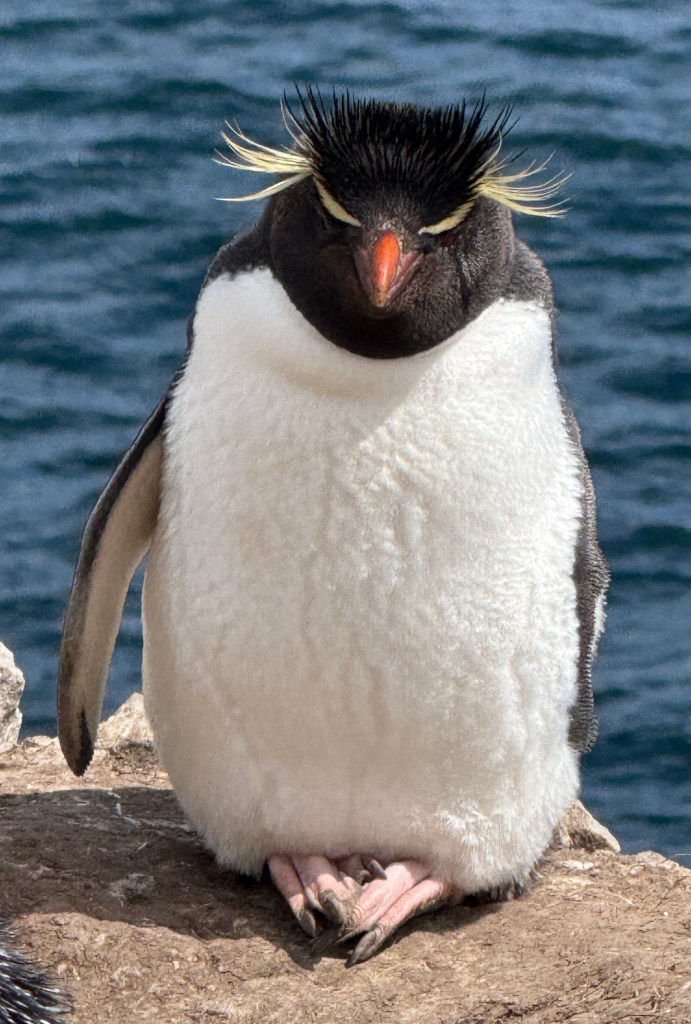
The Falkland Islands hold a significant proportion of the world population (320,000 pairs or 36% of the global population in 2010).
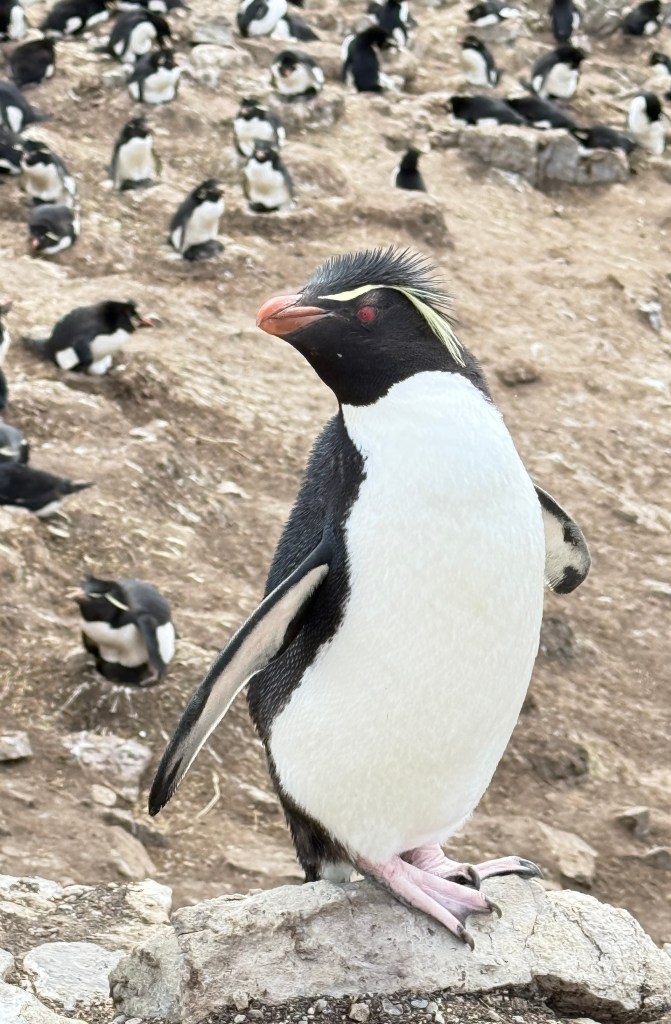
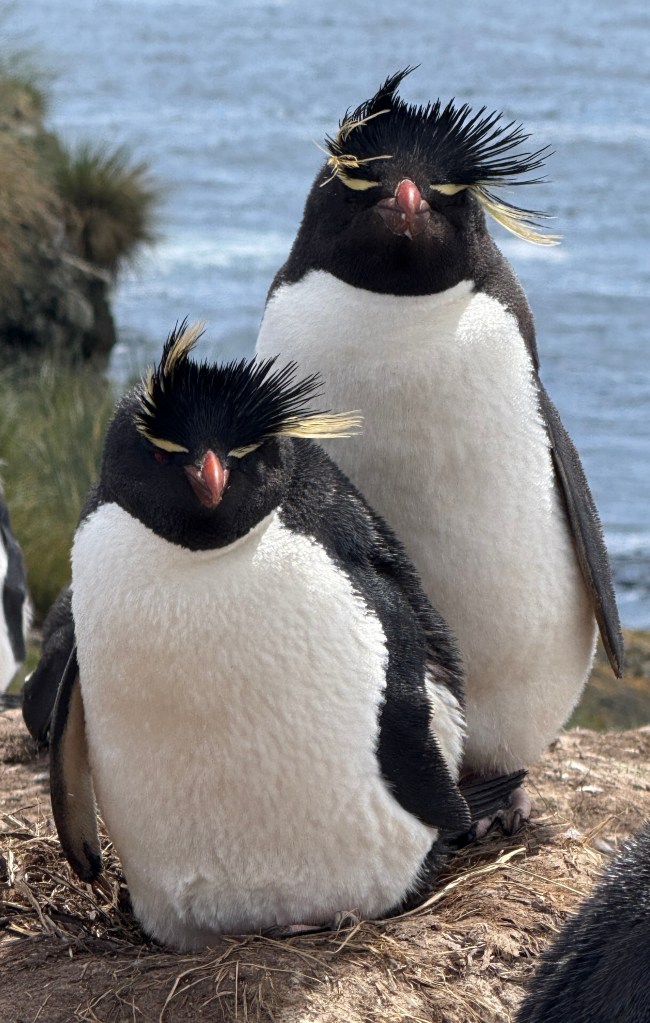
Above: Husband and wife guarding the nest.
Above: You can see why they call them Rockhoppers!!
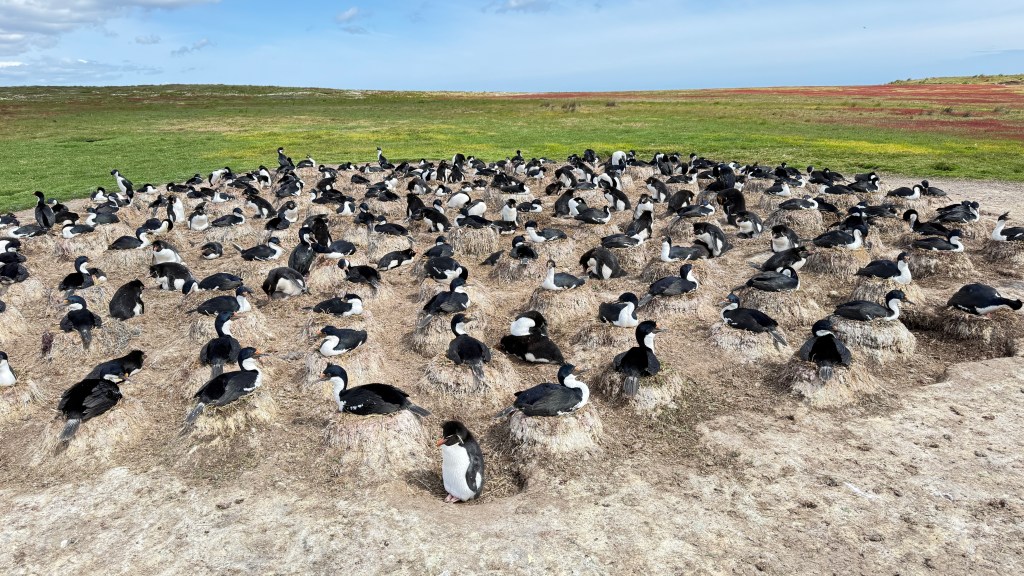
Above and Below: Rockhopper penguins often nest with Imperial cormorants primarily for protection from land-based nest predators like the striated caracara. Interestingly, their color characteristics are nearly identical.
5. MACARONI PENGUINS
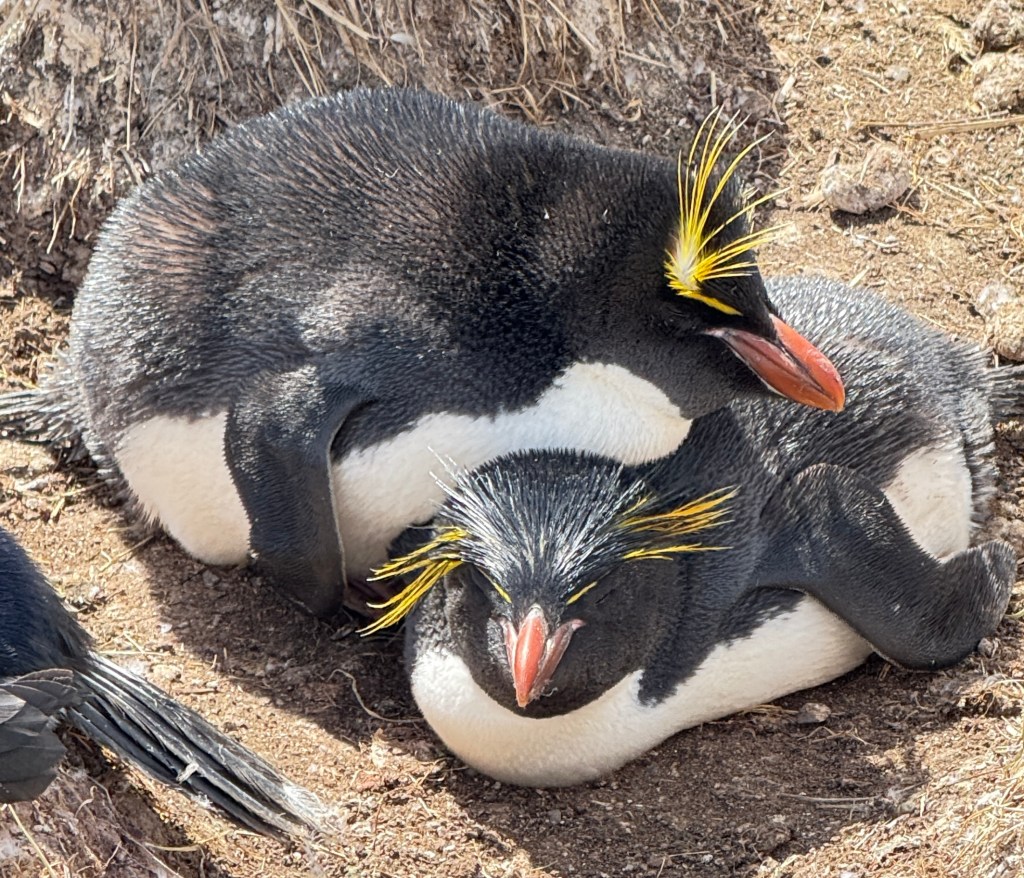
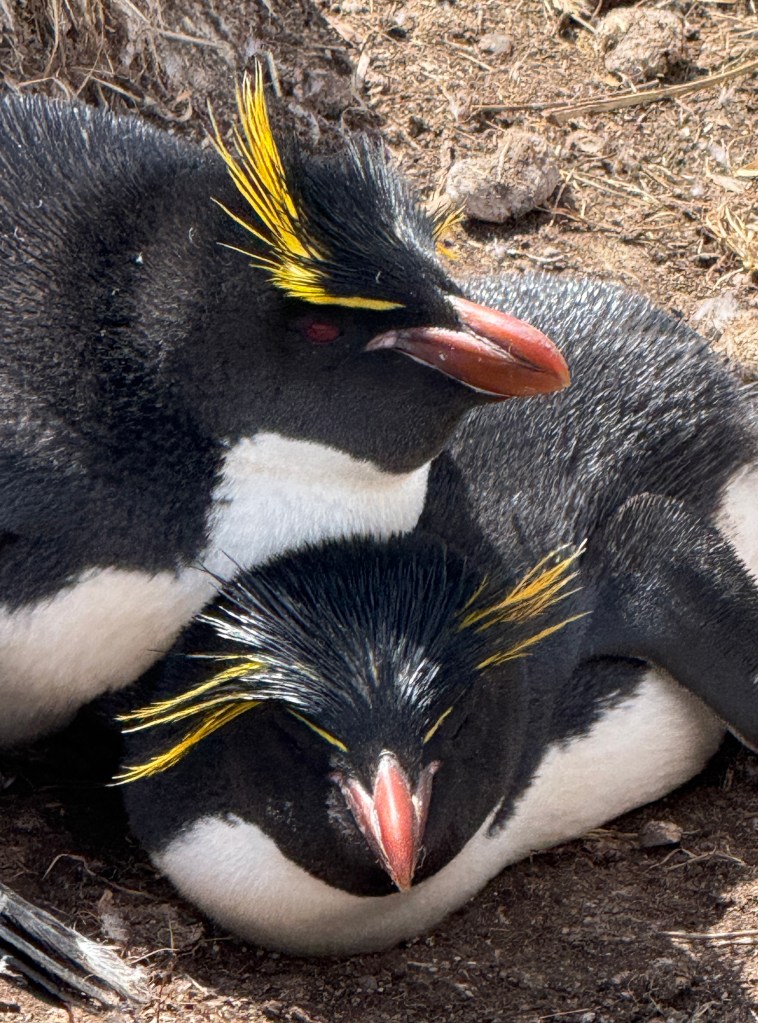
Macaroni penguins are rare visitors to the Falkland Islands, with only about 24 breeding pairs. I was lucky to see a couple of pairs. They hang out in Rockhopper colonies during summer (Sept-April) due to their similar looks and tendency to interbreed, forming hybrids; they are much more common in South Georgia. Macaroni’s have a distinctive bright yellow-orange head plumes contrasting with black bodies and red bills, often mixed in with Rockhoppers
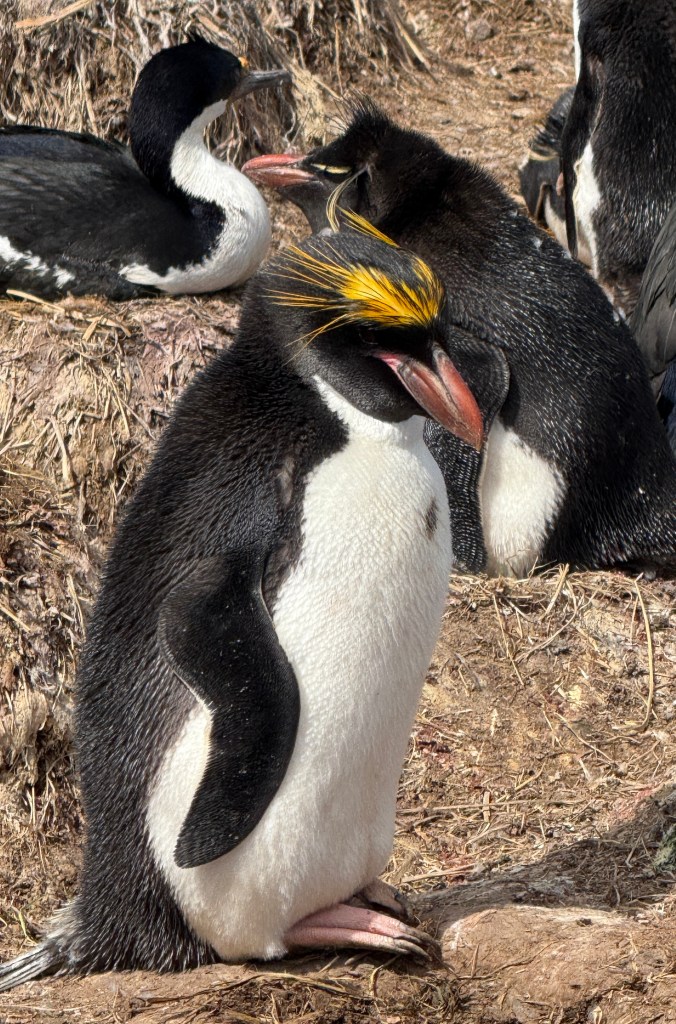
Above and Below: The yellow plume is a dead-giveaway.
Well folks, I promised you penguins and you got penguins!! Falkland penguins are summer penguins, so they do not live on the ice. For that, I will ask you to be patient as I understand there are many colonies on the Antarctic subcontinent (i.e., ICE!!!) that I hope to see. And if I see them, you will too.
The water temperature is now 35 degrees, so that means we are getting close.
HAPPY BIRTHDAY TO JONATHAN H!!!
HAPPY NEW YEAR TO YOU ALL!!!


 Harmon and Randall's Voyage...
Leave a reply to anthonyvlasto Cancel reply