Leg 5, Blog 5, April 12, 2026 (but sent out May 16)
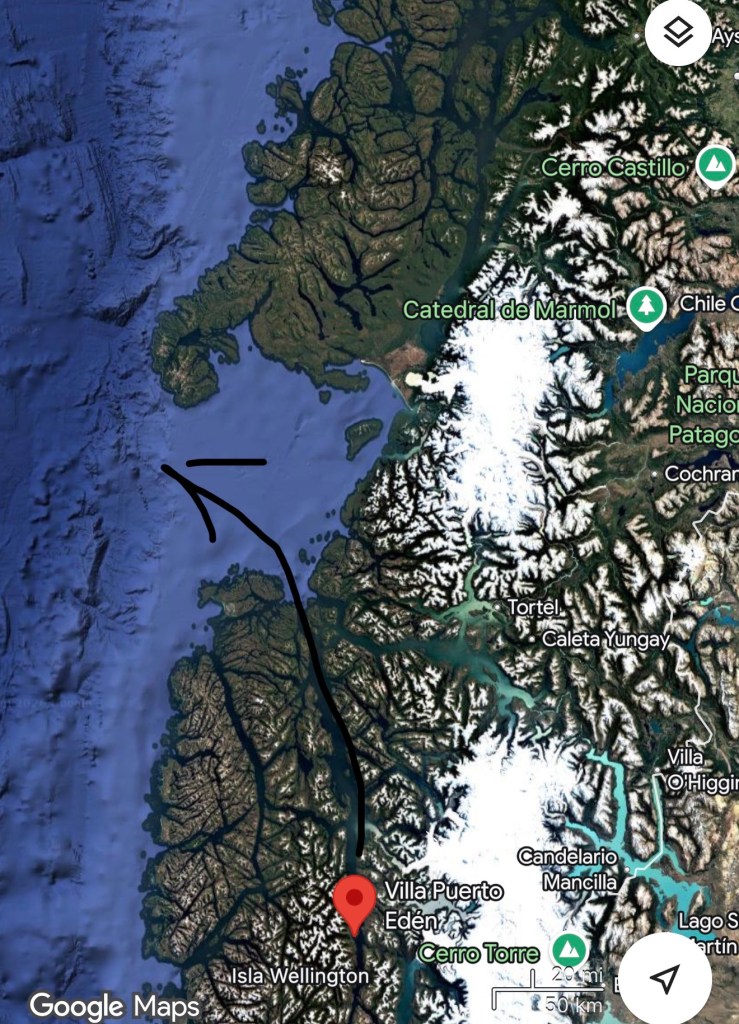
As we get ready to leave Villa Puerto Eden, you can see that we will head north and shoot out of the canal and into the Pacific…..
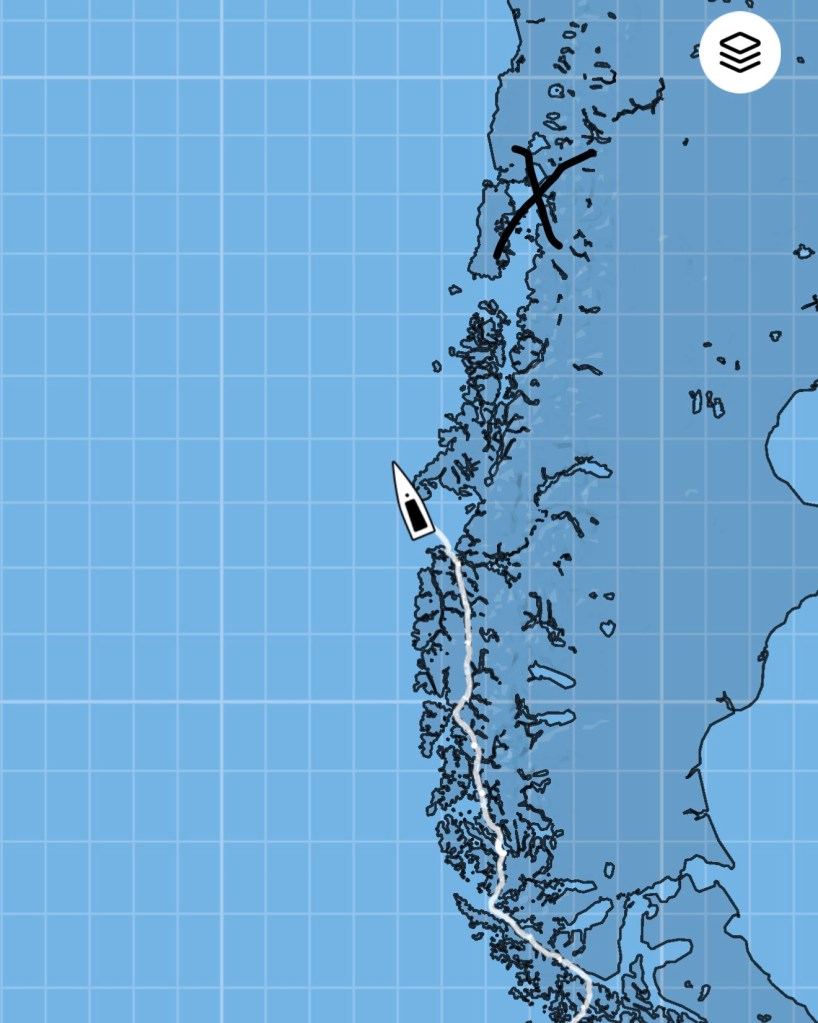
And once we hit the Pacific, we will need to round “The Peninsula of Three Mountains”. Shortly after rounding the point, we will need to make the decision to either head east back into the Patagonian Canals, or keep heading north and enter at the Golfo Corcovado (the first major opening off the Pacific). The deciding factor, of course will be weather and wind direction.
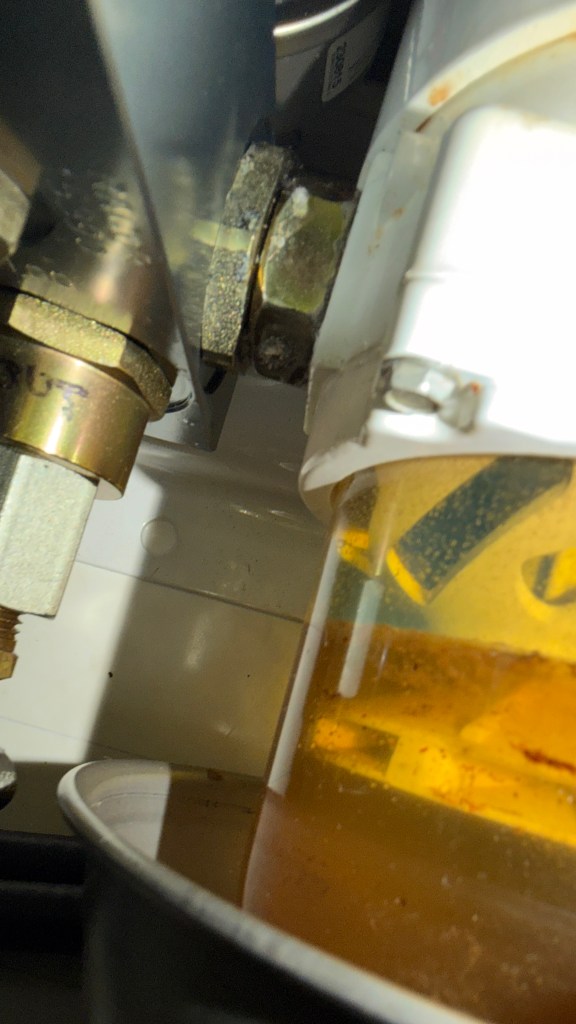
Above: We departed Puerto Eden (per last blog) at 0645 on the morning of April 5, hoping to make anchorage at Wager Island almost 100 miles north (we ended up at Caleta Hale). But 30 minuets following our departure from Caleta Hale the next morning, Randall (who must have switched fuel tanks) noticed that our fuel had been contaminated with water. Notice the grunge in the lower half in filter above. Big trouble.
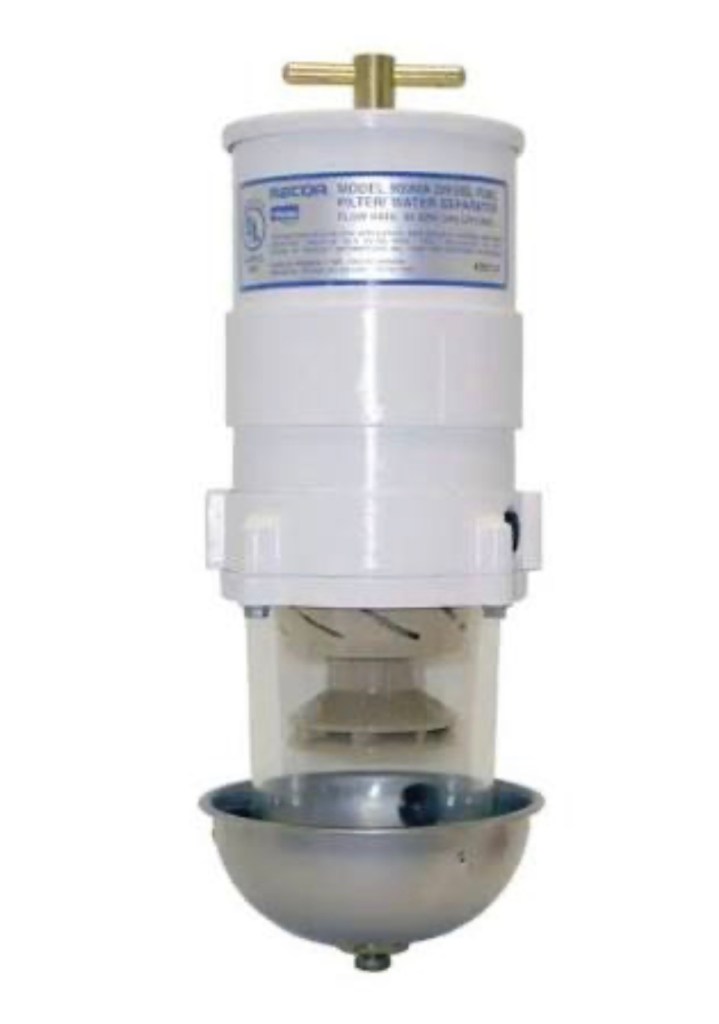
Above: This is your basic Racor fuel separator, designed to separate diesel fuel from water. Water is heavier than diesel, so it sinks to the bottom of the glass. Fuel is taken from the top of the glass, and then run through the filter at the top (which is contained within the metal housing). The bottom saucer, depending upon who you ask, is a catchment for leaked fuel or broken glass.
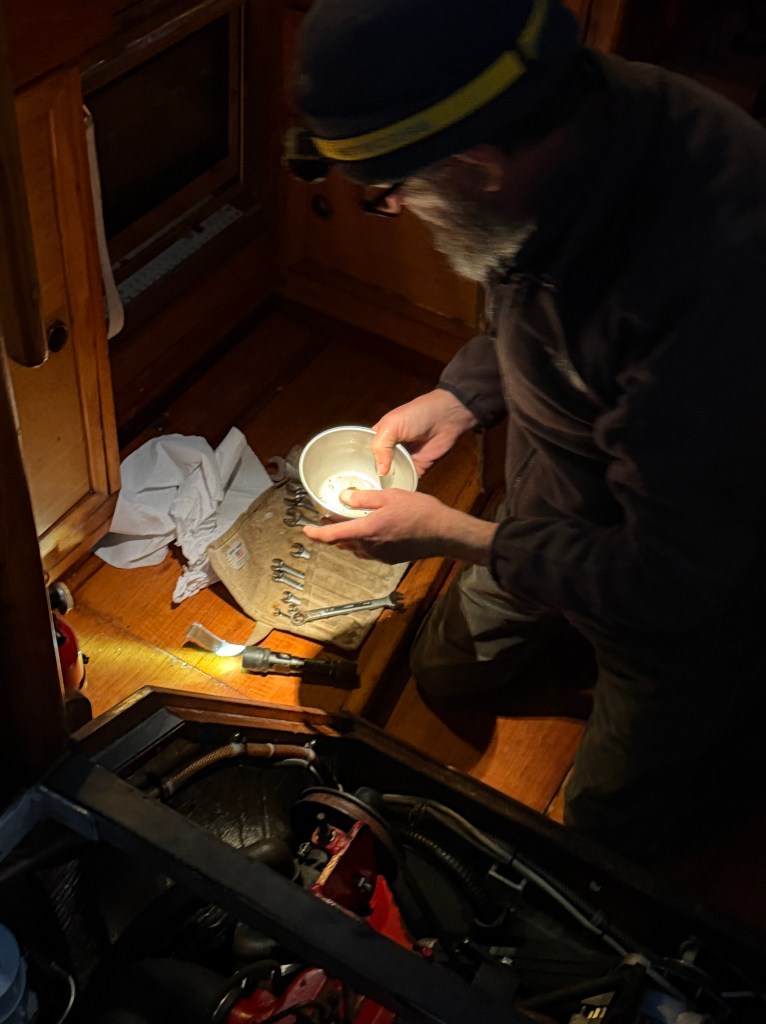
Above: The fouled fuel needed to be cleared our of the Racor fuel separator which is no easy task. It requires that the Racor be disassembled, fuel cleared, Racor cleaned and filter changed. This needed to be done three times within a couple of hours, and then the problem, fortunately seemed to go away. This was so curious because the fuel that we had just purchased in Puerto Eden looked super clean. Who knows??!! Sometimes a little water finds its way in, but all I can say is that up until now, this has, miraculously, not been a problem.
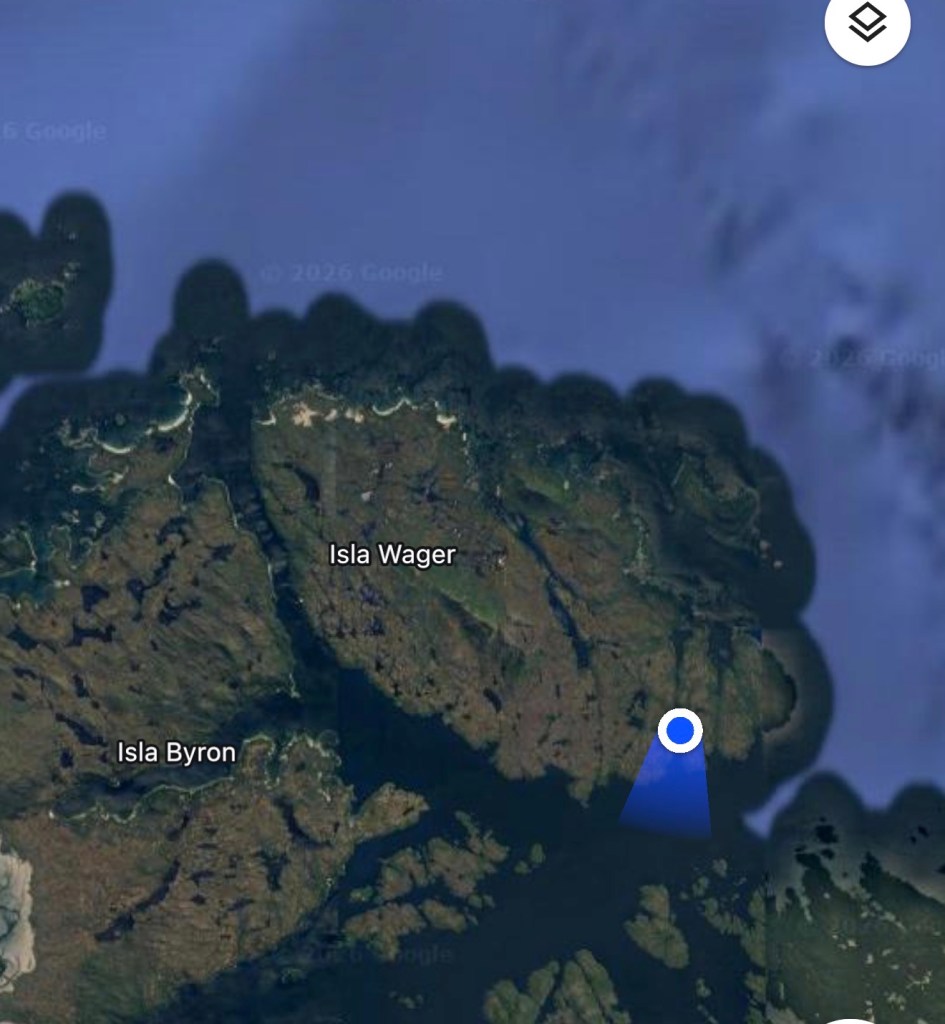
Above and Below: Fuel problem solved it is now time to go to Wager Island, notorious as the 1741 wreck site of the British frigate HMS Wager.
Wager Island is a mountainous, remote, uninhabited island situated in the Guayaneco Archipelago within the Capitán Prat Province of Chile’s Aysén Region, located along the Pacific coast of western Patagonia near the Gulf of Penas.
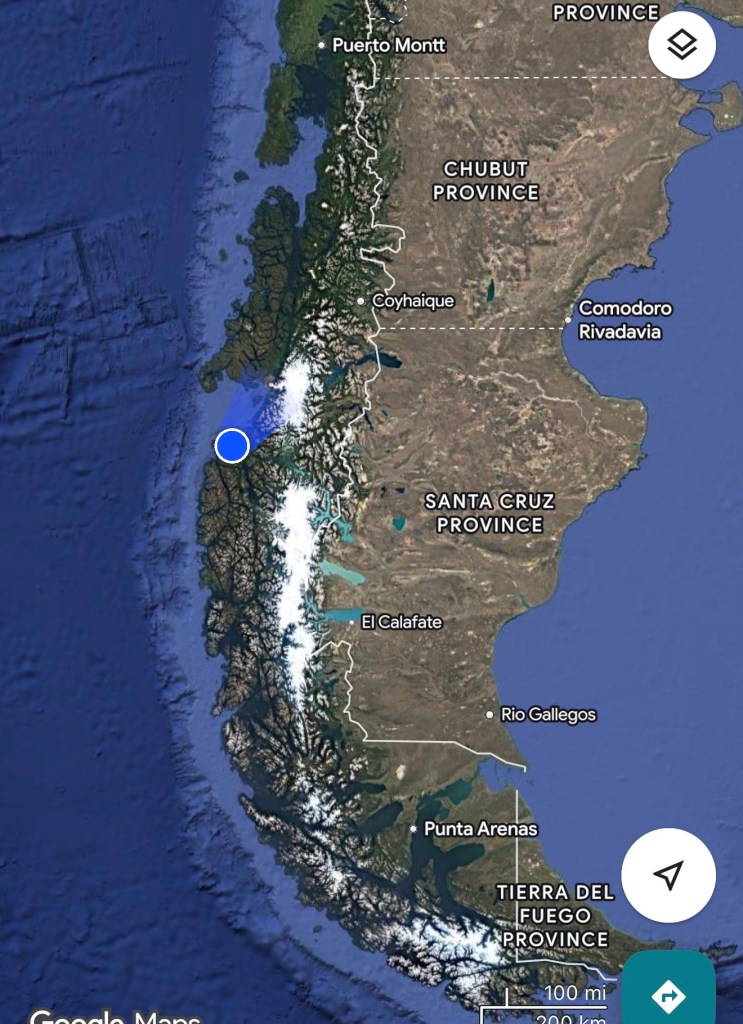
Wager Island was right on our way, so we had to stop to at least take a look at it.
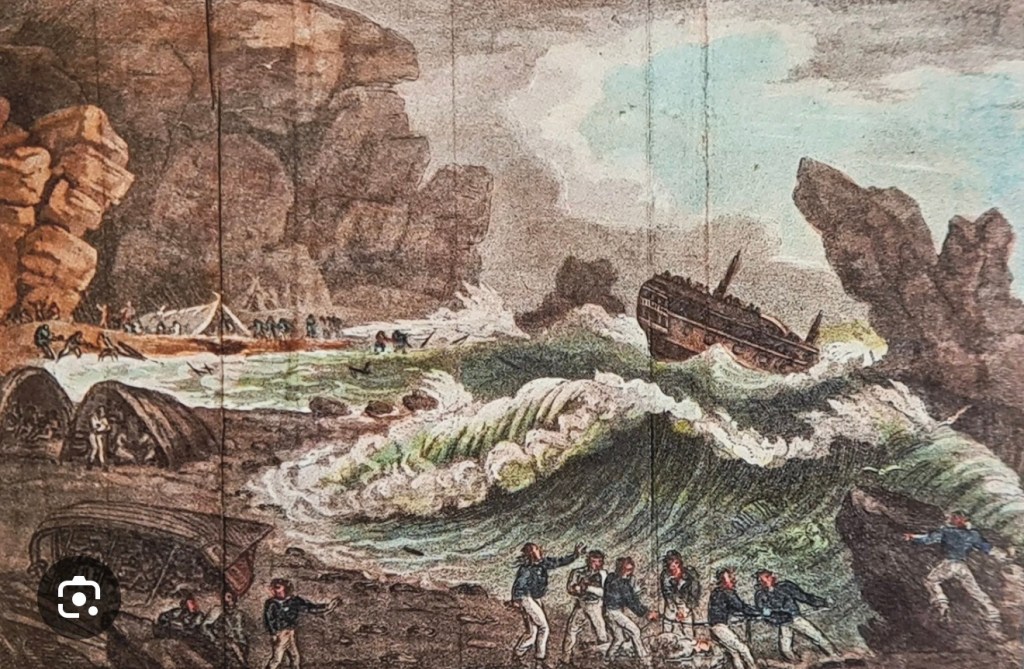
Above: The Wager was part of Commodore George Anson’s squadron during the War of Jenkins’ Ear, tasked with capturing a Spanish treasure galleon. After becoming separated from the rest of the fleet while rounding Cape Horn, the ship headed north up the Patagonian coast and wrecked in May 1741 on what is now known as Wager Island.
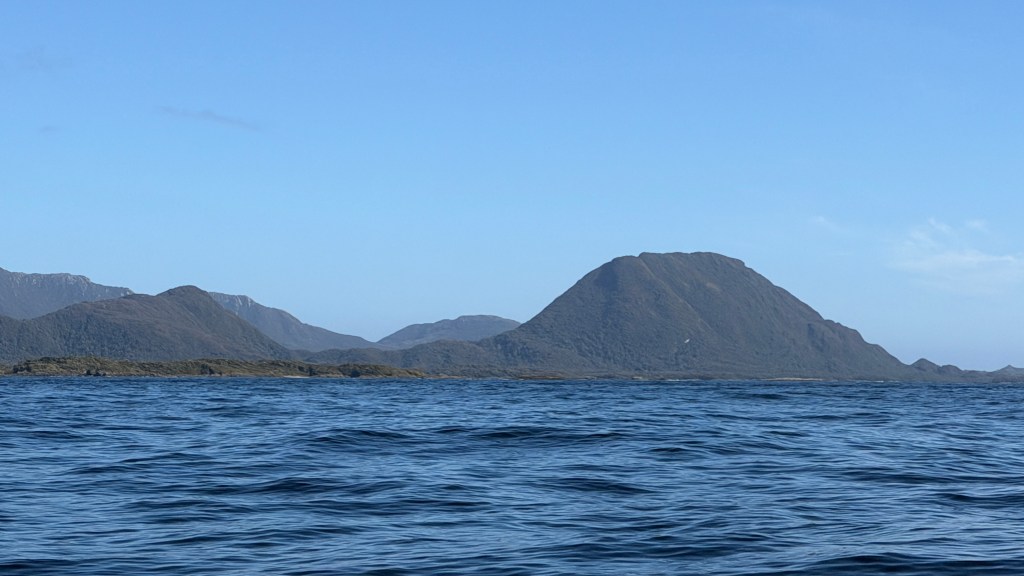
Roughly 140 men survived the initial wreck, but they soon faced starvation and brutal conditions. Discipline broke down, and a large group of men, led by gunner John Bulkeley, mutinied against Captain Cheap and attempted to sail back arounf the Horn towards Brazil, while others stayed behind. The few survivors of both parties returned to England in separate groups, months apart, each claiming the other was guilty of mutiny and murder.
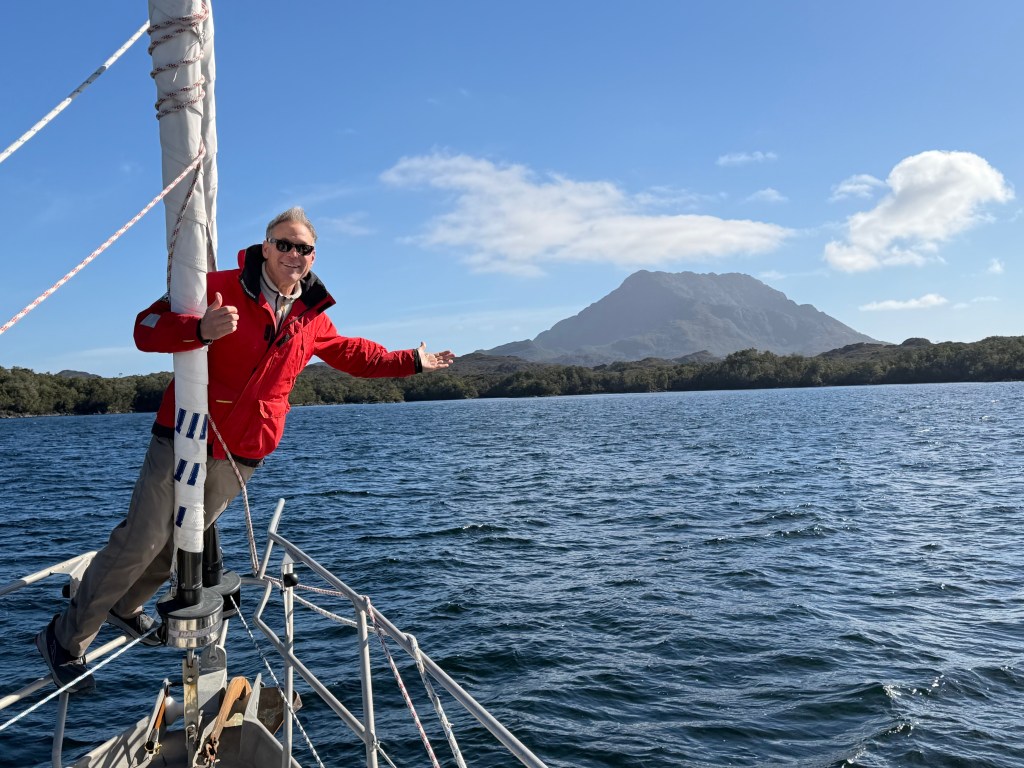
The story, heavily detailed in David Grann’s book The Wager, highlights a massive breakdown of naval authority and the struggle to shape history through narratives and serves as a study in human behavior under extreme pressure, exploring how narratives are crafted to justify survival actions when social order collapses. (Thank you AI!!)
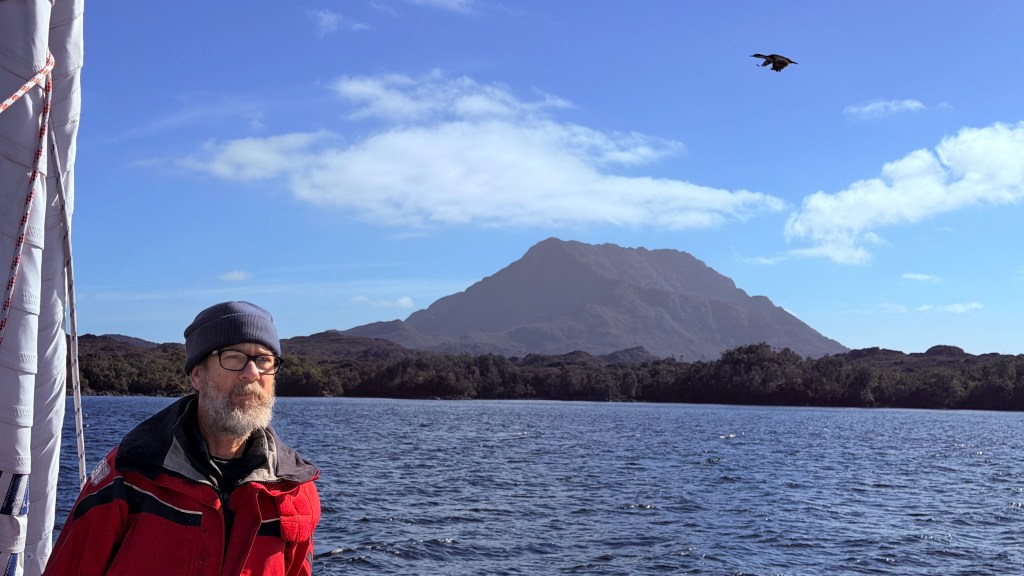
Above: Randall, not about to get us into a wreck situation (or put up with a mutiny!!), took us in as close as we could get, but the inlet (not nearly as picturesque at this) is shallow and rocky. His friend Barry, however, knows where the old cannons from the Wager lie…. Maybe next time!!
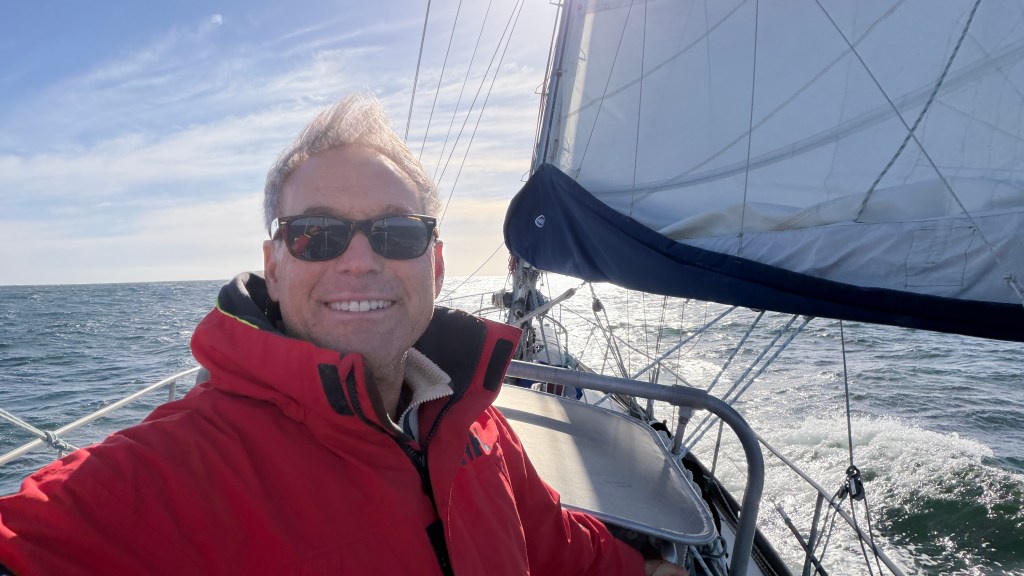
Above: As soon as we pulled away from Wager Island, we headed northwest out into the Pacific. It felt fabulous to be back on the open sea.
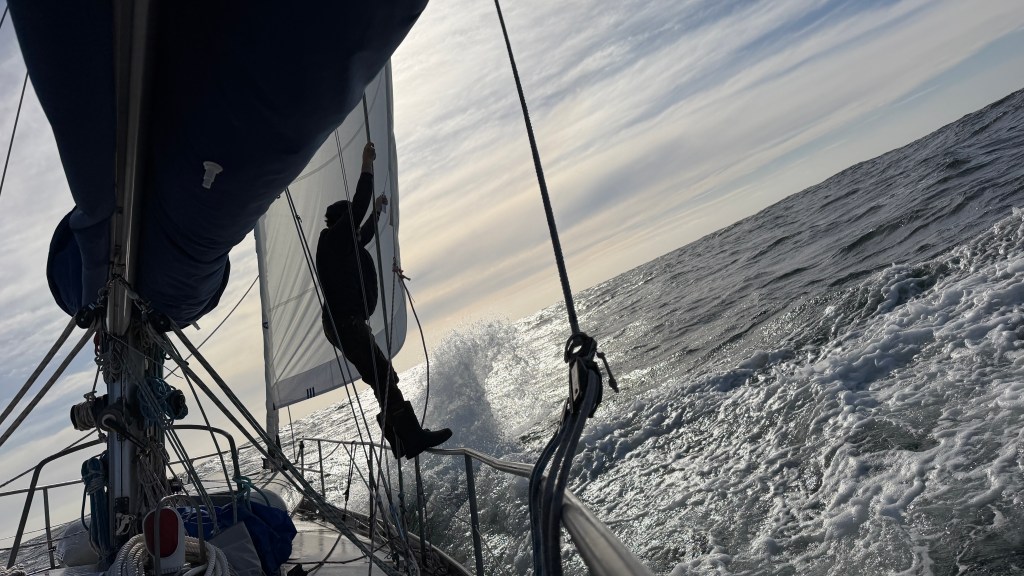
Above: This was one of those rare moments where wind, weather and currents all worked to our benefit and Móli achieved a pace well above her hull speed.
Above: Loving the progress, I give a quick report.
Above: We are each enjoying this fabulous sailing moment in our own way. While I bask in the sun and warm breeze, Randall takes a moment to fix the leach line of the reefed Number two jib which is enabling us to blow past hull speed (mainsail not needed!)
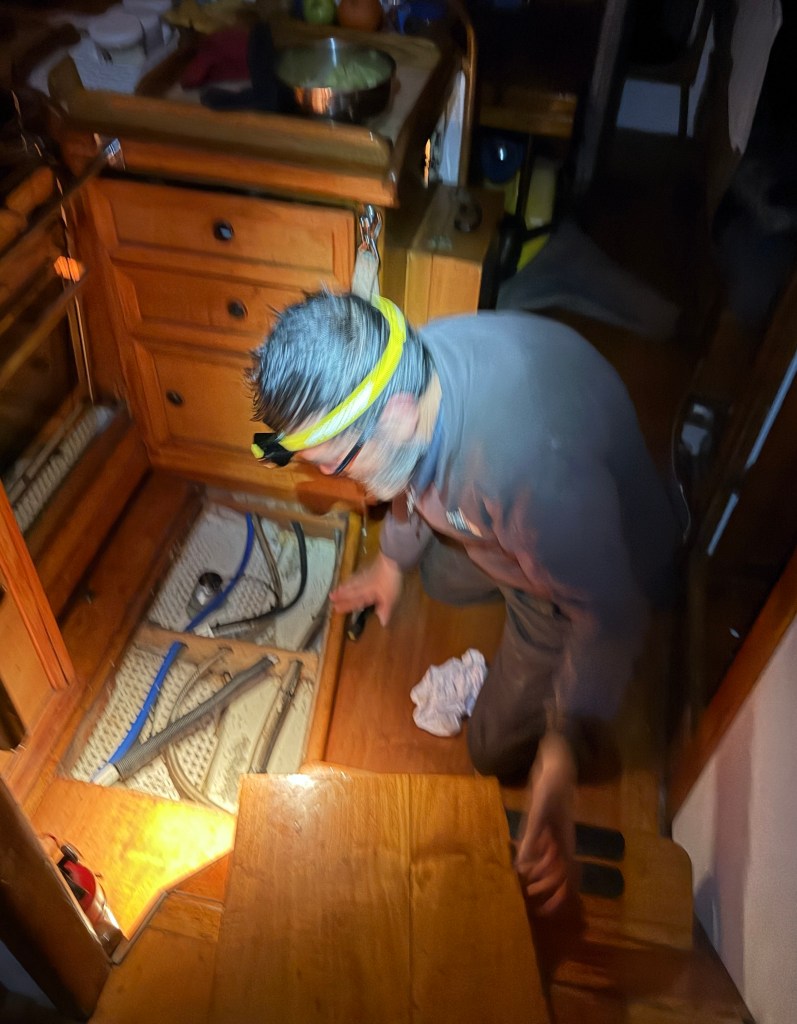
Above: Life was good until late that evening when Randall discovered a minor water leak in sink cabinet in the head. No sailor likes a leak, but Randall takes it personally, and proceeds to disassemble Mōli one floorboard at a time over the next 12 hours. Randall lifted each floor board, checked the engine bilge countless times, and tasted the leaking water over and over to determine its relative salinity (leaked drinking water or incoming seawater?) Like a mad scientist, he would not rest until he could find the source.
Just so happens that the leak was discovered a day after quite a bit of motor oil spilled out of its new container in the head lazarette. Randall finally came to the conclusion that the water was likely a remnant of a leaky hatch that settled into a bilge and was displaced by the leaking motor oil and found its way into the engine bilge. Mystery solved.
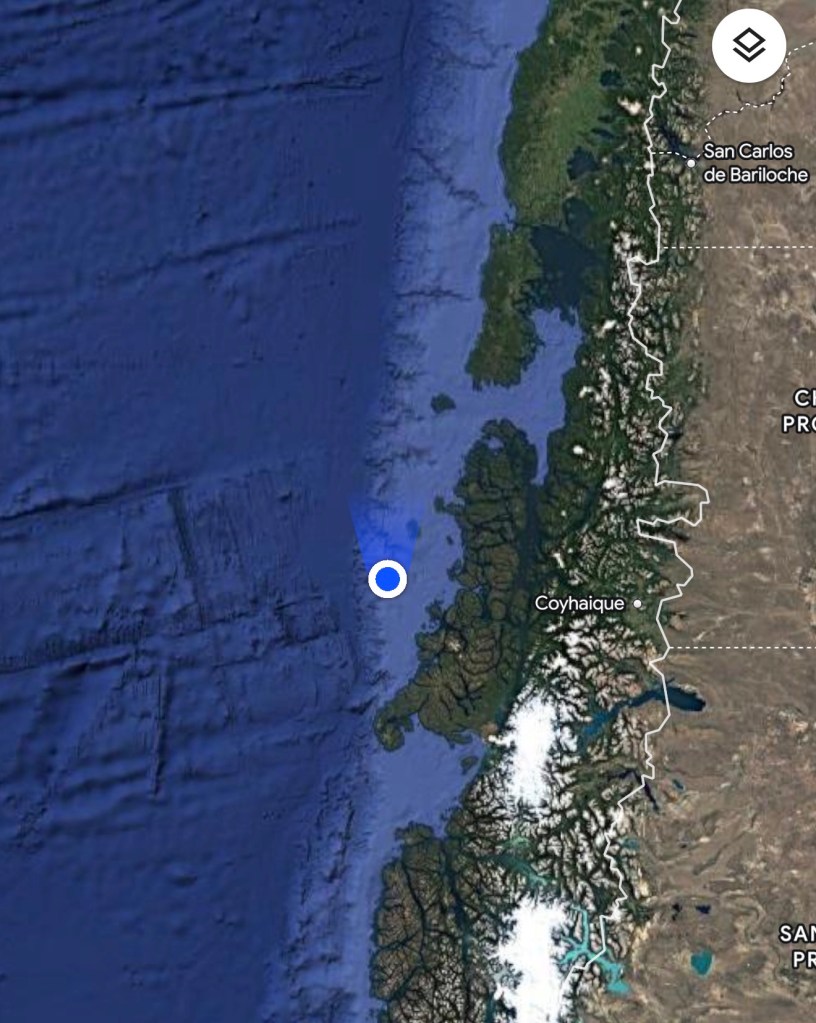
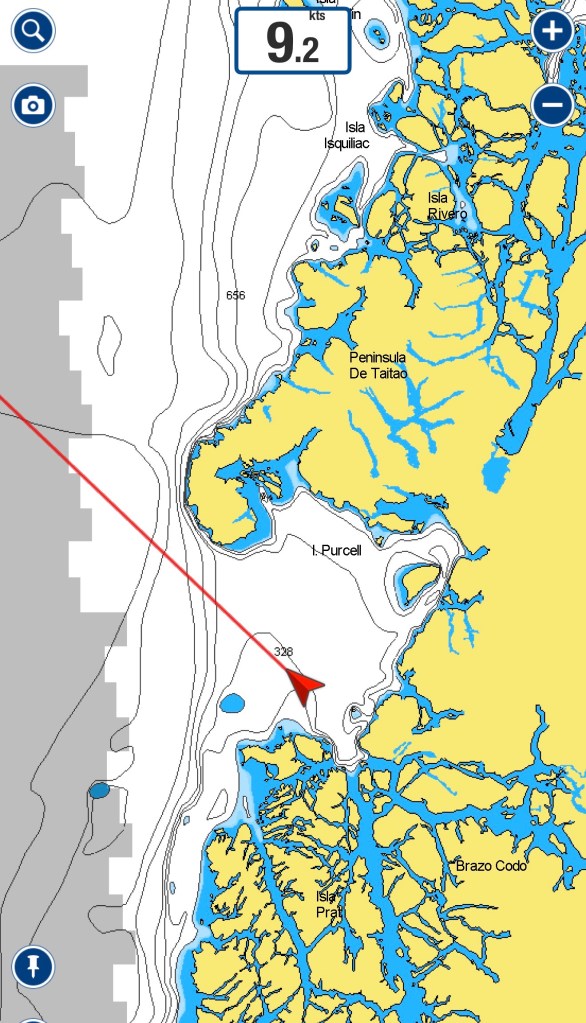
Above: As you can see, we made the decision NOT to head back into the channels and decided to make a run for it on the Pacific. The positive is that we can make better time back to Puerto Montt on this route, but we may miss some scenery along the way, and we will be vulnerable to the Pacific’s weather whims.
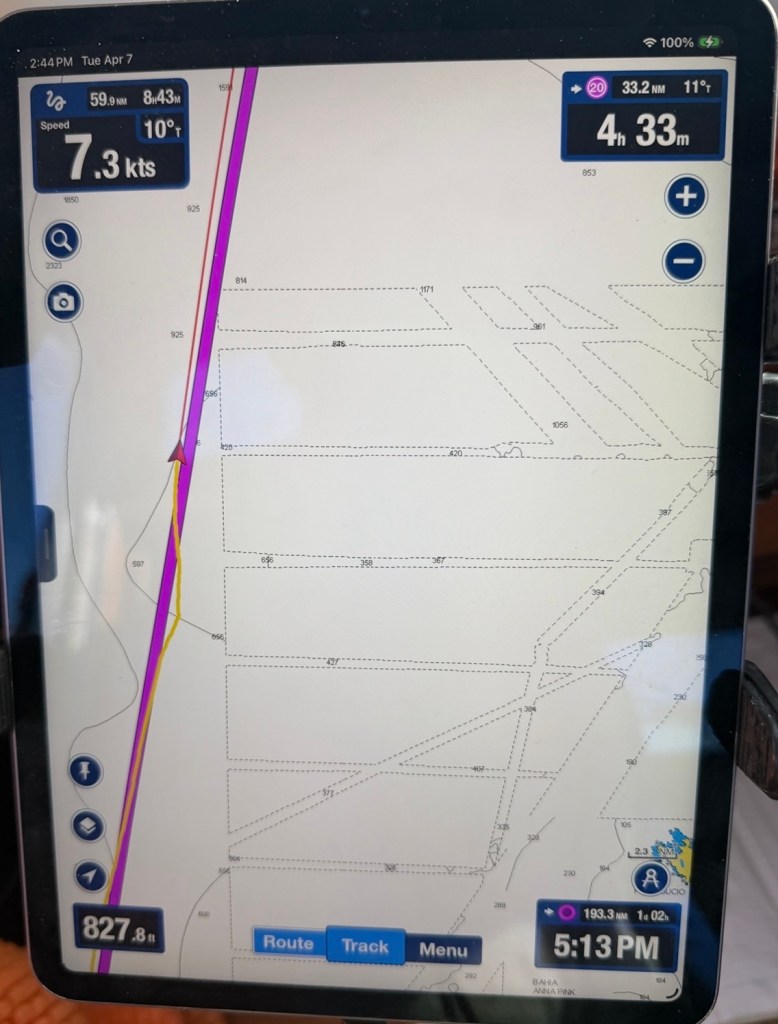
Above: This chart puzzled us to no end because it makes it look like we are sailing through a downtown urban area of city blocks. The chart actually calls this uncharted sea which we find kind of hard to believe as it follows the contour of the Chilean coast. Does anyone have an idea of what this is?
Above: This is it folks, it just does not get a whole lot better than this. A moderate temperature in the high 50’s, 25 knots of wind, following wind AND seas. Again, all we needed was a bit of jib, and we were at hull speed. Sorry for the heavy breathing in the video, but I was excited.
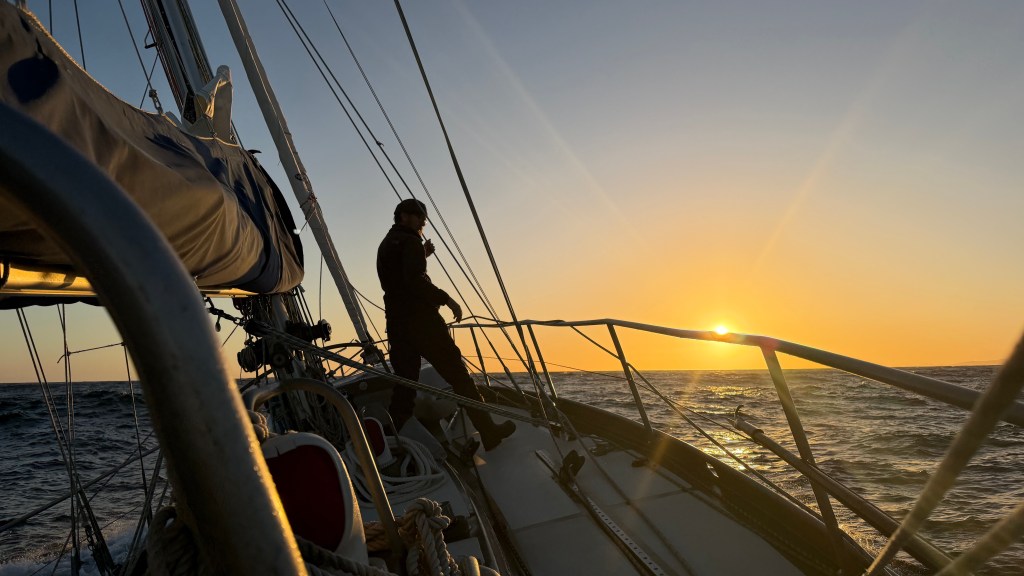
Above: This is our first clear sunset in I can’t even tell you how long. Rather than stop for the evening, we spent the next three days and two nights sailing nonstop.
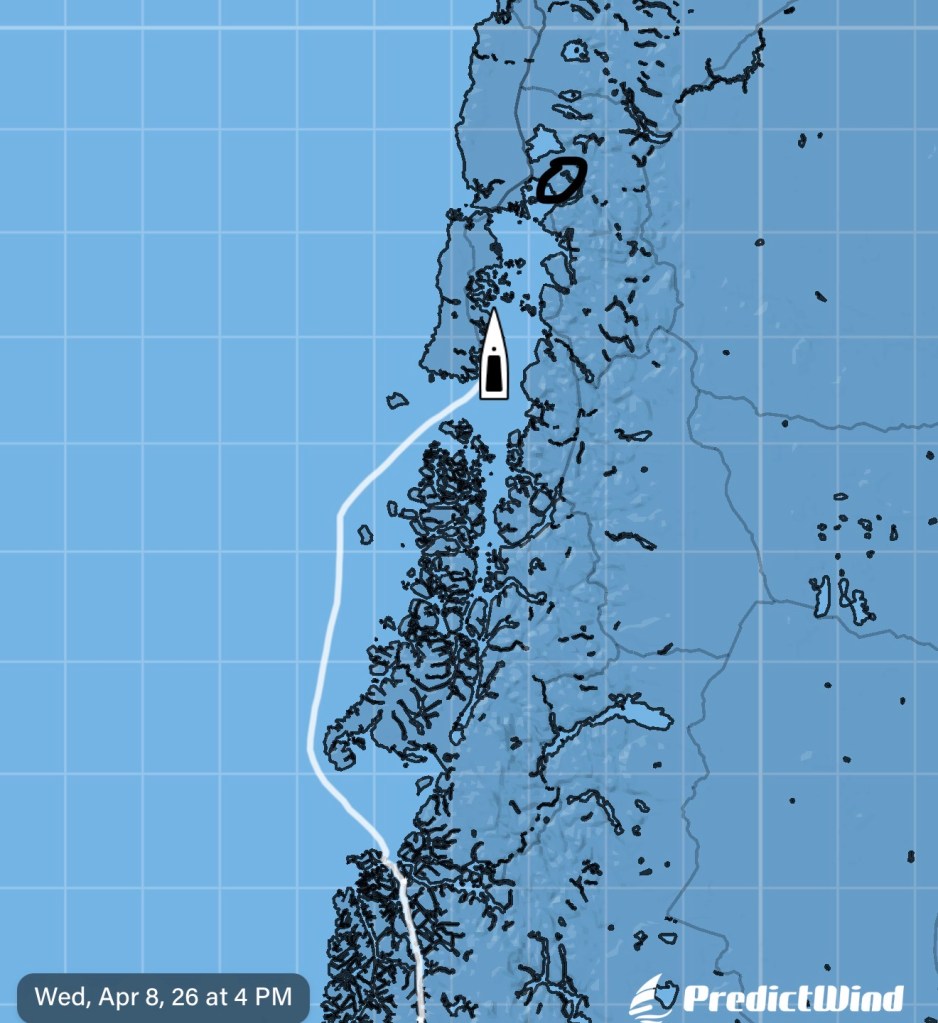
Above: You can see from above that after three glorious days of sailing, as of April 8th, we have left the Pacific once again as we veered NE back into the canals.
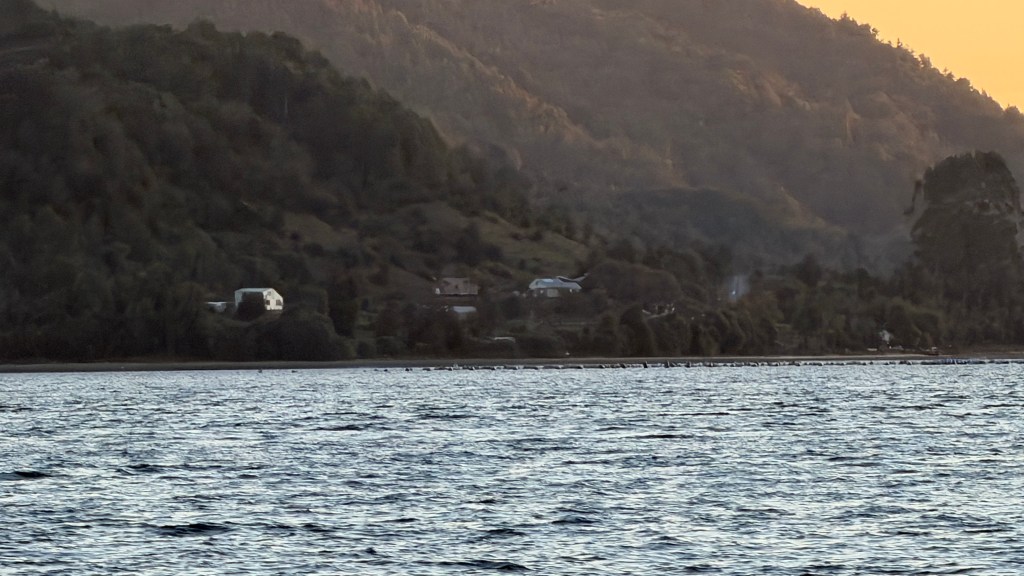
Above: What becomes immediately obvious to us is that we are no longer “alone” in the vast (southern) Chilean canal wilderness. We are now in the northern sector of the canals and have entered “civilization”. I should feel happy and excited, but I suddenly feel sad that we are nearing the end of this leg, and have said goodby to the vastness, beauty and solitude of the south.
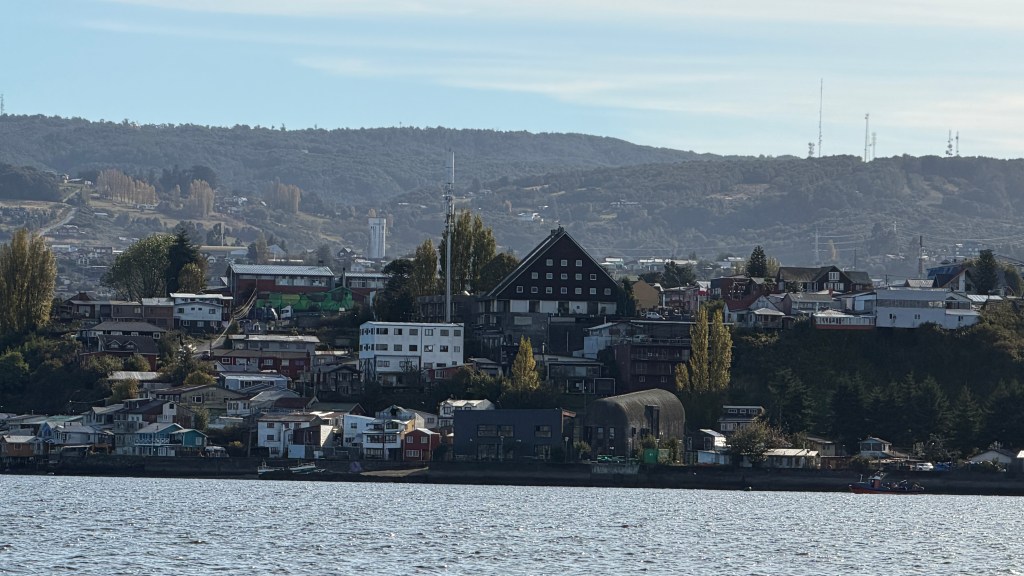
Castro: Night 26: April 9
Our “party” is definitely over as we approach our first big city. Castro is the capital of the Chiloé Province in Southern Chile’s Los Lagos Region, famous for its colorful palafitos (stilt houses shown below) and the UNESCO-listed Church of San Francisco. Founded in 1567, it is one of Chile’s oldest cities and serves as a cultural hub for Chiloé Island’s unique traditions. As one of the oldest cities in Chile, it was established by Spanish conquistador Martín Ruiz de Gamboa. Not sure where the “Castro” came from.
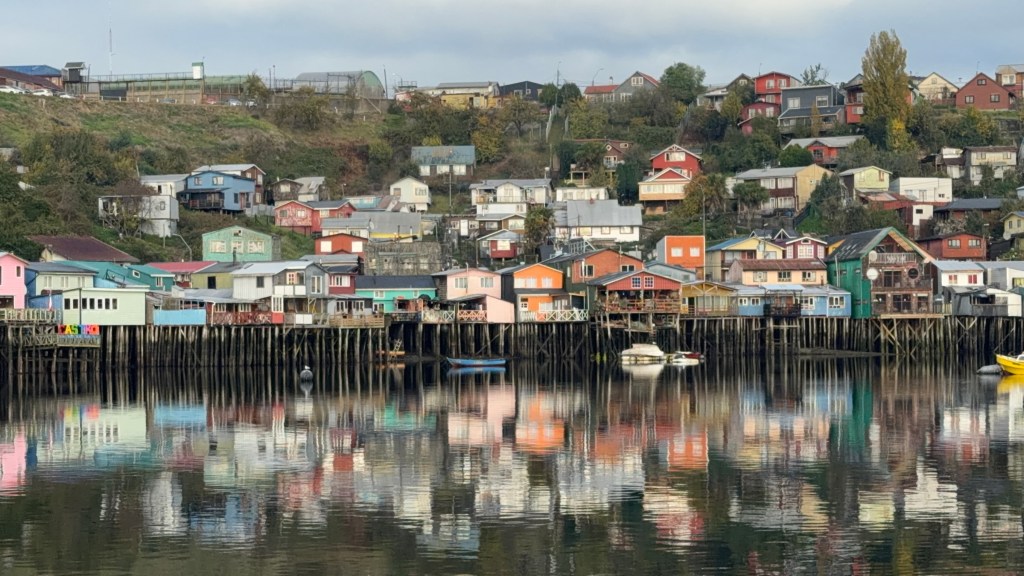
The Palafitos of Castro are iconic, colorful wooden houses built on stilts (palafitos in Spanish) over the water along the coast of Chiloé Island in southern Chile. Primarily located in the Gamboa neighborhood. These structures are a distinct architectural style representing the region’s seafaring culture and history.
This tradition is associated with the maritime history of native peoples, such as the Chono (sea nomads) and Huilliche, who used these houses that were later adopted by fishermen in the 19th century. They have survived natural disasters, including earthquakes and tidal waves, and symbolize the endurance of Chiloé’s cultural identity. While traditionally seen as homes for fishermen and associated with lower-income areas, today many have been renovated into picturesque boutique hotels, restaurants, and cafes, making them a major tourism draw.
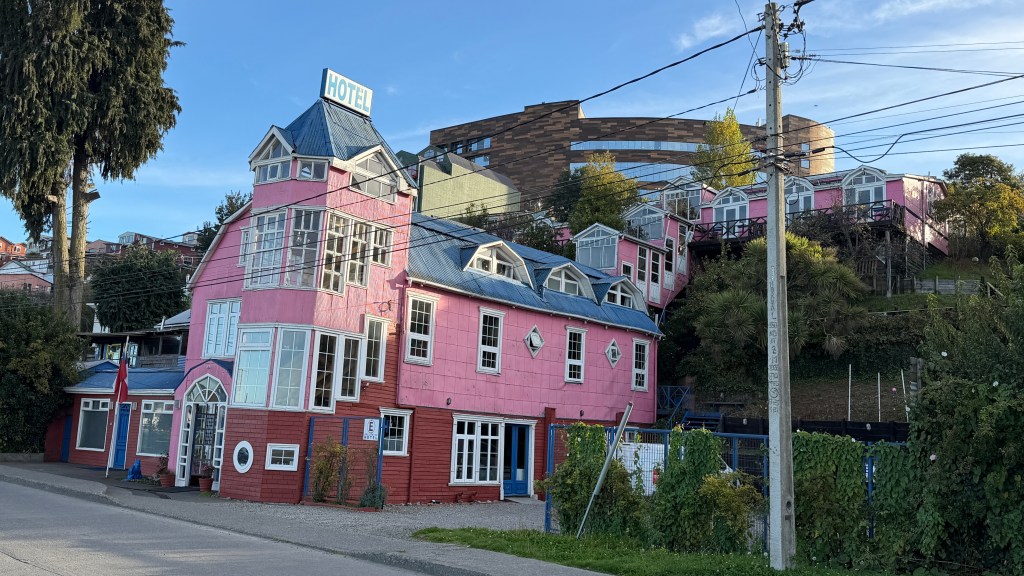
Above: Please let me know if you can figure this out. Above is the Hotel Unicornio Azul aka the “Pink hotel in Castro”. But “azul” means blue (pink or blue? Please make up your mind!. I could not get a strait answer out of anybody. Built in 1910 and restored in 1986, the hotel features traditional Chilote architecture using native woods. Definitely staying there next time.
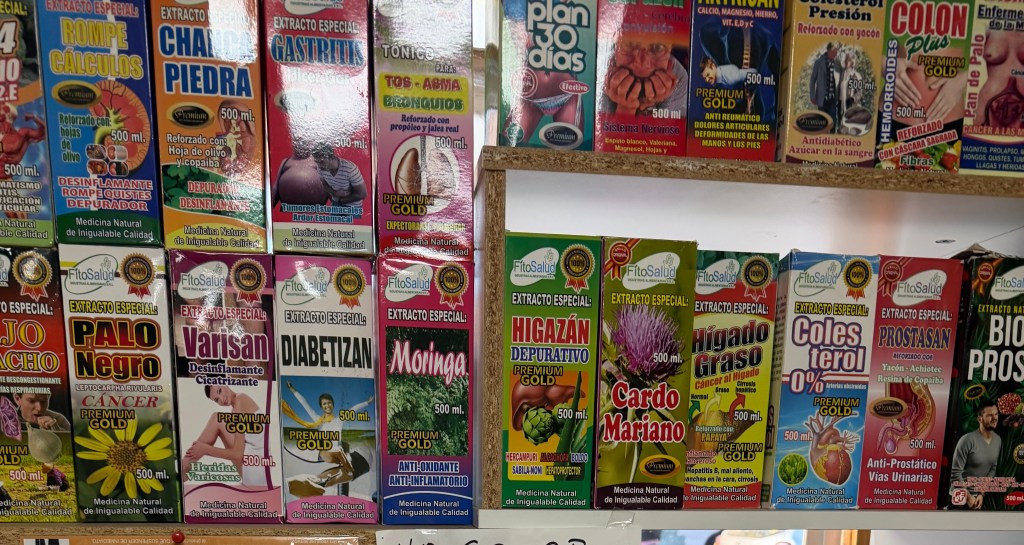
Above and Below: I am always fascinated by alternative approaches to medical care. Acupuncture, Chinese herbs, you name it. Randall and I walked past a small shop run by a super serious proprietor that specialized in herbal cures for all ills including diabetes, ovaries, asthma, inflammation. No judgement here!!
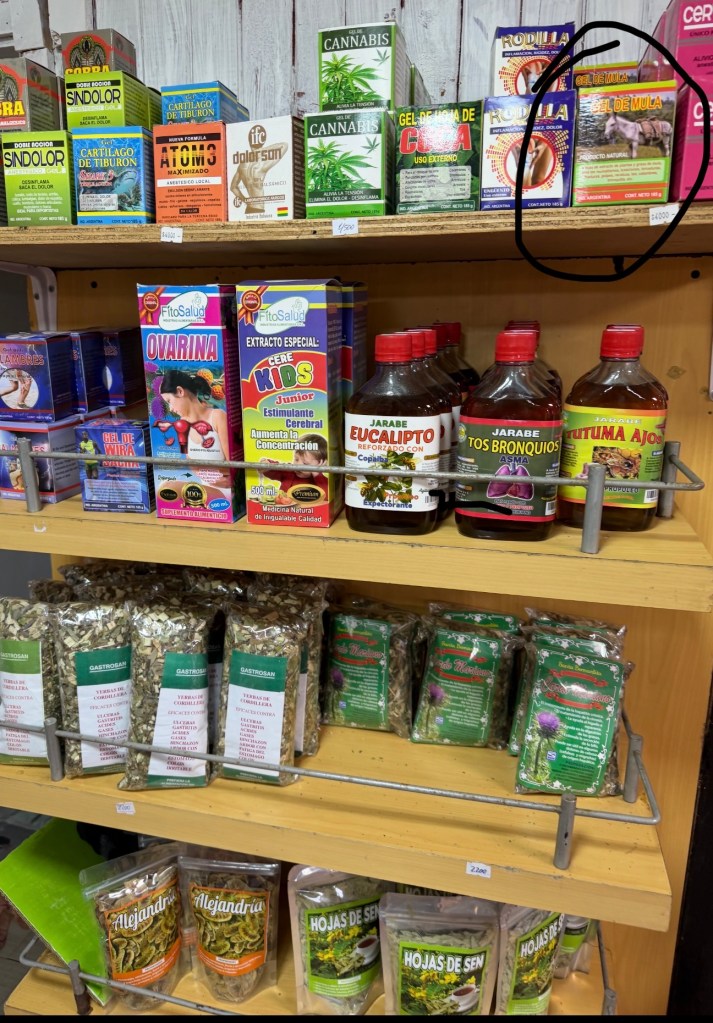
Above: Just gotta say it. My favorite medicine/cure was the “Cel de Mula” or “Donkey Cells” that I circled above. I am not sure if it is to make your children less stubborn, or perhaps make it so they can carry more weight on their backs. Either way, it sounded good to me, so I bought one bottle to use on each of my children.
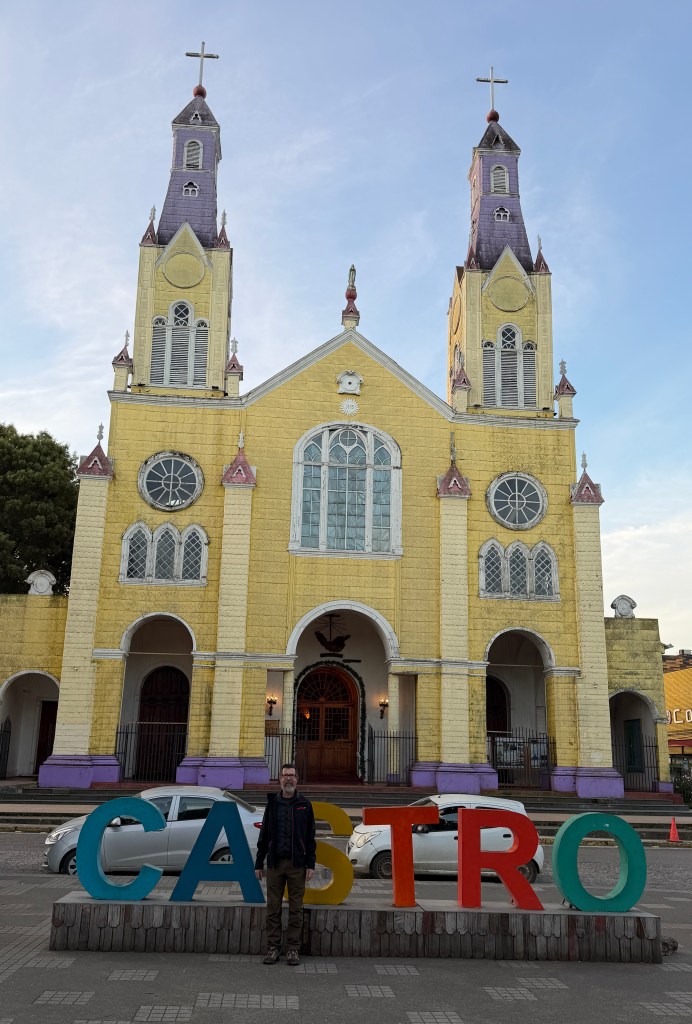
Above: Here Randall stands in front of the Iglesia San Francisco de Castro. It is a bright yellow wooden (tin on the outside) neo-Gothic church, dominating the main Plaza de Armas (below).
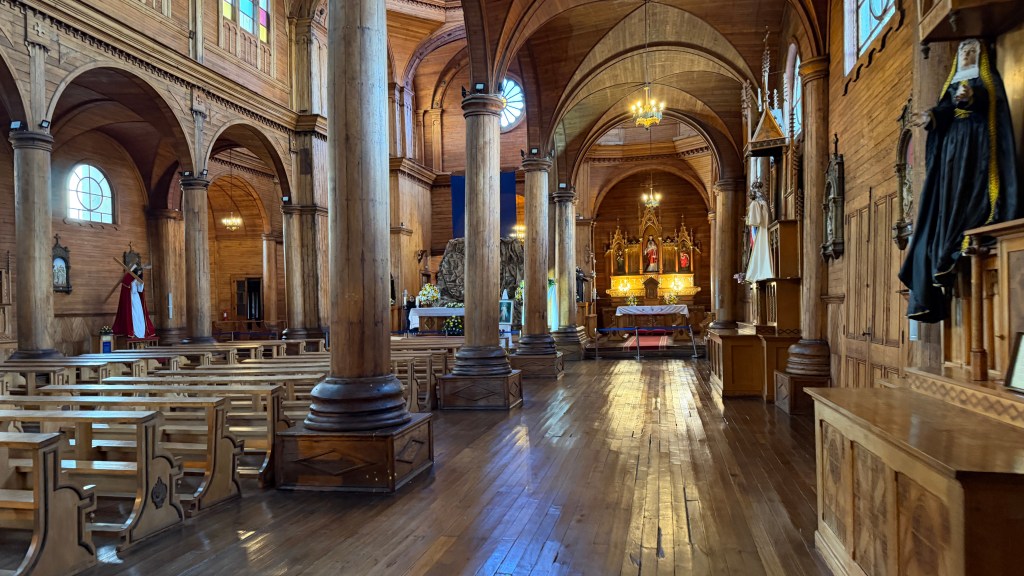
The original church was established around 1567, burned down by Dutch pirates and rebuilt multiple times. The present structure was built out of alerce and cypress wood to withstand the local climate and completed in 1912.
While Jesuit missionaries initiated the “circular mission” in Chiloé and built many chapels in the 17th and 18th centuries, the current San Francisco Church in Castro was built by Franciscan missionaries, following the destruction of earlier churches.
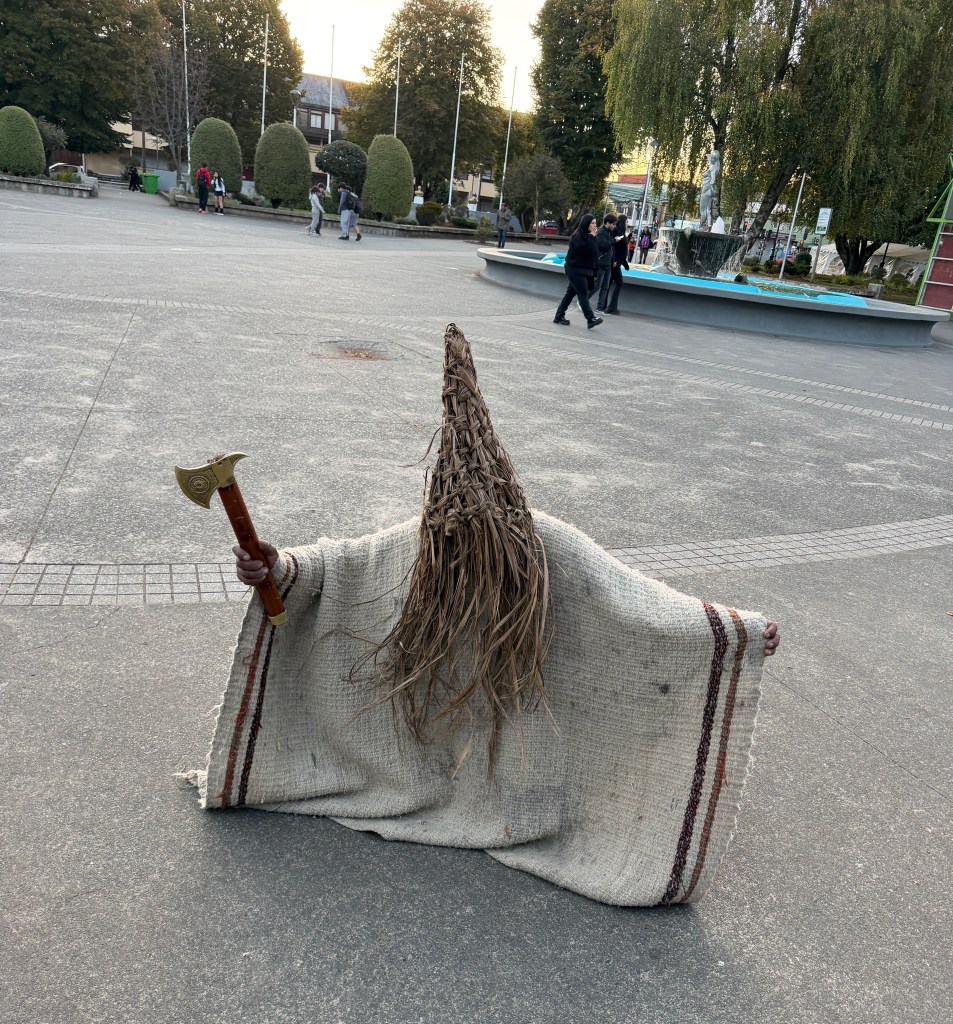
Above: Why us??!! It did not take long for Randall and I long to find alternate spiritual beings in the Plaza outside of the cathedral.
Animist traditions in Castro, Chile, are deeply integrated into daily life, combining indigenous belief systems with Catholicism to honor natural spirits and ancestors. Key practices include creating “animitas” (roadside shrines for tragic deaths), belief in mythical forest/water deities, and respecting magical beings like the Trauco. This, often called “Christianized Animism,” sees the environment as living and enchanted.
Above: Wow!! What are the odds of our own Trauco??!! The Trauco is a central figure in the traditional Chilote mythology of Chiloé Island, particularly around Castro. It is a humanoid creature described as a small, repulsive dwarf or goblin that lives deep in the forest (think troll in Sweden).
The Trauco is described as being about 80 centimeters tall with an ugly face and no feet, having stumps instead. He wears a hat made of forest vines (quilineja) and carries a small, stone-headed axe called a pahueldún, which he uses to strike trees, symbolizing his sexual potency.
Like Rasputin, legend says he possesses an irresistible magnetic allure that attracts young and middle-aged women, making them helpless against his advances. In traditional folklore, the Trauco is often blamed for mysterious or unmarried women’s pregnancies (“sorry honey, I swear it was the Trauco!”) While he seduces women, the Trauco is feared by men, as his gaze is believed to be able to cripple or kill them.
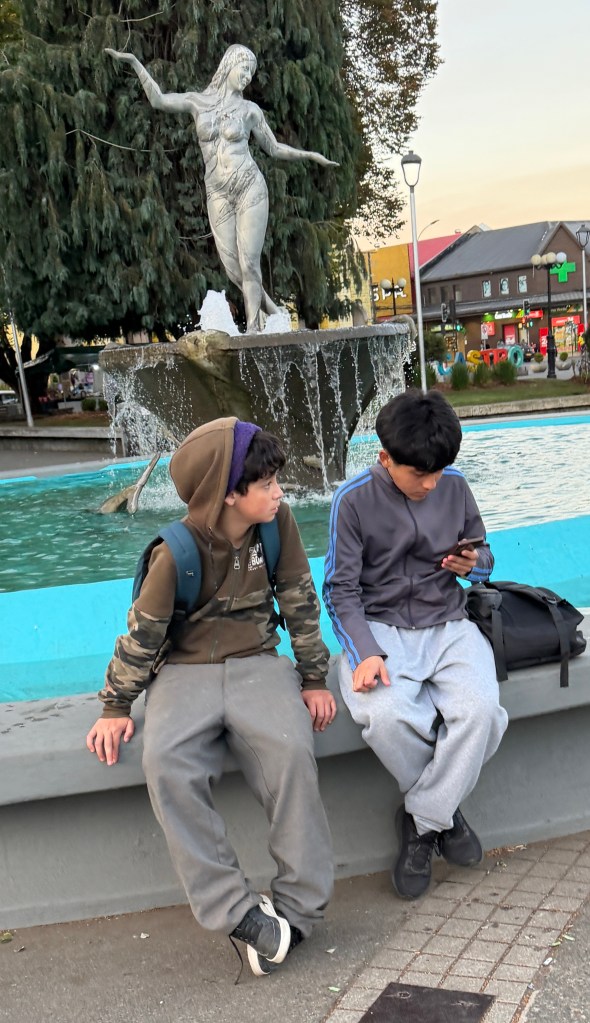
Above: The fountain sits at the center of the Plaza de Armas, which has been the social and urban heart of Castro since its founding in 1567. It represents the “zero point” where the town’s religious, administrative, and social lives meet. While it does not have a single official religious “symbolism” it is widely recognized by locals and visitors as a symbol of community life and resilience.
The current plaza and its features are part of the city’s recovery from numerous tragedies, including the devastating 1960 earthquake and various fires. The fountain serves as a symbol of the “new” Castro that emerged from these disasters.
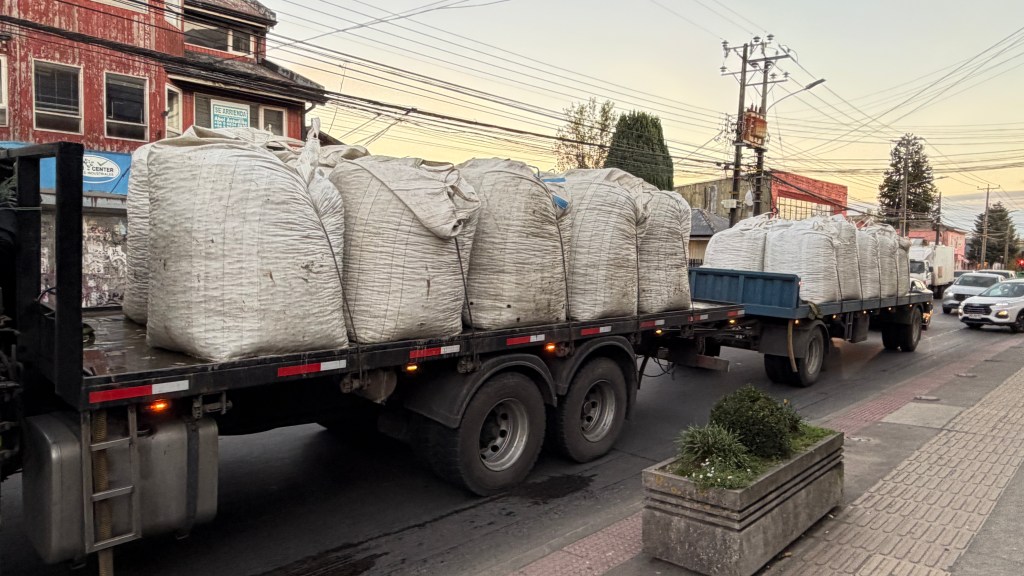
Above: While walking the streets of Castro, Randall and I noticed truck after truck carrying these huge white industrial size sacs. Upon closer inspection, we found they were filled with recently harvested mussels.
Mussel farming in and around Castro, is a major component of the country’s aquaculture industry, which is the second-largest mussel producer in the world. The industry focuses on the native Chilean mussel (Mytilus chilensis), locally known as “chorito”.
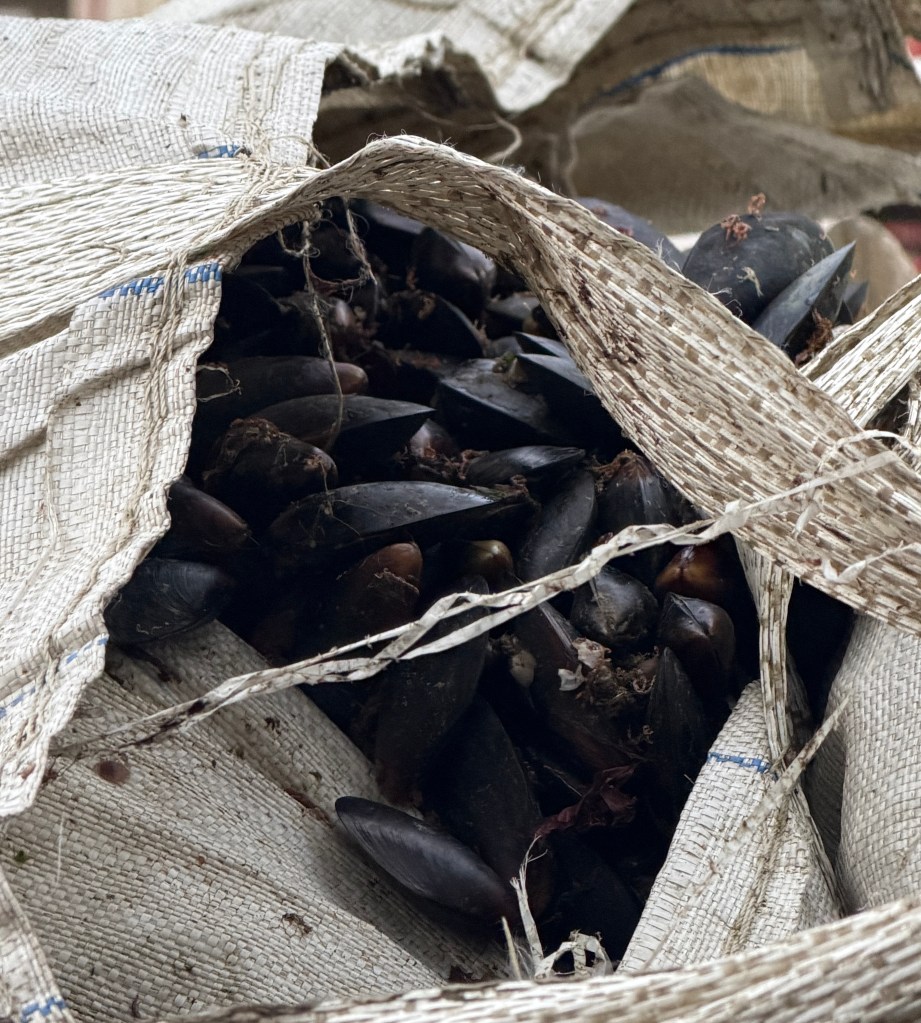
The Castro area is the heart of Chilean mussel farming. Chile produces over 400,000 tons of mussels annually and over 90% of this production is exported, mainly frozen. Not sure I believe it, but mussel farming in the region is generally considered “sustainable”. It is seen as a way to provide ecosystem “services”, such as reducing nutrients (phosphorus and nitrogen) in the water. But the massive infrastructure evident for this aquafarming adventure turns a pristine coastline into into a series of industrial factory farms.
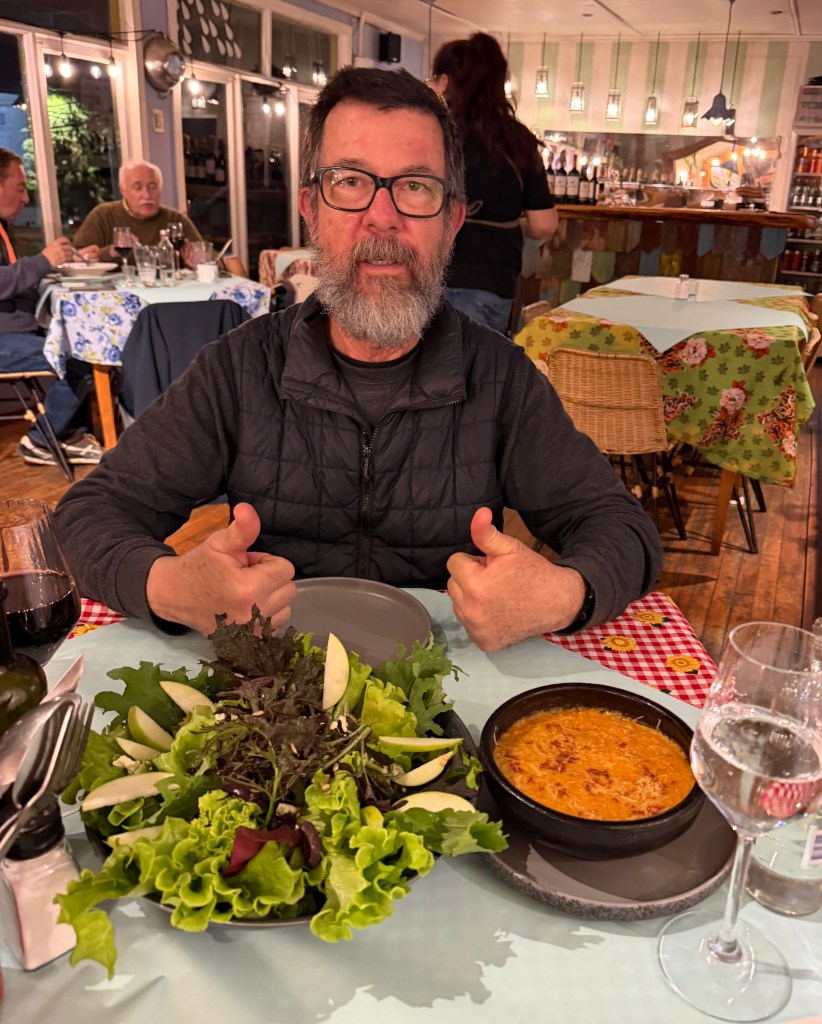
Above: That night we went to Barry’s (Randall’s friend that is soon to be formally introduced) favorite restaurant, El Marcadito (small market) known for its creative, fresh, and local Chilote cuisine. It is situated in a cozy, remodeled house overlooking the bay at Pedro Montt. While It is known for “Bombas de Jaiva” (breaded crab bombs), and “Mi Borrachito” (spicy conger eel stew), I did not see mussels on the menu.
I settled on Merluza (hake) which is a popular, mild-flavored white fish, closely related to cod. Randall had a pork shoulder and we shared a Chupe de Centolla which is thick, savory, and creamy casserole featuring crab meat, enhanced with bread, cream, garlic, onions, and parmesan cheese, which is then browned on top. Very rich, but I need to try this with our Dungeness Crab.
“Caleta Barry”: Night 27: April 10
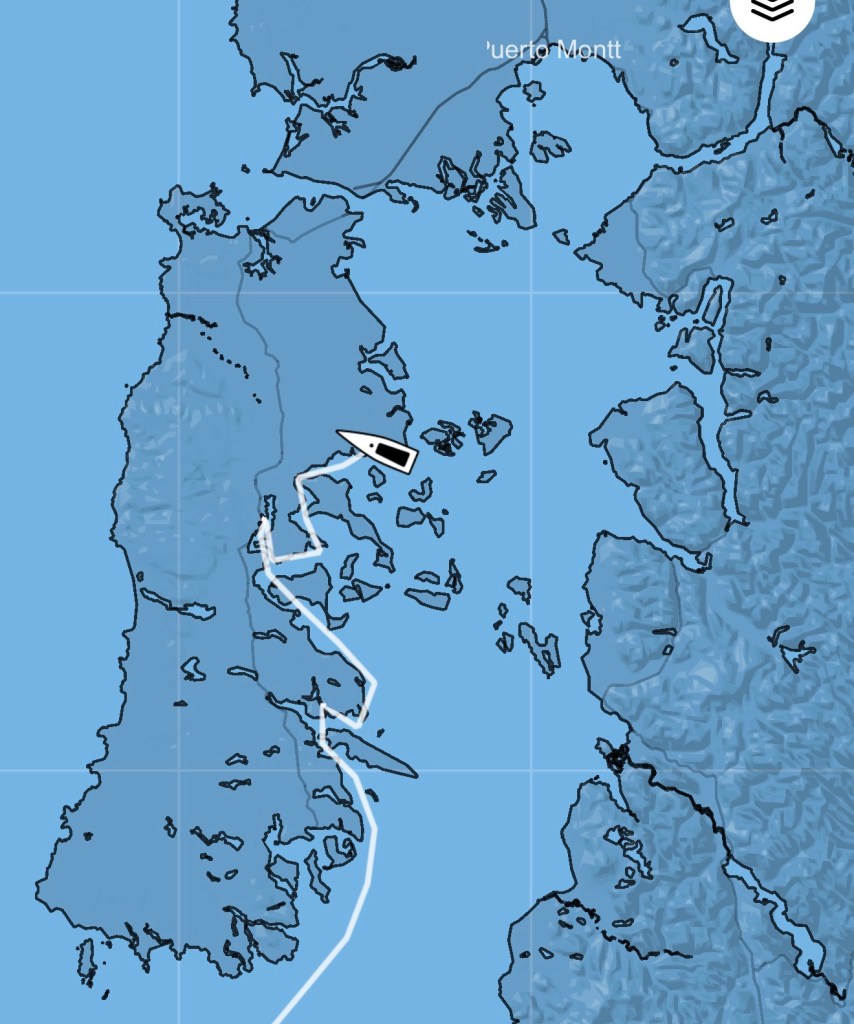
Above: You can see that we are now less than 70 miles south of Puerto Montt. We are heading to the spot that Randall’s friend Barry is building his home and is presently living with his partner Martha on their boat right off the beach.
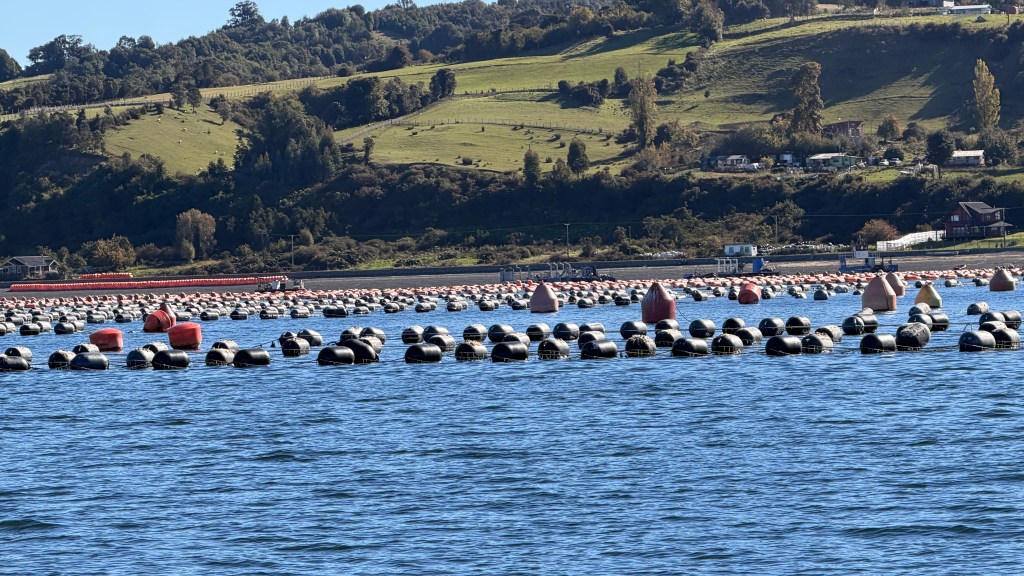
Above: Once past Castro, we are back in a remote part of the country, but the muscle, oyster and salmon farms start start sprouting up literally everywhere along the coast. I am guessing the above is a muscle farm. Strung through the pontoons is a horizontal line, and in between each pontoon falls a vertical line of three to ten feet that holds the muscles.
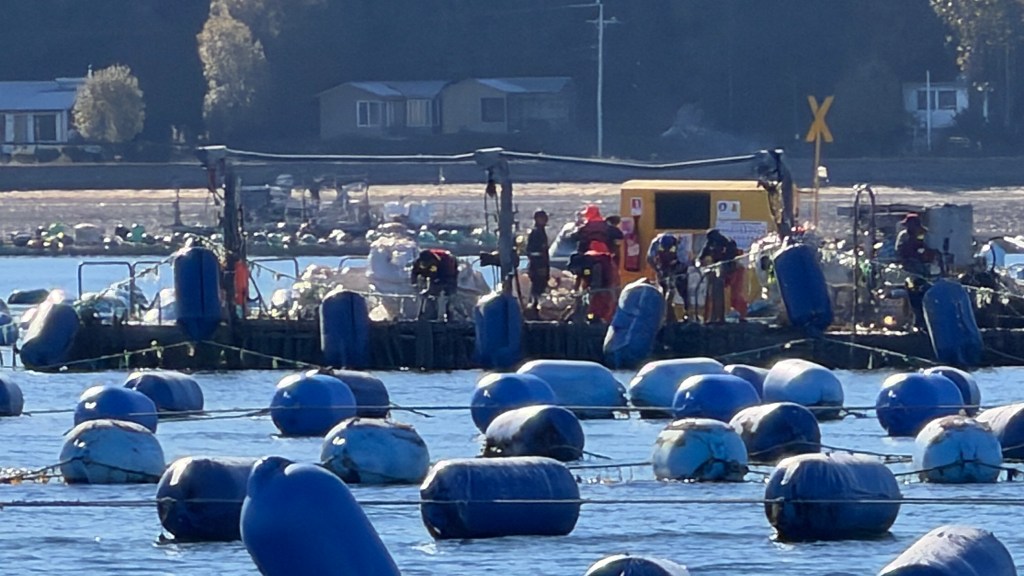
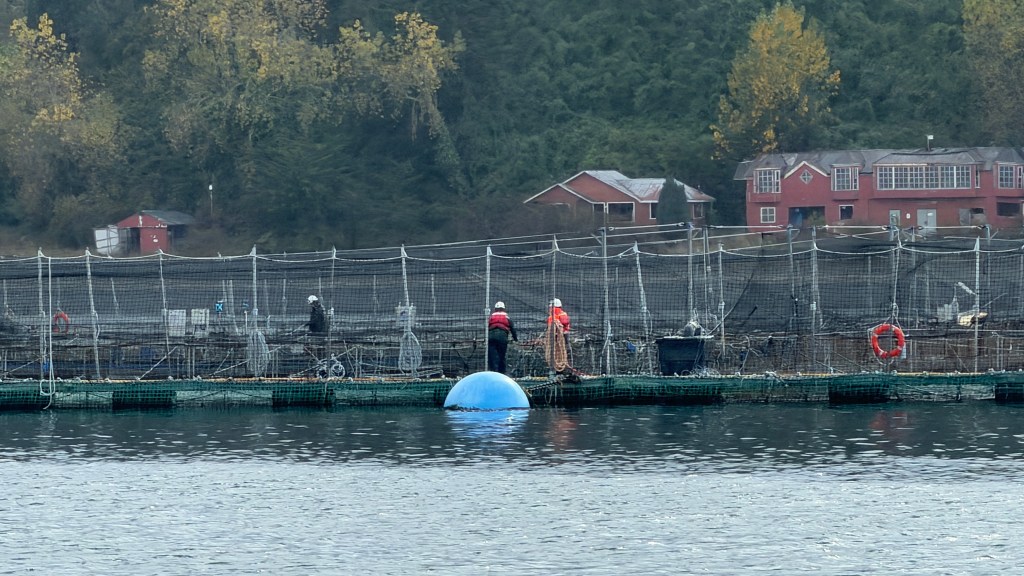
Above: Here is a close up of a muscle harvest team. Starting from the right of the picture, you can see one man who lifts the pontoon out of the water. To the left of him are a group of men that are in the process of harvesting the muscles, and the man on the far left seems to be wrapping things up as the pontoon (or actually the floating tender) proceeds along and by the far left of the photo, the pontoon drops back into the water. Factory farming at its best!
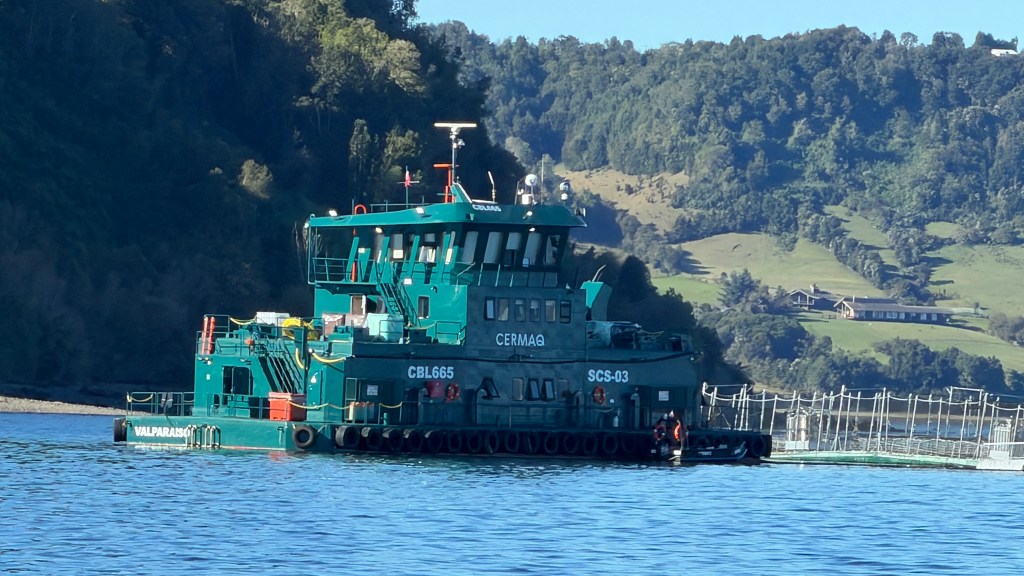
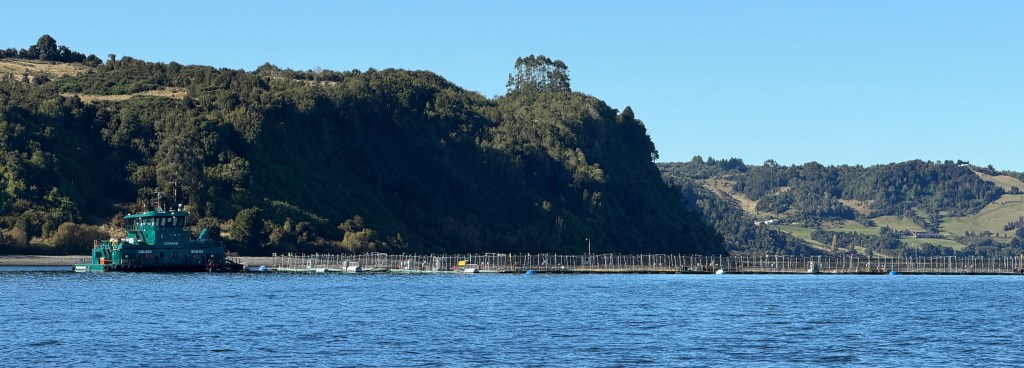
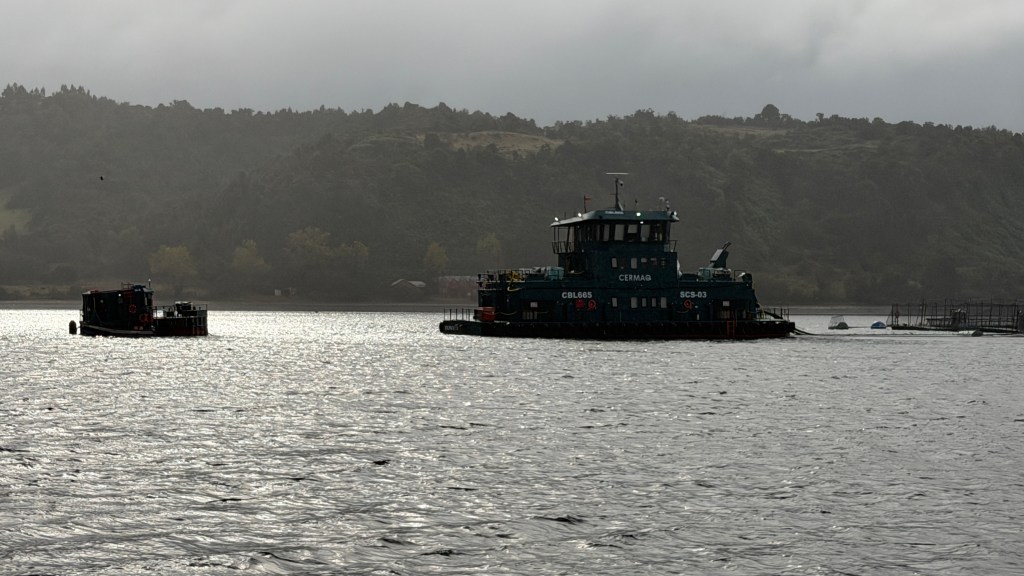
Let’s talk salmon. Puerto Montt is the nerve center of the Chilean salmon farming industry, located in the Los Lagos Region. As the world’s second-largest salmon exporter after Norway, this region is dotted with hundreds of intensive, open-net cage fish farms where Atlantic (say what??) and Coho salmon are raised. Above is a tender taking care of his salmon farm that is maybe two acres.
The industry spans the entire salmon chain, from freshwater hatcheries (smolt production) to seawater maturation in cages, and finally processing plants. Companies like Salmones Austral are increasingly using land-based Recirculation Aquaculture Systems (RAS) to produce larger post-smolts to reduce time at sea. Parents neglecting their kids again!
Many companies are pursuing certifications such as the Aquaculture Stewardship Council (ASC) to demonstrate compliance with environmental standards. The industry has faced challenges with algae blooms (such as in 2016), escapes of fish, and high use of antibiotics/antiparasitics, leading to environmental criticism.
The salmon farming industry generated approximately $6.4 billion to $6.5 billion in export revenue in 2024. Chile exported over 782,000 metric tonnes of salmon and trout in 2024.Chile accounts for approximately 31% of the world’s total salmon production.
For fun, let’s see how the Chilean salmon industry compares with ours in Alaska and those Norwegians. It ain’t pretty! Alaska is on the bottom, but at least we can boast that 100% of Alaskan salmon is wild-caught. But dang, those Norwegians are kicking our pink (farmed butt).
Salmon Production Volume & Market Share (2024–2025)
| Feature | Norway | Chile | Alaska |
|---|---|---|---|
| Global Market Share | ~46% | ~31% | ~10-12% (est.) |
| Annual Volume (MT) | ~1.2 – 1.4 Million | ~1.0 – 1.1 Million | ~360,000 – 400,000 |
| Production Type | Farmed (99%+) | Farmed (99%+) | Wild-Caught |
Above: This is just one of many, many, many salmon farms on our way. Some are active 24 hours a day as they need to be watched, monitored and adjusted. Not necessarily a pretty sight to see and hear from your idyllic beachfront site, but lots of good fish in the sea nearby.
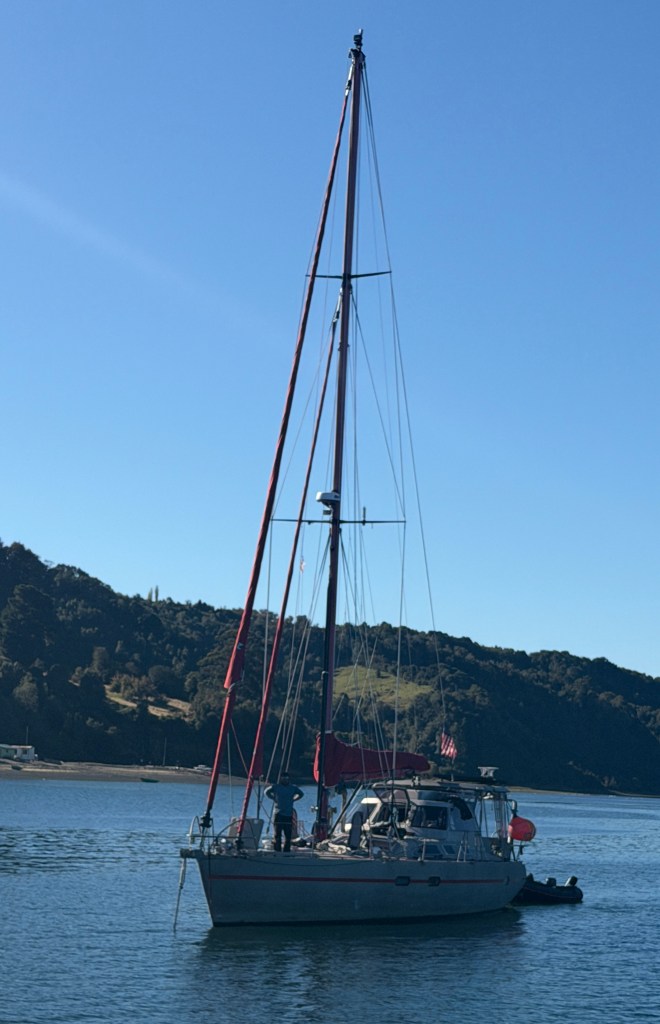
Above: On April 10, at 1545, we pulled up to Barry’s floating home, his Garcia that he shares with his soulmate, Martha.
Above: Anchored just offshore of his beachfront plot of land (home under construction), Barry splits his time between Chile (sailing and constructing his home) and flying helicopters for commercial purposes in the U.S.
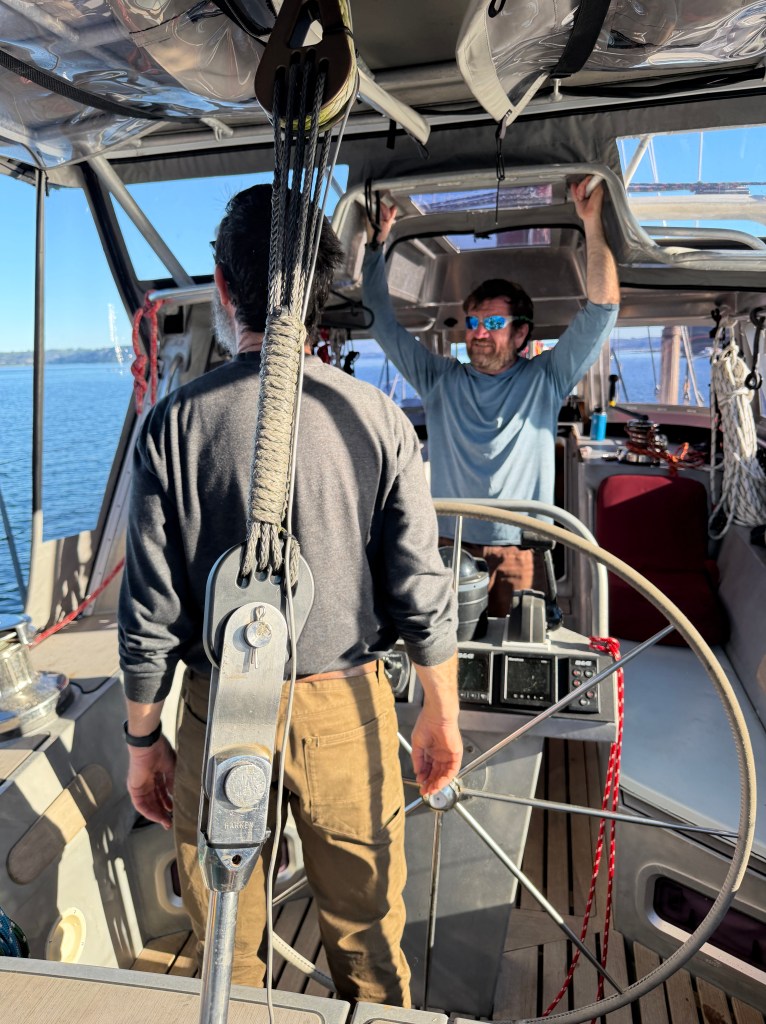
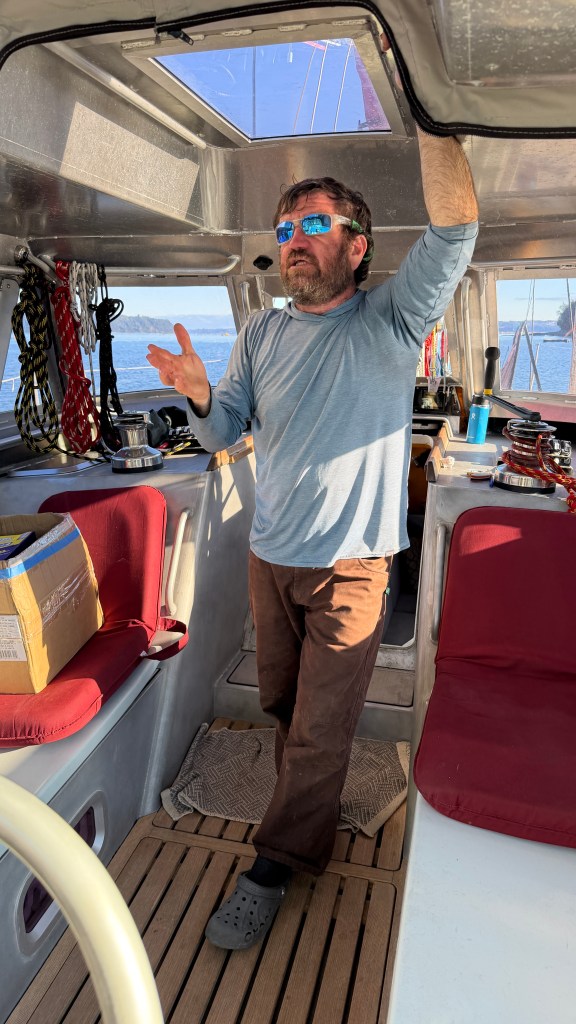
Above: Much as we love and respect Mōli, Randall and I were agog with the spacious doghouse.
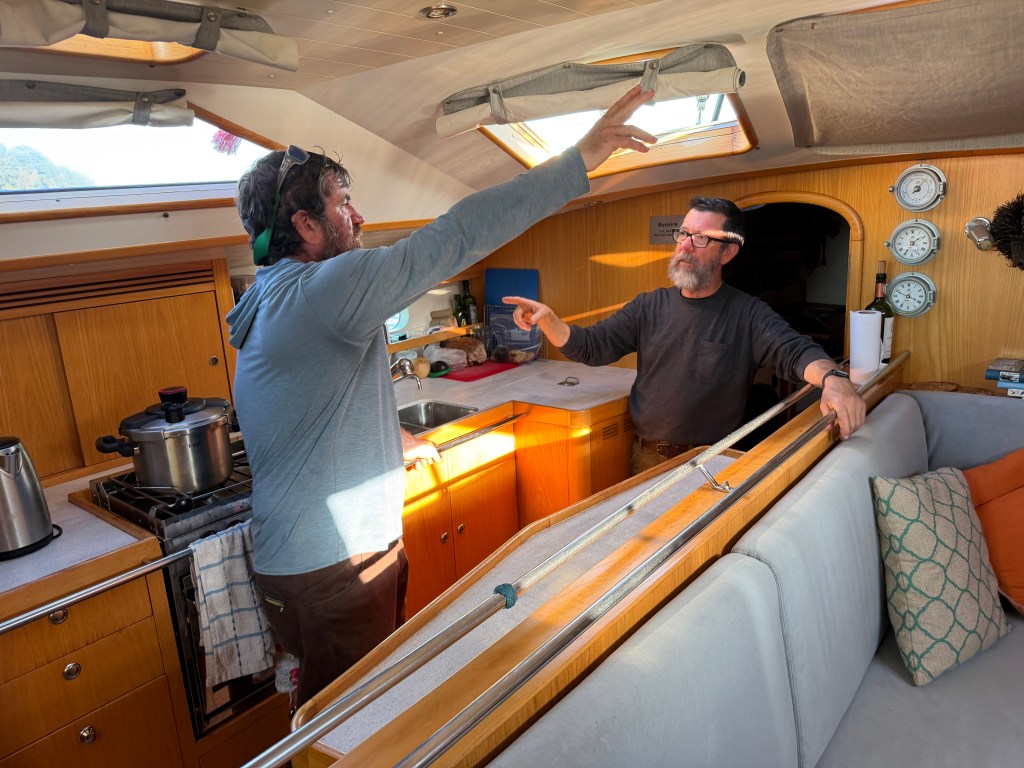
Above: Inside the salon, there was a spacious galley, sofa, water maker, freezer, refrigerator, hot water heater, shower, washing machine (I am going to stop there) all appliances we do not possess. Of course, neither of our wives ever steps on board and now I am beginning to understand why.
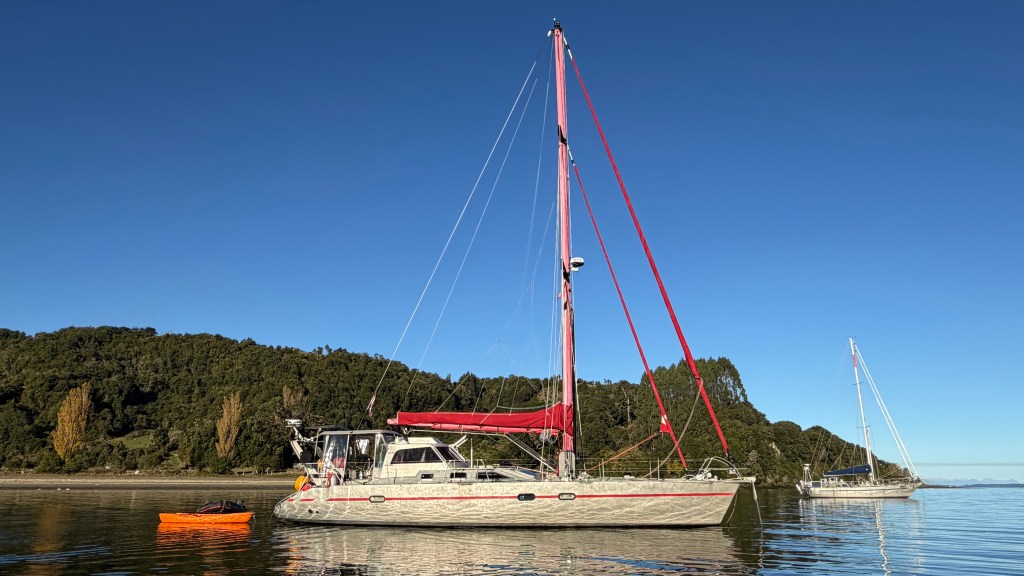
Above: Lovely afternoon – you can see Mōli in the distance.
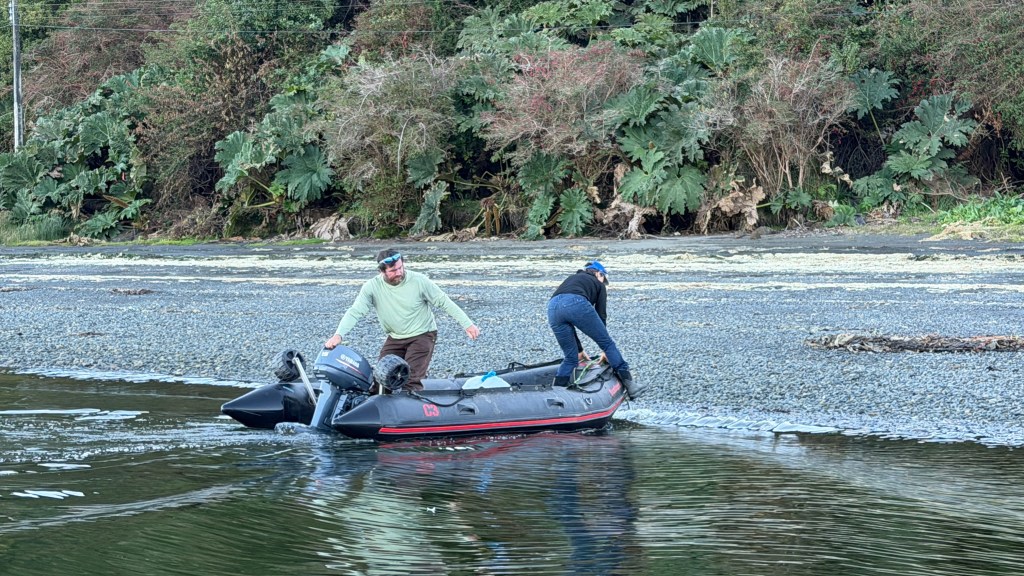
Above: That evening we came ashore to “Barry’s Beach”
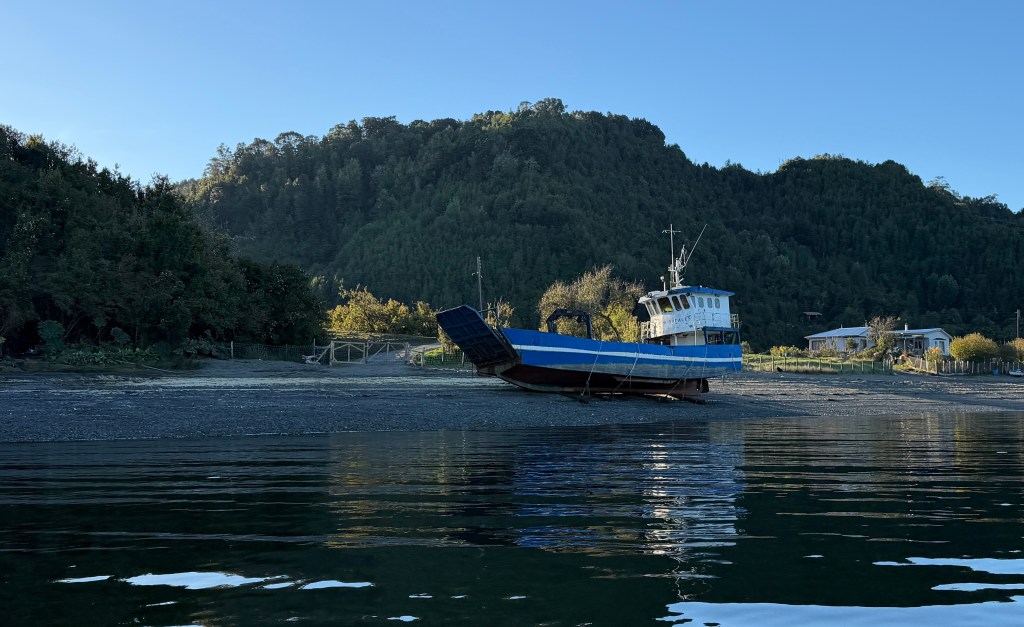
Above: Barry’s neighbor promises to move his boat off Barry’s Beach “soon”!!
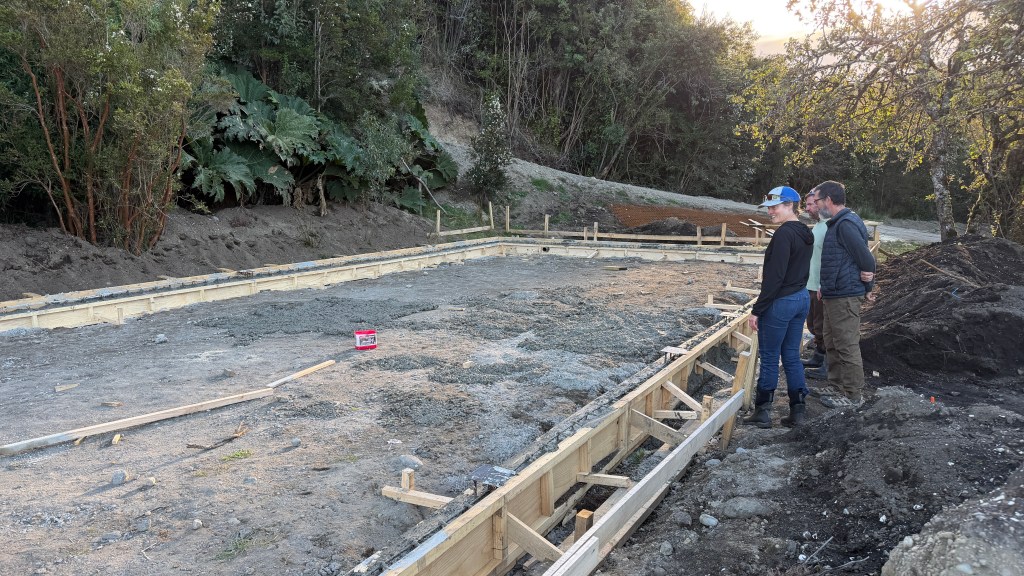
Above: Barry and Martha gave us a tour of their beach and home site. We found the quality of construction on par with the U.S. (at maybe 1/2 the cost). Lots of fruit trees abound, and the views are fantastic.
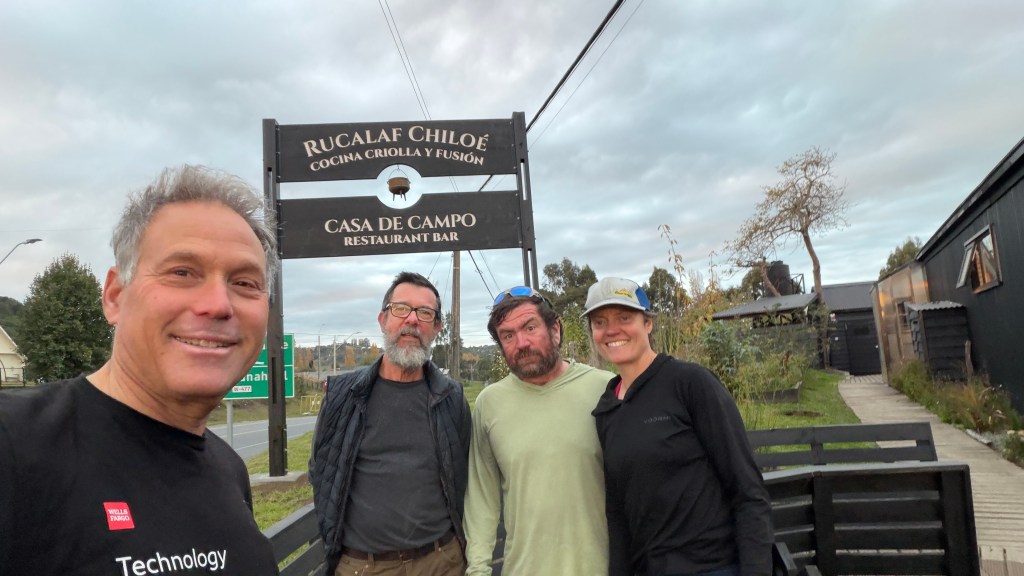
Above: That night, Barry and Martha took us to an outlying village with an incredible farm-to-table restaurant.
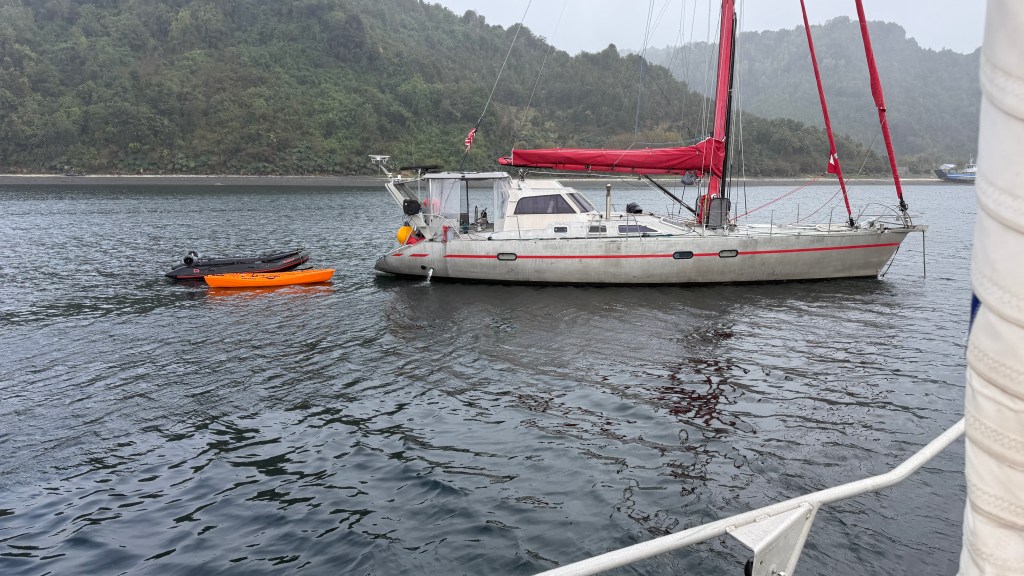
Above: The next morning we said goodby to Barry and Martha over the radio. We swung by their boat expecting them to come out and wave us goodby…. but we must have tired them out the night before. I asked Randall if we should sound the air horn on our exit but he advised not.
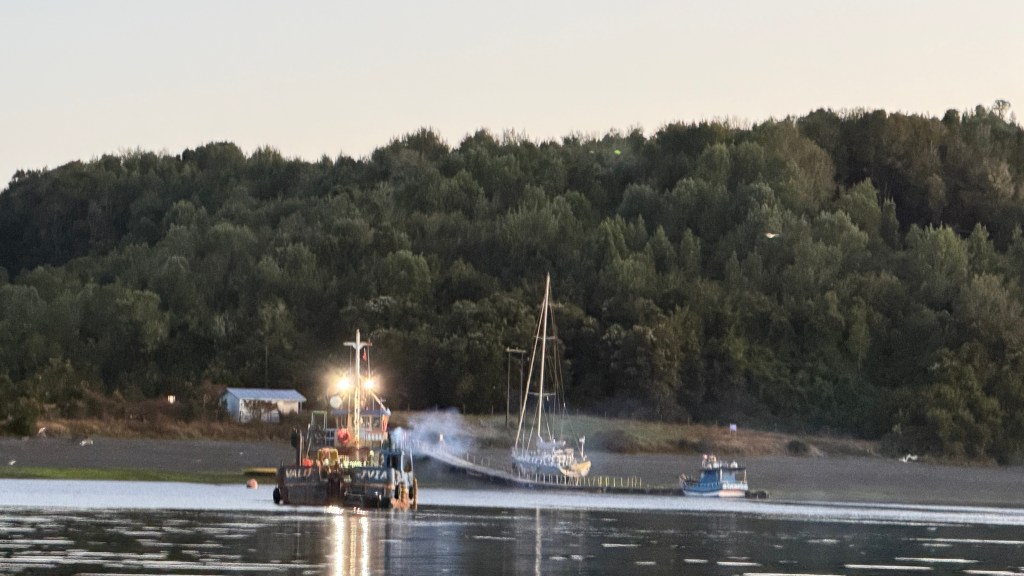
Above: Our last night (April 11) before we pulled into Puerto Montt was anti-climactic. This tiny bay called Puerto Huite looked sleepy when we pulled in, but as we transited in the cove, alarms (flashing lights and air horns) went off to (we think) warn us not to go in too far due to the receding tide. As the night went on, many local fishing boats (we think most of them were tenders for the salmon farms) pulled in and out.
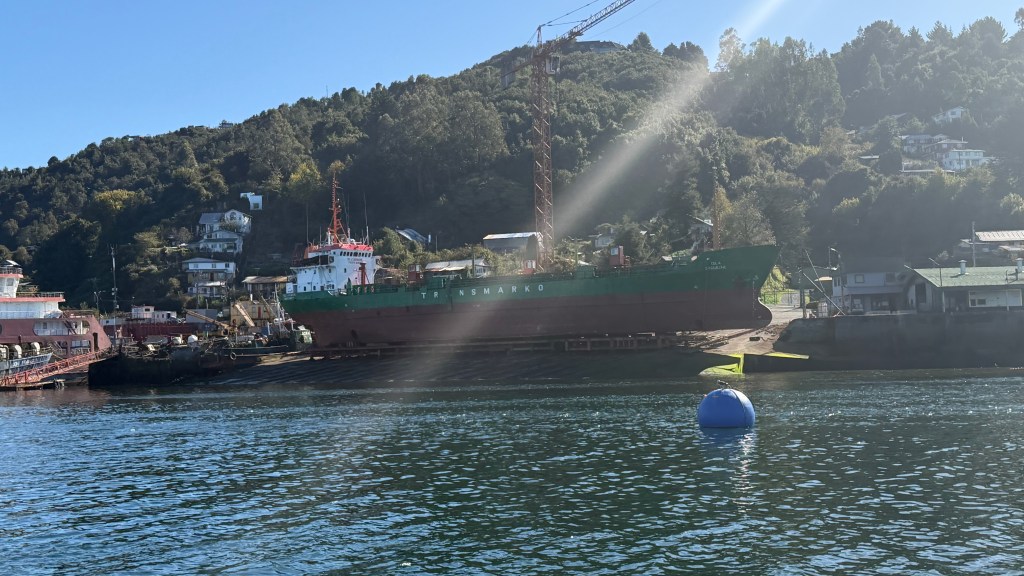
Above: Pushing into Puerto Montt the next day came faster than expected. I was in the salon when I realized Randall was about to pull into the slip! I quickly helped ready the lines and lower the fenders but most were already in place.
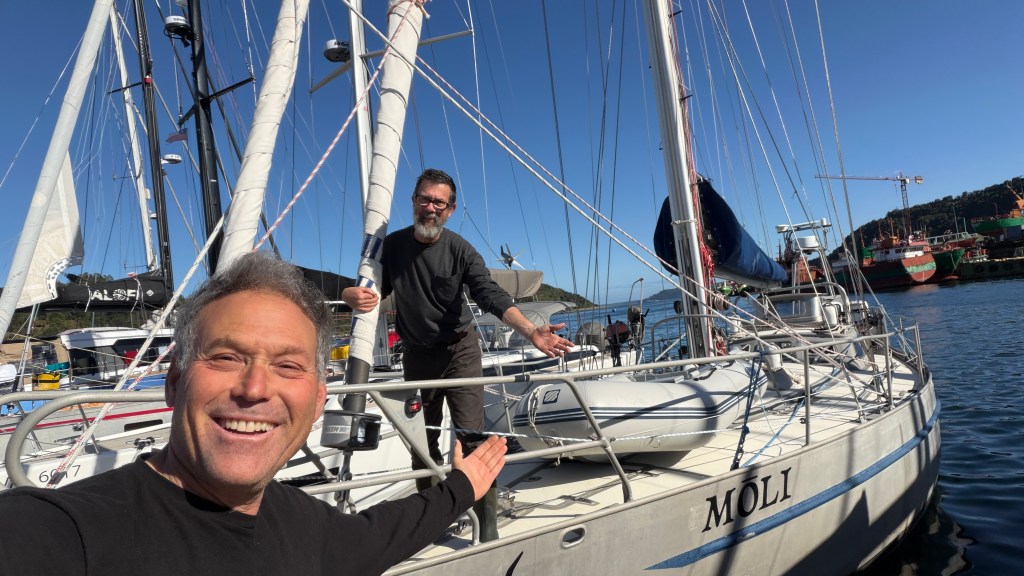
Above: We pulled into our slip at Puerto Montt at 1504 on April 12, 2026.
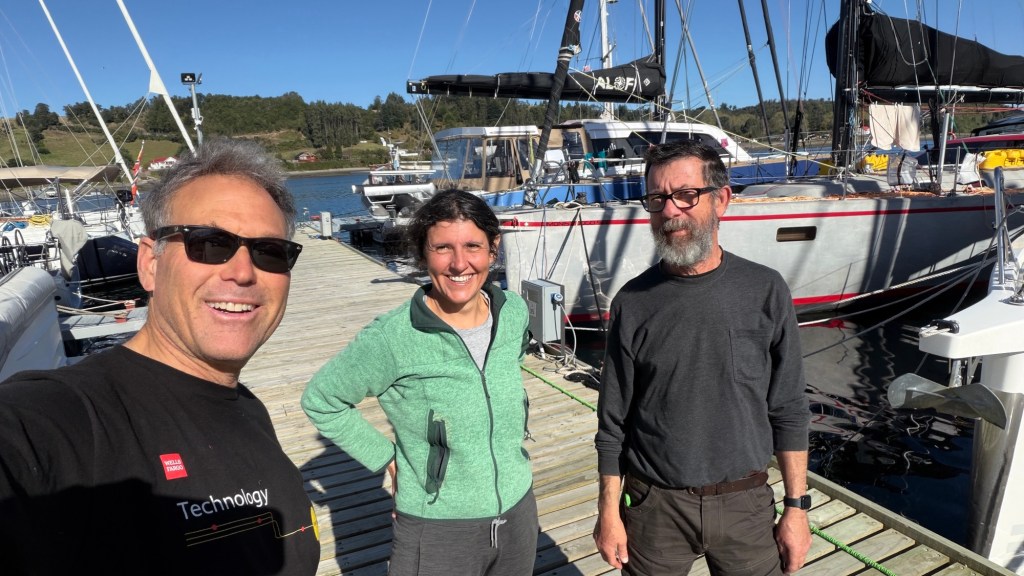
Above: We were met by fellow northern-bound sailor Gabrielle who is French Canadian and just transited the same passage with her boyfriend.
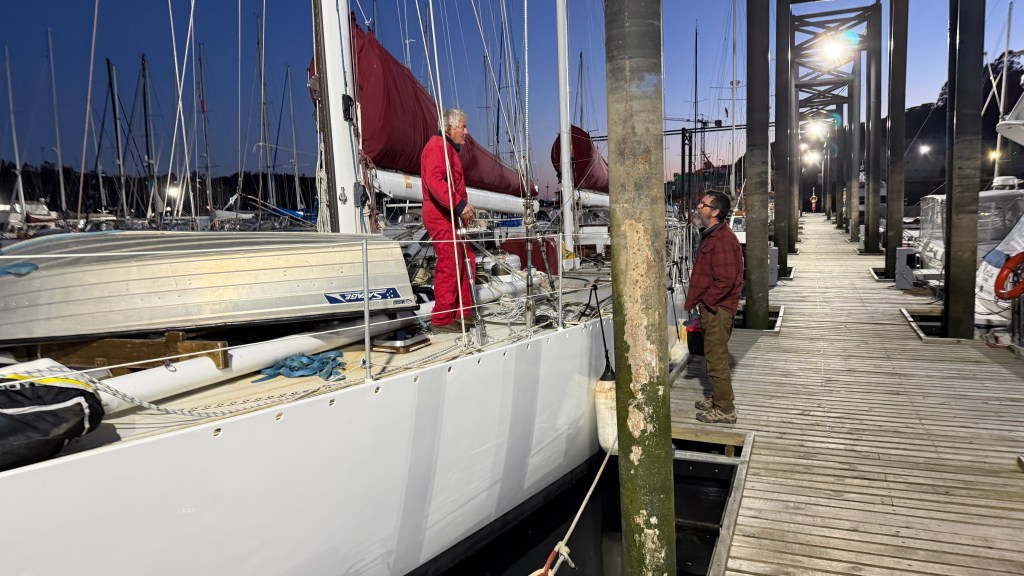
Above: You meet the most interesting people dockside (man in red). Earlier I had met Hamish (Scottish name that serves as equivalent of James) as I heard that he had been an instructor for the Clipper Around the World race way back in 2010. Since then he has worked the North Sea servicing oil rigs and picking up water bound migrants.
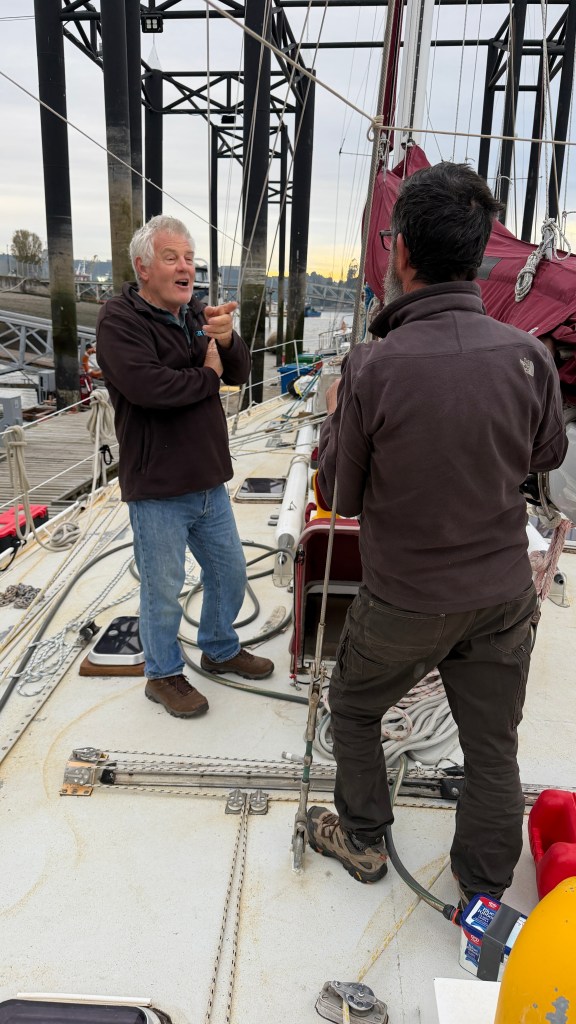
Above: Later, Hamish took us on a tour of his Palmer Johnson 68 (1980’s) that he is both restoring and sailing single handed. Sailing a boat of that size alone and attempting to restore it to it’s former glory is sheer insanity. Did I mention that it is his fist sailboat? Halfway through the tour below deck, Randall and I could not help but notice that the interior looked like a bombed-out naval training vessel of the last century. I looked Hamish straight in the eye and told him that he is a “madman”. Nodding in agreement he said something to the effect of “If we do not work to conquer our fears we will make no progress in our lives”.
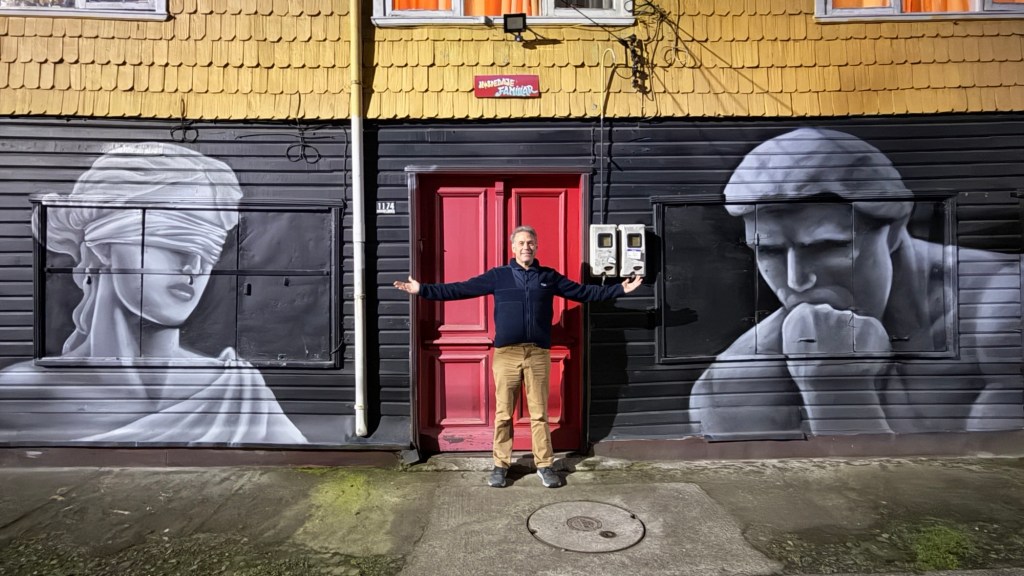
Above: Puerto Montt is known for its vibrant street art scene where murals often blend aesthetic beauty with social and political commentary.
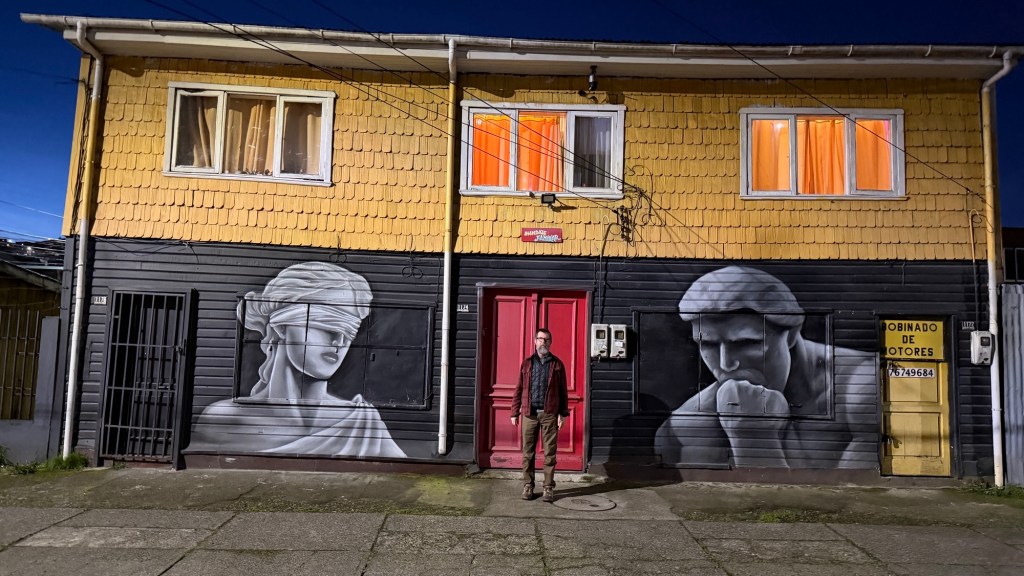
Above: Randall stands between Lady Justice – traditionally a symbol of impartiality and the rule of law, and The Thinker often used to represent collective self-reflection and contemplation. Does anybody know a better place for a skipper to stand??!!
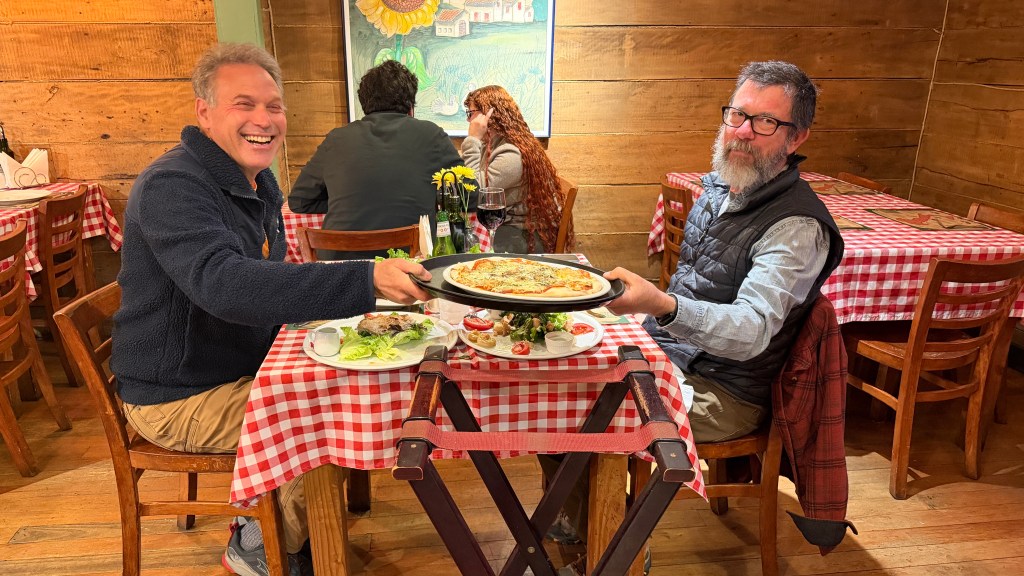
Above: Our first night in Puerto Montt, we went to a local spot and ordered one of everything. It was so much food that we could not even make it through the fish salads and crab starter when they brought us the pizza we forgot that we ordered.
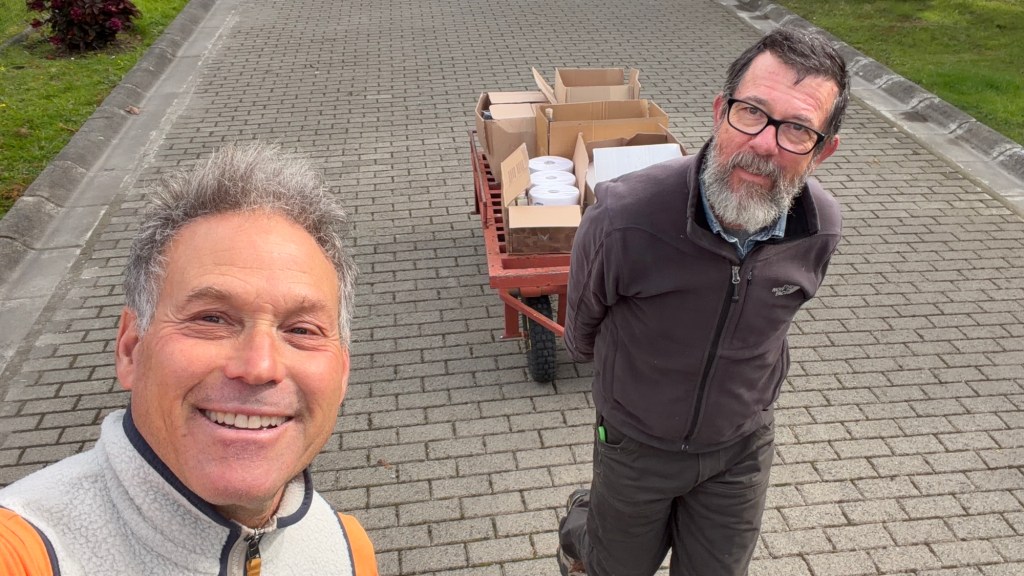
Above: The next day is was back to work as I did laundry and shopping for dry goods and replaced all of the condiments, dried and canned food, cookies and paper goods that we had consumed along the way.
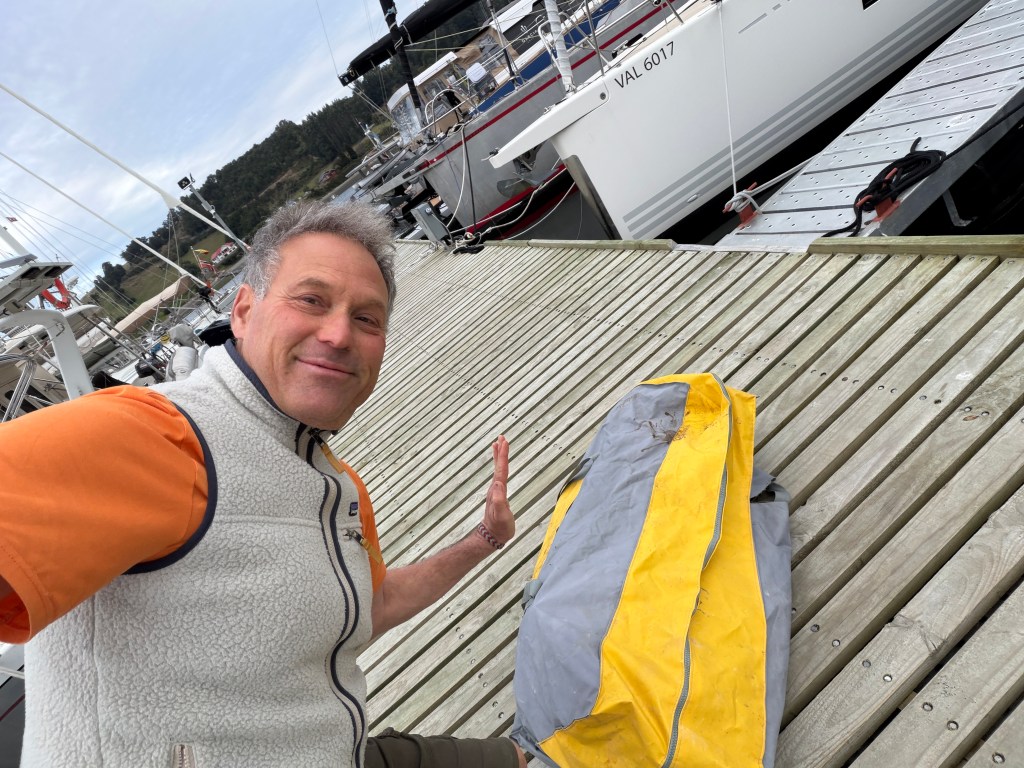
Above: Deflating and putting away the dingy for the last time. It served us well.
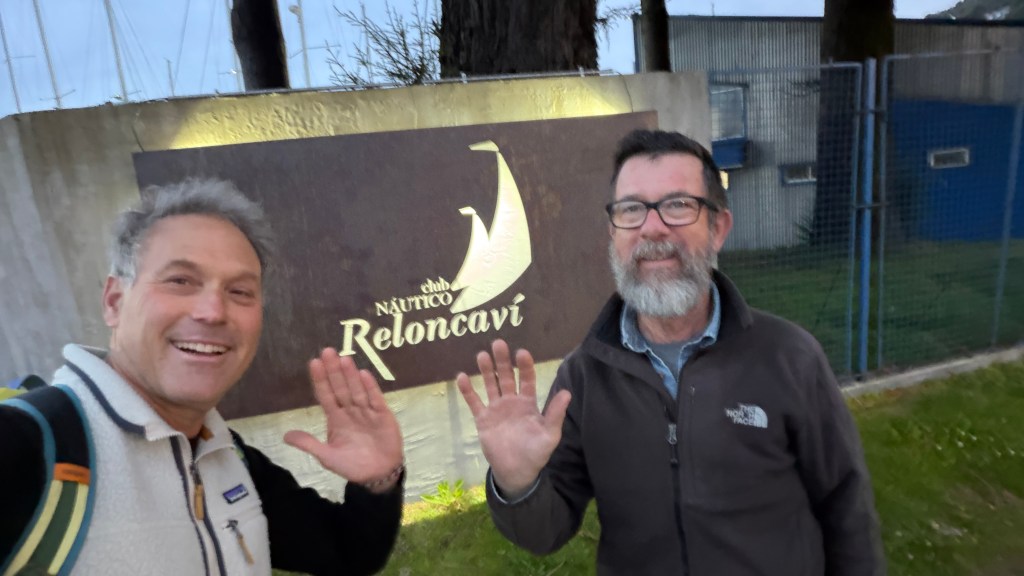
Above: Randall and I saying goodby as I head off for a midnight flight to Santiago.
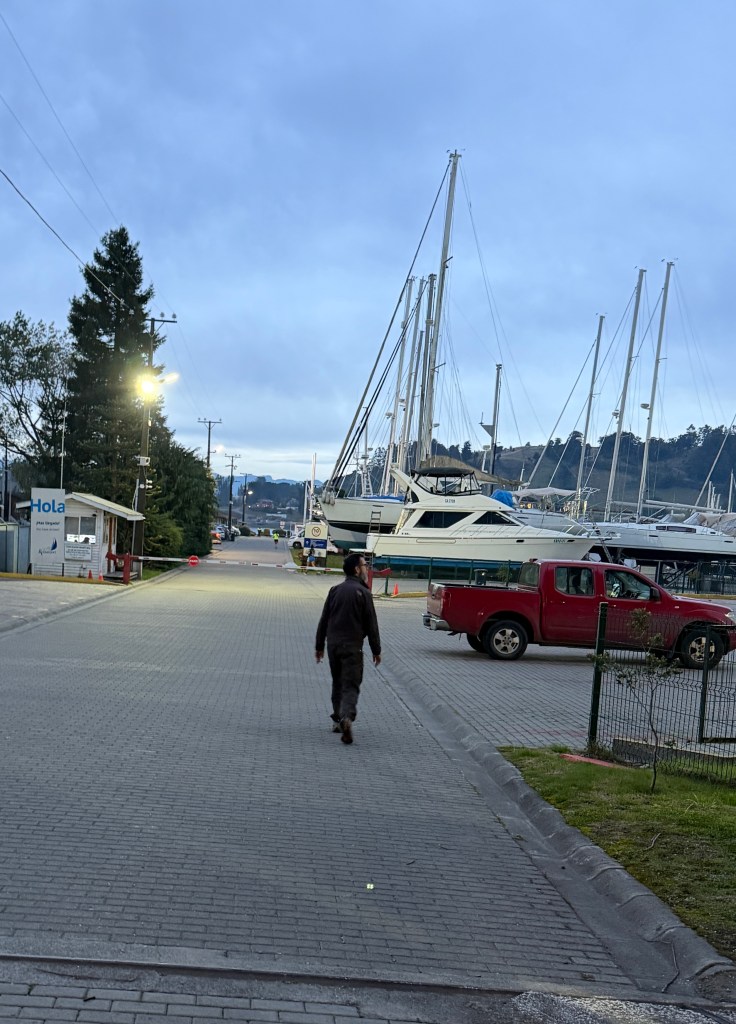
Above: Randall heads back to the Club Deportes Náuticos Reloncaví, his home for the next week as prepares Mōli for a short winter break.
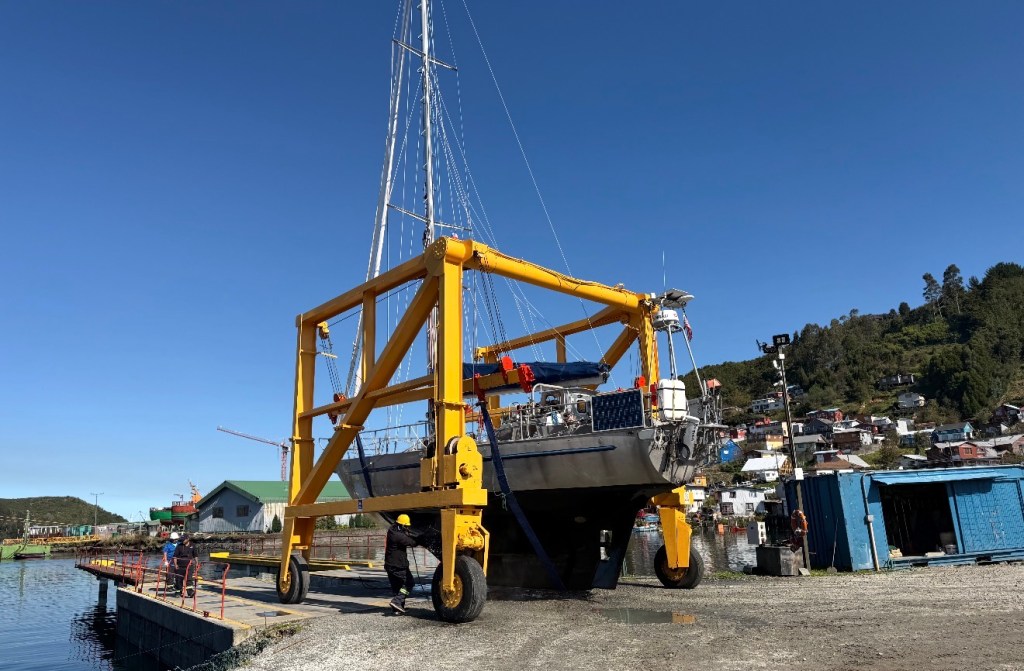
Above: Randall sent me this picture the next day as Mōli is pulled from the water to find her place on the hard.
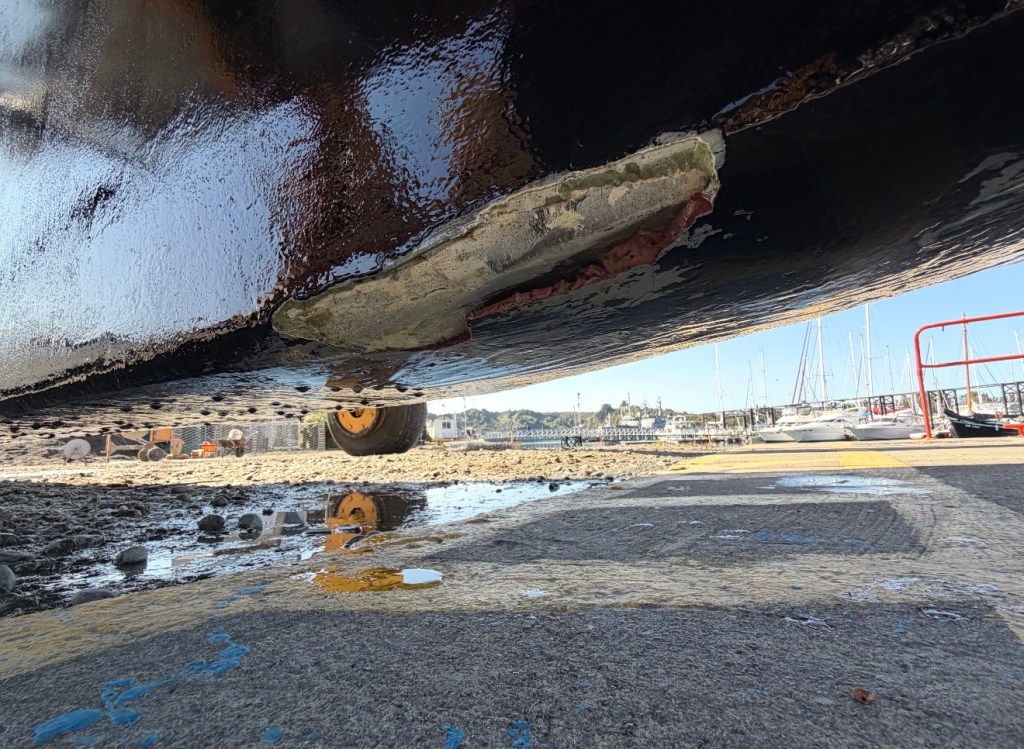
Above: Ouch! This is what happens when you run aground…..twice!!
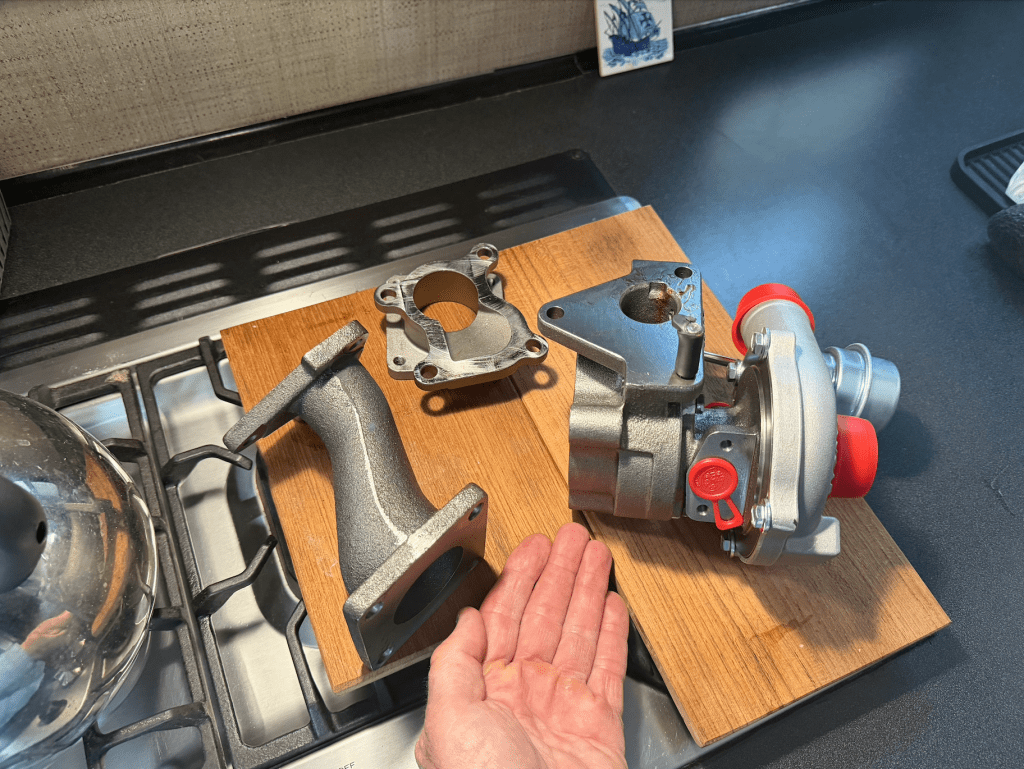
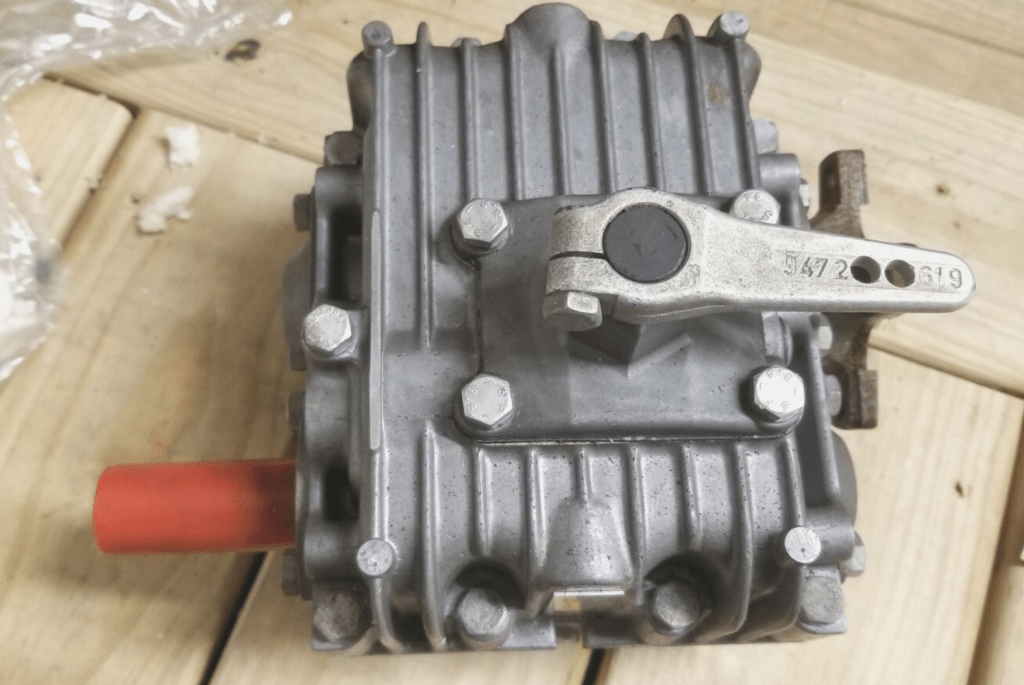
Above: Randall, now back at home, is taking his “break” fixing, repairing and nursing all critical parts. To the left is a new turbo for Mōli’s Bukh along with a new transmission (right). We just need to get the parts to Chile and to have the repairs made.
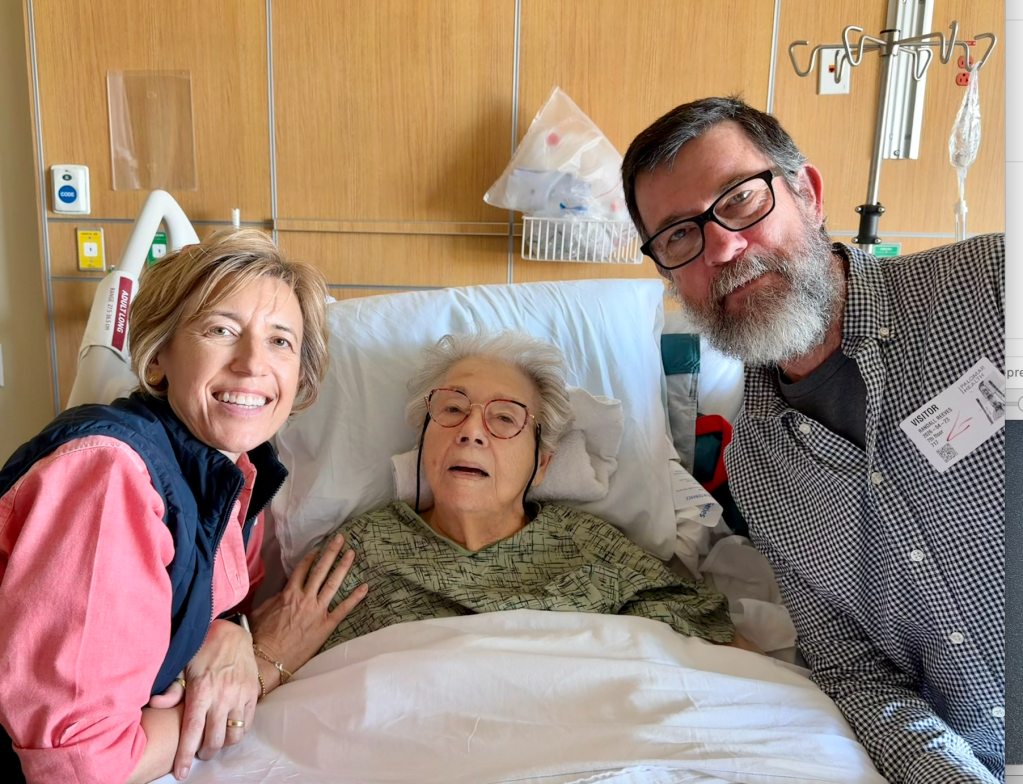
Above: Randall and sister Lavonna are presently in Southern California nursing their mother Evon back to health. Everyone is looking good, especially Randall!
I know you all join me in wishing Evon all the best. Randall and I have decided to postpone the next leg of our journey (tentative route: Pueto Montt to Easter Island to Pitcairn Island to the Gambier islands to the Tuamotu Islands to Hawaii and finally back home!) Our current weather window is rapidly closing, and taking care of Evon is top priority. Our journey will pick back up with the next weather window – as early as October 2026, but likely in January 2027.
A huge thank you to our faithful readers and followers. Randall and I will look forward to communicating with you soon. In the meantime, you can check out this recent article on Page 36 in Latitude 38 https://www.latitude38.com/issues/may-2026/#36.
Goodby for now!
Harmon


Leave a comment